String Instrument Maintenance in Hong Kong Humidity
A practical guide to caring for violins and violas in Hong Kong humidity, from case habits and wiping down to pegs, bridges, strings, and luthier checks.
Hong Kong asks a lot from a string instrument. A violin or viola may spend the morning in an air-conditioned flat, the afternoon in a humid school corridor, the evening in a lesson studio, and the journey between them in rain, heat, or a crowded MTR carriage. The player adapts without thinking. The instrument cannot.
Humidity care is not a luxury concern for expensive instruments only. It affects tone, tuning stability, string response, pegs, seams, bridges, bow hair, and the everyday confidence of a student trying to practise. A good maintenance routine does not need to be complicated, but it does need to be consistent.
The aim is not to keep the instrument in a perfect laboratory climate. It is to reduce sudden extremes, notice small changes early, and build habits that protect the instrument without making the student afraid to use it.
Why Hong Kong Humidity Is Difficult For Violins And Violas
Violins and violas are made mostly of wood, and wood responds to moisture. When the air is very humid, the wood can swell slightly, seams may become more vulnerable, pegs can stick, and the sound can feel slower or less open. When the instrument moves quickly into strong air conditioning, the surrounding air may become much drier, which can make tuning unstable and put stress on glued joints.
The problem is not simply that Hong Kong is humid. The real difficulty is movement between different microclimates. A student may leave a damp outdoor environment, enter a cold classroom, then open the case immediately. That sudden change is often harder on the instrument than one stable condition.
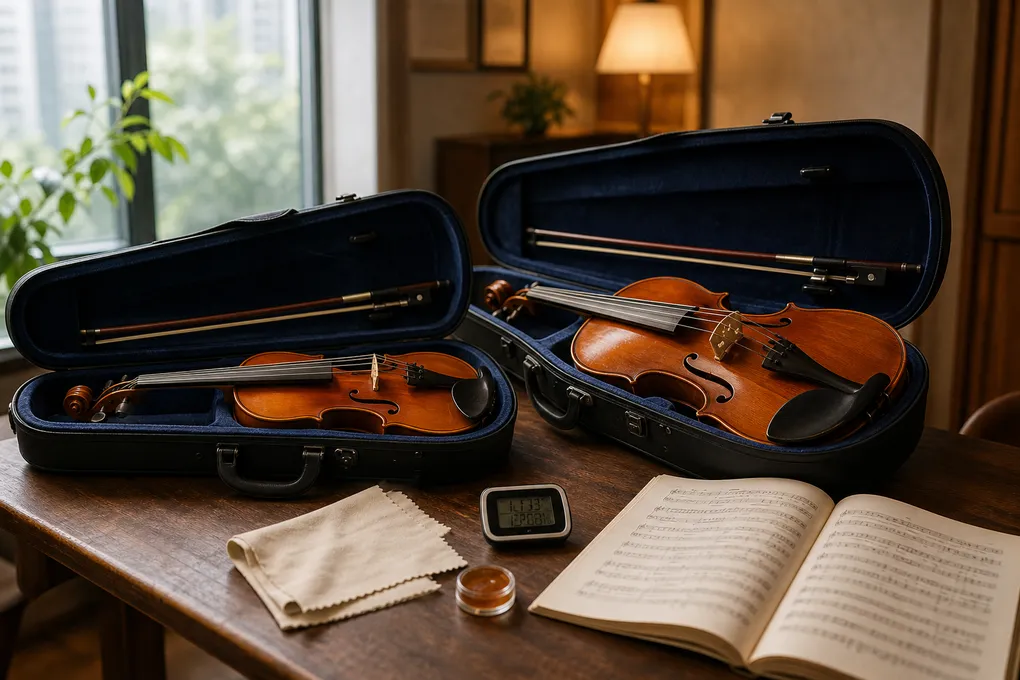
This is why the case matters. A decent case is not only impact protection; it gives the instrument a calmer buffer between environments. I discuss case choice more fully in the viola case buying guide, but for humidity care the key points are insulation, a secure interior, reliable closure, and space for a small hygrometer or humidity-control product if needed.
For younger students, instrument care should sit alongside basic setup decisions such as choosing the right viola size for a child. For adult learners, comfort and instrument size are also connected to tone and physical ease, which I cover in choosing a viola size for adults.
Keep A Hygrometer In The Case
A small digital hygrometer is one of the simplest useful tools for Hong Kong string players. It does not solve humidity by itself, but it stops the player from guessing. Many cases feel normal on the outside while the inside is telling a different story.
For most violins and violas, a moderate and stable humidity range is usually better than repeated swings. Exact recommendations vary between luthiers, instruments, and local conditions, so treat the hygrometer as a warning system rather than a moral judge. If the reading is persistently very high, the case smells musty, the bow hair feels limp, the pegs behave badly, or the instrument sounds unusually dull, it is time to adjust the storage routine.
Avoid placing the hygrometer loose against the varnish. Keep it fixed inside the case where it can read the air without touching the instrument. Check it regularly for a few weeks until you understand the pattern in your home, studio, and commute.
Let The Instrument Acclimatise Before Opening The Case
After moving from outdoors into a strongly air-conditioned room, wait a few minutes before opening the case fully. This is especially sensible after rain, summer travel, or a long journey through humid streets. The case acts as a small climate buffer; give it time to do that job.
Do not leave the instrument near an air-conditioner outlet, dehumidifier exhaust, sunny window, or bathroom wall. These may seem obvious, but many school and home practice spaces are arranged around furniture rather than instrument care. A violin left beside a cold air stream can experience a surprisingly harsh change even inside a comfortable room.
At home, store the instrument in its closed case when it is not being used. A violin or viola displayed on a stand may look beautiful, but in Hong Kong it is more exposed to humidity changes, dust, accidents, and curious hands. For daily practice, convenience matters; for long hours of storage, the case is usually kinder.
Wipe Down After Every Practice
Humidity care is also about sweat. After practice, gently wipe the strings, fingerboard area, chin rest, and nearby varnish with a clean dry microfiber cloth. This removes sweat, skin oil, and rosin dust before they settle into the instrument.
Do not use alcohol, household cleaners, wet wipes, essential oils, or furniture polish on the varnish. Violin and viola varnish can be delicate, and many common cleaning products can damage it. If rosin has built up and will not come away with a dry cloth, ask a luthier or teacher before trying stronger methods.
Keep one cloth for the strings and one softer clean cloth for the instrument body if possible. The cloth used on strings may collect rosin and metal residue. It should not be rubbed aggressively over varnish.
Pegs, Bridge, And Strings Need Watching
Hong Kong humidity often shows itself in small mechanical frustrations. Pegs may become sticky in damp weather or slip after environmental changes. Do not force a peg violently. If it is difficult to turn, ask a teacher or luthier to check it. Peg compound, correct fitting, and careful adjustment matter more than strength.
The bridge should stand upright, with its back face usually close to perpendicular to the top of the instrument. Tuning can gradually pull the bridge forward, and humidity changes can make the instrument feel less stable. A warped or leaning bridge should not be ignored; if it falls, it can damage the instrument or frighten a student badly enough to make them nervous about tuning.
Strings also suffer from sweat and humidity. They may corrode, unwind, lose clarity, or become harder to tune. Students sometimes blame their intonation when the strings are already tired. If the sound has become dull across several weeks, or one string responds very differently from the others, maintenance may be part of the musical problem.
Bow Hair And Rosin Change In Humid Weather
The bow is part of the instrument’s climate story. In humid weather, bow hair can stretch and feel less able to grip the string. Players may respond by tightening the bow too far or adding too much rosin. Both habits can create new problems.
Tighten the bow only enough for playing, then loosen it after practice. Leaving a bow tight in a humid climate is unkind to the stick. If the hair remains too loose even when the screw is near its limit, do not keep tightening. The bow may need a rehair or inspection.
Rosin also behaves differently in damp conditions. Too little grip can make the sound feel weak, but too much rosin can create a harsh, dusty tone and leave residue on the strings and instrument. Apply a small amount, listen, and adjust gradually. Good maintenance is often quieter than the player’s first instinct.
A Simple Hong Kong Care Routine
For most students, a practical routine is enough:
| Moment | Habit |
|---|---|
| Before travel | Close the case properly and avoid leaving it in direct sun, heavy rain, or a hot car. |
| After entering air conditioning | Wait briefly before opening the case if the journey was hot or humid. |
| Before playing | Check bridge position, peg behaviour, and whether the bow tightens normally. |
| After playing | Loosen the bow and wipe strings, fingerboard area, chin rest, and nearby varnish. |
| Weekly | Check the case hygrometer and look for musty smell, corrosion, loose seams, or unusual buzzing. |
| Seasonally | Ask a teacher or luthier to look over the setup if tuning, sound, or response has changed. |
This table is not meant to create anxiety. It is meant to make care ordinary. When maintenance becomes part of the rhythm of practice, the instrument feels more reliable and the student spends less energy fighting avoidable problems.
When To See A Luthier
Some signs deserve professional attention: an open seam, a persistent buzz, a bridge that keeps leaning, pegs that cannot be tuned smoothly, a crack, sudden change in tone, or visible mould inside the case. Do not wait for a small repair to become a large one. String instruments are designed to be maintained, and many problems are easier to solve early.
For parents, this is especially important because children may not know how to describe what has changed. They may simply say the instrument feels “bad” or “hard to play.” Sometimes that is a practice issue, but sometimes the instrument is genuinely asking for care.
If a teacher is helping a family separate setup problems from practice problems, that is a good sign. I discuss that broader teaching judgement in how to choose a good violin or viola teacher in Hong Kong.
Related Maintenance Guides
- Why does my violin sound bad in Hong Kong?
- How often should you rosin a violin bow in Hong Kong?
- When should you rehair a violin or viola bow in Hong Kong?
- When should you visit a violin luthier in Hong Kong?
- Violin strings in Hong Kong: when should you change them?
- Bow care for violin and viola students in Hong Kong
- How to clean rosin off violin strings safely
- Should you repair, upgrade, or replace a student violin in Hong Kong?
Maintenance Supports Music
Instrument care can sound like a separate subject from music, but it is not. A viola that stays in tune encourages listening. A violin with clean strings responds more honestly to the bow. A bridge that stands correctly protects tone and stability. A bow that is loosened after practice remains more useful for the next phrase.
Hong Kong humidity cannot be removed from musical life here. It can, however, be managed with calm habits: a good case, a hygrometer, careful storage, dry wiping, patient tuning, and timely help from a luthier.
The best maintenance routine is not dramatic. It is the quiet care that lets the instrument arrive at each lesson ready to speak.