How to Choose a Good Violin or Viola Teacher in Hong Kong
How to choose a violin or viola teacher in Hong Kong, with advice on musicianship, communication, technical care and long-term fit.
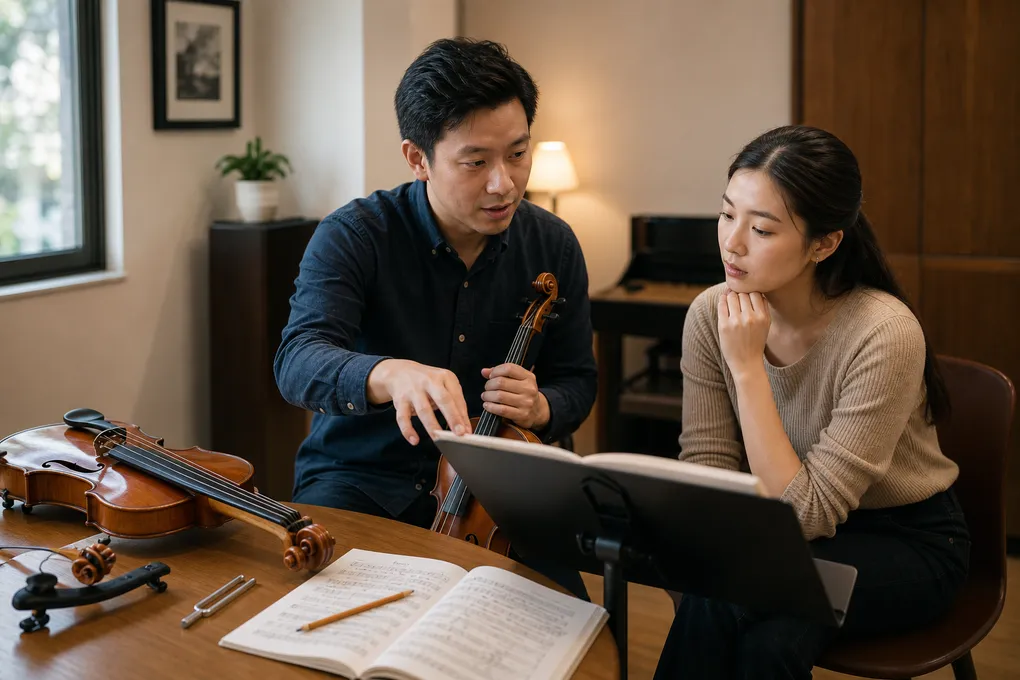
Choosing a violin or viola teacher in Hong Kong is not only a question of convenience, fee, or exam record. Those things matter, but they do not tell the whole story. A good teacher shapes how a student listens, practises, solves problems, and understands music over many years.
This is especially true for string players. Violin and viola technique is physical, aural, and highly personal. A small habit in the left hand, bow arm, shoulder, or ear can grow quietly in the background until it becomes difficult to change. The right teacher notices early, explains clearly, and keeps the student moving without making the lesson feel like a weekly inspection.
My own path began on the violin before I later switched to the viola. That experience still affects how I teach. I know what it feels like to build a foundation on one instrument, then discover that a similar-looking instrument asks for a different kind of listening, weight, colour, and physical balance. Together with my training at HKAPA and HKBU, and my work in orchestral and chamber settings, it has made me cautious about choosing teachers by surface credentials alone.
For related context, you may also want to read how much music lessons cost in Hong Kong and why I teach music first, not exam first.
If you are choosing specifically for viola, it is also worth reading why learn viola in Hong Kong and the practical guide to private viola lessons in Hong Kong so the teacher search is connected to the student’s actual musical path.
Look for musicianship, not only correction
A teacher should correct wrong notes, unstable rhythm, poor posture, and unclear technique. But if a lesson is only correction, the student may learn to fear mistakes without learning to hear music.
Good teaching helps the student understand why a correction matters. Intonation is about hearing where the note belongs in the phrase. Bow control is about shaping sound, direction, weight, and character. Rhythm is the living pulse that allows the music to speak.
When you observe or try a lesson, listen for the teacher’s language. Do they talk only about errors, or do they connect technique to sound? Do they ask the student to listen, sing, compare, or describe what changed? Do they make music feel larger than the next exam?
This matters for beginners as much as advanced students. Musical thinking should not be postponed until the technique is “ready”.
Technical care should be specific
String teaching needs precise attention. For violin and viola, posture affects tone, shifting, vibrato, intonation, stamina, and injury risk.
A good teacher should notice details such as:
- whether the left hand is free or squeezing
- whether the bow arm uses weight or pressure
- whether the student’s shoulders rise when concentrating
- whether the instrument size and setup fit the body
- whether the student hears the pitch before placing the finger
- whether practice habits are creating confidence or tension
These points should be explained in language the student can use at home. A vague instruction like “relax” is rarely enough. The teacher should be able to show what changed, give a practical exercise, and help the student recognise the feeling or sound.
This is why the first few months matter. Early habits become familiar quickly. A patient teacher who builds foundations carefully can save a student from unnecessary rebuilding later.
Ask how exams fit into the bigger picture
In Hong Kong, many families naturally ask about ABRSM, Trinity, school auditions, competitions, or the Hong Kong Schools Music Festival. These goals can be useful because they give structure, repertoire, and a sense of progress.
If exams are already part of the decision, compare this section with what ABRSM exams can and cannot teach and the more practical guide to ABRSM viola exams in Hong Kong.
But exam experience is not the same as good teaching. A teacher who only trains students to pass may produce short-term results while leaving gaps in listening, technique, confidence, and musical independence.
I am not against exams. I support them when they serve the student’s growth. But I would be careful with any teacher who treats the exam as the whole purpose of learning. Ask whether scales, sight-reading, aural work, tone, and musicianship are part of the weekly lesson, not rushed at the end.
A healthy teacher keeps perspective. The certificate is one moment; the student’s relationship with music lasts much longer.
Communication with parents and adult learners matters
For children, the teacher is also guiding the family. Parents do not need to become professional musicians, but they do need to understand what useful practice looks like. A good teacher should be able to explain what to practise, what to listen for, and when not to push.
For adult learners, communication matters in a different way. Adults often arrive with old memories, self-consciousness, busy schedules, or body tension from work. They may need reassurance, but they also deserve serious teaching.
In both cases, the teacher should be honest without being harsh. Encouragement is helping the student face the next step without shame.
Check whether the teacher is still musically active
A teacher does not need to perform constantly to teach well. Some excellent teachers focus mainly on education. But there is real value in learning from someone whose teaching is connected to living musical practice.
For me, orchestral playing, chamber music, rehearsals, masterclasses, and collaborative performances all feed back into teaching. They remind me that technique is not an isolated system; it exists so musicians can listen, blend, lead, respond, and communicate.
When choosing a teacher, look for signs of this broader musical life. Does the teacher listen deeply? Can they talk about sound, phrase, style, and performance pressure from real experience? Do they help the student become a musician, not only a student of an instrument?
Use a trial lesson wisely
A trial lesson is not only for deciding whether the teacher is nice. It is a chance to notice how the teacher thinks.
After the lesson, ask:
- Did the teacher identify the student’s real level accurately?
- Did the student leave with one or two clear things to practise?
- Did the teacher balance encouragement with useful correction?
- Did the explanations make sense?
- Did the lesson include listening and sound, not only instructions?
- Did the student feel more curious, or only more judged?
For a young child, do not judge only by whether the lesson was entertaining. A good lesson can be warm and enjoyable while still being serious. For an advanced student, do not judge only by how many corrections were given. The best lesson is the one that gives the student the right next work.
A good fit feels clear, not magical
Choosing a violin or viola teacher in Hong Kong can feel overwhelming because there are many options: private studios, music centres, school programmes, online lessons, home visits, and teachers with very different backgrounds. The goal is not to find a perfect name on paper. The goal is to find a teacher whose musicianship, care, communication, and values match the student’s needs.
A good teacher helps the student hear more truthfully. They protect the body from unnecessary tension. They explain practice in a way that can continue between lessons. They respect exams without letting exams shrink the whole musical world. They notice the person in front of them.
That kind of teaching may look quiet from the outside. But over time, it changes everything: the student’s sound, confidence, patience, and sense of belonging in music.