What Size Viola Should an Adult Use? 15-17 Inch Guide
Not sure whether to choose a 15, 15.5, 16, 16.5 or 17 inch viola? A practical adult viola size guide for beginners and returning players.
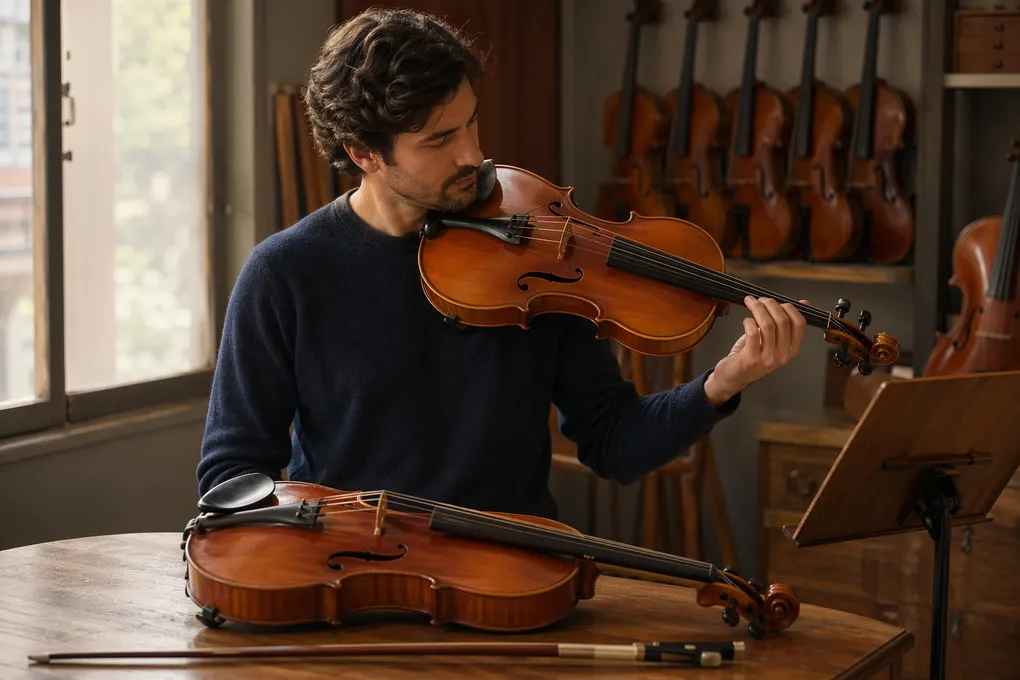
Adult beginners often feel pressure to choose the largest instrument they can manage, but comfort matters more than prestige. If you are still at the beginning of the process, this guide pairs naturally with learning viola as an adult and common beginner viola problems.
Once you know the size range that suits your body, the next practical decision is how to protect and carry the instrument. I cover the main options in the viola case buying guide.
Quick answer: what size viola should an adult use?
Most adult beginners should first try 15.5” and 16” violas. Smaller adults, players with shorter arms, or people with shoulder or hand tension may prefer 15” or 15.5”. Taller adults and more experienced players may try 16” or 16.5” if the instrument still feels physically easy. A 17” viola is usually a specialist choice, not a default beginner size.
| Viola size | Often best for | Be careful if |
|---|---|---|
| 15” | Smaller adults, shorter arms, hand tension | You want a very deep C-string sound |
| 15.5” | Many adult beginners and returning players | You need a much larger orchestral projection |
| 16” | A common adult middle point | It causes shoulder, wrist, or fourth-finger tension |
| 16.5” | Taller adults with secure technique | Shifting or long practice starts to feel strained |
| 17” | Advanced or specialist players | You are choosing mainly for prestige |
Adult violists meet a sizing question that violinists rarely have to face in the same way: what is a full-size viola? The answer is not a single number. For adults, the practical range often begins around 15” and extends through 15.5”, 16”, 16.5”, and sometimes 17” or beyond. Unlike the violin, the viola never settled into one standard adult body length.
That freedom is part of the instrument’s character, but it can also make choosing confusing. A larger viola may offer more depth and warmth, but only if the player can use it without tension. A smaller viola may be easier to handle, but it still needs enough resonance, projection, and character to feel like a true viola. The best size is not the biggest size. It is the size where sound and body can work together for years.
Why Adult Viola Size Is Not Standard
The viola sits in an awkward and beautiful place acoustically. If it were built strictly in proportion to the violin, it would be much larger than most people could comfortably play under the chin. Makers have therefore spent generations balancing sound against human reach.
That is why adult violas vary so much. A 15” viola can be a serious instrument, especially for smaller adults or players with shorter arms. A 16” viola is often considered a common middle point. A 16.5” viola may offer more breadth and darkness for players who can manage it comfortably. A 17” viola can be magnificent in the right hands, but it is not automatically better, and it is not a sensible default for most adult beginners.
The question is not whether a viola is “full size” in the abstract. The question is whether this particular instrument fits this particular player.
A Practical Adult Size Guide
Use this table as a starting point when trying instruments. It should not replace a teacher, luthier, or careful trial period.
| Viola body length | Often suits | Strengths | Main caution |
|---|---|---|---|
| 15” | Smaller adults, adult beginners, players with shorter arms or smaller hands | Manageable reach, lighter feel, often easier for early technique | Needs careful selection so the sound does not feel thin or violin-like. |
| 15.5” | Many average-sized adults and teenagers | Good compromise between comfort and viola warmth | Still check string length and neck shape; body length alone is not enough. |
| 16” | Common adult size for players with comfortable reach | Often gives a fuller lower register and strong general projection | Can become tiring if the left hand or shoulder has to work too hard. |
| 16.5” | Taller adults or players with long arms and secure technique | Can offer a broader, darker sound and generous resonance | Not worth it if shifting, fourth finger, or long practice sessions become tense. |
| 17” | Advanced players with the build, technique, and reason to use it | Potential for depth, power, and distinctive viola color | Usually a specialist choice; comfort and injury risk must be taken seriously. |
This is why an adult should not choose by height alone. A tall person with narrow shoulders and small hands may prefer a 15.5” viola. A shorter person with broad shoulders, long arms, and flexible hands may manage a 16” comfortably. The body is more complicated than a single measurement.
What To Consider Beyond Inches
Arm length matters, but it is not the whole story. Hand size, finger length, thumb flexibility, shoulder shape, neck length, and old injuries all affect whether a viola feels playable. So do the instrument’s string length, neck thickness, rib depth, weight, and balance.
This is especially important for adults because adults often arrive with established body habits. Some have desk-related shoulder tension. Some have wrist or neck issues. Some can practise only after a long workday, when the body is already tired. A viola that feels exciting for five minutes in a shop may feel very different after forty minutes of scales, shifting, and slow practice.
A useful test is not only whether you can reach the scroll. Ask whether you can play first position without gripping, place the fourth finger cleanly, shift without dragging the shoulder, and hold the instrument through a normal practice session without accumulating strain.
Sound: Larger Is Not Always Better
Many adults are drawn to the viola because of its darker and warmer sound. It is natural, then, to assume that the largest viola will sound the most like a viola. Sometimes a larger body does bring more depth, especially on the C string. But size does not guarantee quality.
A well-made 15.5” viola can sound more open and responsive than a heavy, poorly set up 16.5” instrument. A 16” viola with a good bridge, suitable strings, and healthy resonance may project better than a larger viola that feels slow under the bow. The player also matters: an instrument only gives its best sound when the body can release into it.
For adult beginners and returning players, response may be more important than sheer darkness. If the viola speaks easily, the player can learn tone production without forcing. If the sound requires constant pressure, the player may mistake effort for expressiveness.
When A 15” Or 15.5” Viola Is The Better Choice
There is no shame in choosing a smaller adult viola. A 15” or 15.5” instrument can be the right choice for a smaller adult, a beginner, a player with hand strain, or someone who values ease and control. The question is whether the instrument still has a convincing viola sound.
Try to listen for warmth on the lower strings, evenness across all four strings, and whether the A string remains pleasant rather than tight or nasal. A smaller viola should not feel like an apology. It should feel like an instrument with its own voice.
For many adult learners, this size range allows better posture, calmer shifting, and longer practice with less fatigue. That can lead to better playing than struggling nobly with a larger instrument.
When A 16” Or 16.5” Viola Makes Sense
A 16” viola is often a strong choice for adults who can handle the reach comfortably. It may offer enough body size to produce the warmth people associate with viola while still remaining practical for regular study, ensemble playing, and technical development.
A 16.5” viola can be wonderful for the right player. It may give a broader sound, especially in chamber music or orchestral settings where the viola needs color and presence. But the player should be honest. If fourth finger feels unreliable, if the left shoulder begins to travel forward, or if long rehearsals create discomfort, the instrument may be asking too much.
The right larger viola should feel spacious, not heroic.
What About 17 Inches?
A 17” viola is not a badge of seriousness. It is a choice with consequences. Some players love large violas for their depth and individuality, and some instruments of this size are extraordinary. But for most adults, especially beginners, 17” should be approached cautiously.
Before choosing a 17” viola, ask several questions. Can you play it for an hour without tension? Can you shift cleanly and use the fourth finger without strain? Does the sound genuinely improve enough to justify the physical cost? Does a teacher or experienced violist agree that the size serves you?
If the answer is uncertain, a smaller and more responsive instrument is usually the wiser path.
Try Instruments The Way You Actually Play
When testing violas, do more than play one open C string and admire the darkness. Play slowly in first position. Use the fourth finger. Shift. Cross strings. Play softly. Play something lyrical on the A string. Then play for long enough to notice what your body does when the first excitement wears off.
If possible, take instruments home on trial or bring them to a lesson. The room, bow, shoulder rest, and setup can all change your impression. A teacher can often see tension before the player feels it clearly.
The final decision should balance three things: physical ease, musical sound, and long-term honesty. If one of those is missing, keep looking.
The Adult Answer
For many adults, the best starting range is somewhere between 15.5” and 16”. Smaller adults may be happier around 15” or 15.5”. Taller or more experienced players may prefer 16” or 16.5”. A 17” viola can be beautiful, but it should be chosen because it truly fits, not because it sounds serious on paper.
The viola’s voice comes from warmth, depth, and inner resonance, but also from the player’s freedom. A comfortable instrument allows the body to listen. That is where tone begins.
If you are choosing your first viola for lessons in Hong Kong, it helps to bring the instrument question into the lesson itself. I can check basic fit, posture, left-hand reach, and whether the instrument lets the student practise without unnecessary strain during private viola lessons.
Adult Viola Size FAQ
What viola size should most adult beginners try first?
Many adult beginners should start by trying 15.5” and 16” violas, then compare smaller or larger instruments only if their body or sound preference clearly points that way. The right size is the one that allows relaxed posture, reliable fourth finger, and a sound the player can develop.
Is a 16.5” viola too big for a beginner?
Not always, but it is not a default choice. A 16.5” viola can suit taller adults with comfortable reach, but beginners should avoid choosing it only because it sounds more serious. If shifting, fourth finger, shoulder position, or long practice sessions become tense, a smaller viola is usually wiser.
Can a 15” viola still sound like a real viola?
Yes, if it is well made and well set up. A good 15” viola can be more useful than a larger instrument that feels heavy, slow, or physically defensive. Listen for warmth on the lower strings and even response across the instrument.
Is a 16 inch viola full size?
For viola, “full size” is less fixed than violin. Many adult violas sit around 15.5” to 16.5”, with 16” often treated as a common adult middle point.
Is a 15.5 inch viola too small for an adult?
No. A good 15.5” viola can be a serious adult instrument if it gives enough warmth, resonance, and comfort. For many adults, it is a better musical choice than a larger viola that creates tension.
Should adult beginners choose the biggest viola they can play?
Usually no. Comfort, relaxed technique, and a responsive sound matter more than choosing the largest possible body length. A viola that lets the body stay free will usually teach better tone than one that constantly asks the player to compensate.