What Size Viola Is Right for Your Child?
A practical guide for parents on choosing a child-sized viola, with a sizing chart, measurement tips, and advice on avoiding the common mistake of buying too large.
Choosing the right size is one of the simplest ways to prevent avoidable beginner frustration. If the student is already struggling with posture, sound, or left-hand tension, it may also help to read common beginner viola problems.
Once the instrument size is settled, protection and portability become the next practical question. I explain the options in this viola case buying guide.
Choosing a viola for a child is not like choosing a school bag with a little room to grow. A viola that is too large does not simply wait politely for the child to catch up. It changes the way the left arm reaches, how the hand falls on the fingerboard, how the bow meets the string, and how much tension the child learns to accept as normal.
That is why size matters so much at the beginning. The right viola should let a child stand naturally, reach the notes without strain, and make a sound that feels possible. A slightly smaller instrument that the child can play freely is usually more useful than a larger one that looks more impressive but quietly teaches bad habits.
If you are still deciding whether viola is the right starting instrument, it may help to read why learn viola in Hong Kong and the broader comparison of viola vs violin before choosing a size.
Start With The Child, Not The Label
Viola sizes are measured by the length of the instrument body, usually in inches. This is different from violin sizing, where parents often hear fractions such as 1/2 or 3/4. For children, you may see 11”, 12”, 13”, 14”, 14.5”, and 15” violas. Sometimes a small violin is strung as a viola, especially for younger beginners, because very small true violas are less common.
The number on the label is only a starting point. Two children of the same age can have very different arm length, shoulder width, hand size, flexibility, and posture. Even two violas with the same body length may feel different because of their neck shape, rib depth, weight, and setup.
So the better question is not only “How old is my child?” It is: can this child hold this viola in a balanced playing position and move without strain?
How To Measure For A Viola
Use the measurement as a guide before visiting a teacher or string shop.
Ask the child to stand normally with the left arm extended out to the side, roughly level with the shoulder. The shoulder should stay relaxed, not lifted. Measure from the base of the neck to the middle of the palm, or to the area where the hand naturally bends, depending on the sizing chart being used. Different shops use slightly different measuring points, which is why the numbers should not be treated as law.
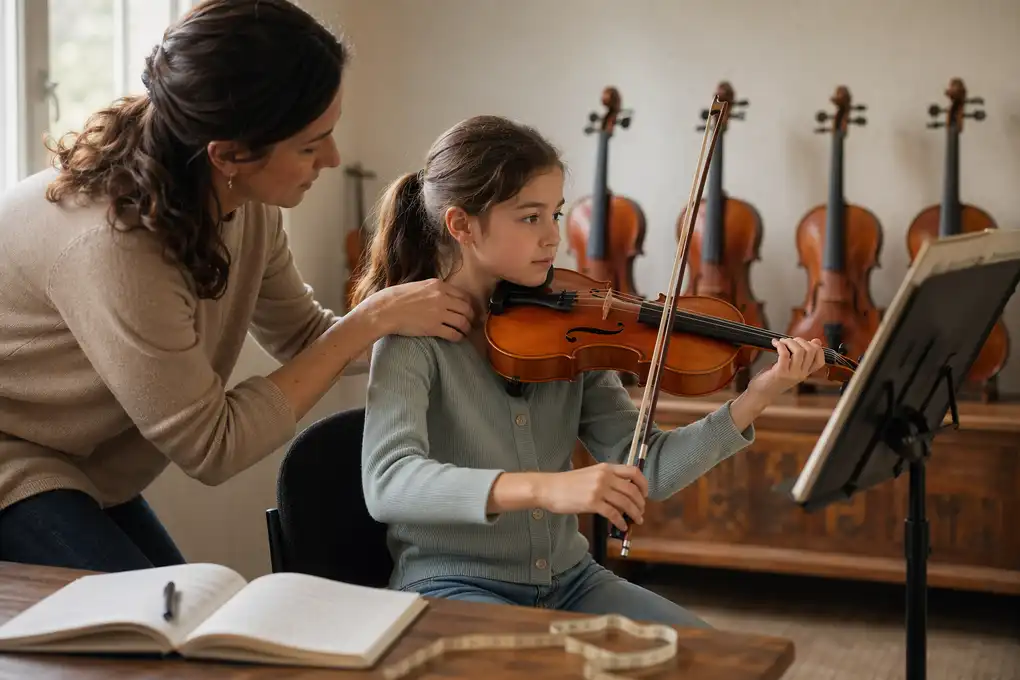
Then check the instrument in playing position. The child should be able to support the viola without collapsing the shoulder, overreaching the left arm, locking the elbow, or twisting the wrist. If the measurement falls between two sizes, beginners are often better served by the smaller option, especially if the larger one makes the hand stretch or the shoulder rise.
Child Viola Size Chart
This chart is a practical starting point, not a final prescription. It combines common sizing ranges from string-shop guides and should be confirmed with the student’s teacher before renting or buying.
| Arm length from neck to palm | Approximate age | Common viola size to try | Practical note |
|---|---|---|---|
| 16.5” to 18.5” | 5 to 7 | 11” viola or small violin conversion | Best for very young beginners who need a light, manageable setup. |
| 18.5” to 20.5” | 6 to 9 | 12” viola | The child should still be able to curve the fingers without stretching. |
| 20.5” to 22.25” | 7 to 10 | 13” viola | Often a useful middle size before moving toward a larger student viola. |
| 22.25” to 23.75” | 9 to 12 | 14” viola | Similar in body length to a full-size violin, but set up and tuned as viola. |
| 23.75” to 24.75” | 10 to 13 | 14.5” or small 15” viola | Try carefully; comfort matters more than moving up quickly. |
| 24.75” to 25.5” | 12+ | 15” viola | Often the first adult-range size, but still small enough for many teenagers. |
| 25.5” to 26.25” | 13+ | 15.5” viola | Suitable for taller teenagers only if the reach and hand frame remain relaxed. |
| 26.25” and above | 14+ | 16” or larger viola | Treat this as teacher-guided territory, not an automatic upgrade. |
The age column is deliberately approximate. A tall ten-year-old may fit a larger instrument than a small thirteen-year-old. A child with long arms but small hands may still need a more modest size. A child with a tense shoulder or locked thumb may need time on a smaller instrument even if the tape measure suggests otherwise.
The Best Size Is The One That Protects Technique
Parents are often tempted to choose the larger size because it seems better value. The thought is understandable: children grow quickly, rentals cost money, and nobody wants to change instruments too often. But on viola, “growing room” can be expensive in a different way.
If the viola is too large, the child may learn to reach forward with the left shoulder, squeeze with the thumb, flatten the fingers, or avoid using the fourth finger. The bow arm may also become awkward because the instrument feels heavy and the child cannot balance it comfortably. These habits can stay long after the child has physically grown.
A good size lets the child develop a relaxed left hand, a flexible bow arm, and a sense that sound can be made without fighting the instrument. That feeling is not a luxury. It is the foundation of technique.
Signs The Viola May Be Too Big
A viola may be too large if the child regularly complains of shoulder, neck, wrist, or thumb discomfort after short practice. It may also be too large if the left elbow locks straight when reaching the scroll, the wrist bends sharply backward, the fourth finger cannot land without strain, or the child keeps pulling the instrument inward to shorten the reach.
Watch the face as well as the posture. A child who looks tense before the music has even begun may be carrying too much instrument.
This does not mean every difficulty is caused by size. Beginners need time to learn coordination. But if several of these signs appear together, it is worth reassessing the instrument rather than asking the child to push through.
Signs The Viola May Be Too Small
A viola that is too small can also create problems. The child may feel cramped, the bow may run out of space too easily, the left fingers may sit too close together, and the sound may become thin or limited for the level of playing. A student who has grown may start to look folded around the instrument, with the left arm too compressed and the right arm unable to move freely.
Children should be remeasured regularly, often every six to twelve months during growth periods. The goal is not to rush through sizes, but to notice when the current setup has stopped serving the student’s body and sound.
Renting Is Often Wiser Than Buying Early
For many families, especially with younger children, renting a correctly sized viola is wiser than buying a larger one too soon. A good rental program usually allows size exchanges as the child grows. This keeps the instrument matched to the student instead of forcing the student to adapt to a purchase.
If buying, ask the teacher to check the exact instrument before committing. Do not judge only by the listed size. Check the weight, bridge height, string response, pegs, bow, shoulder rest, and whether the child can play a few simple notes with a relaxed body.
This is also one reason a careful teacher matters early on. A good teacher can tell the difference between ordinary beginner coordination and a setup that is quietly working against the child; I write more about that in how to choose a good violin or viola teacher in Hong Kong.
If you would like the instrument fit checked inside a lesson context, I also describe my approach to private viola lessons in Hong Kong.
The best first viola is not the biggest possible viola. It is the viola that lets the child begin well.
A Final Word For Parents
Viola has a warm and generous voice, but it asks the body to cooperate honestly. For a child, the correct size can make the difference between curiosity and frustration. It can decide whether practice feels like exploration or a small daily battle.
Choose the size that allows ease, not pride. Let the teacher help. Recheck as the child grows. And remember that a comfortable beginning is not a compromise on seriousness. It is how serious learning becomes possible.