Last updated on
ABRSM Viola Grade 1 Syllabus 2026: Repertoire, Pieces and Scales
The 2026 ABRSM Viola Grade 1 syllabus: repertoire list and scale requirements, with practical notes for choosing three beginner-friendly exam pieces.
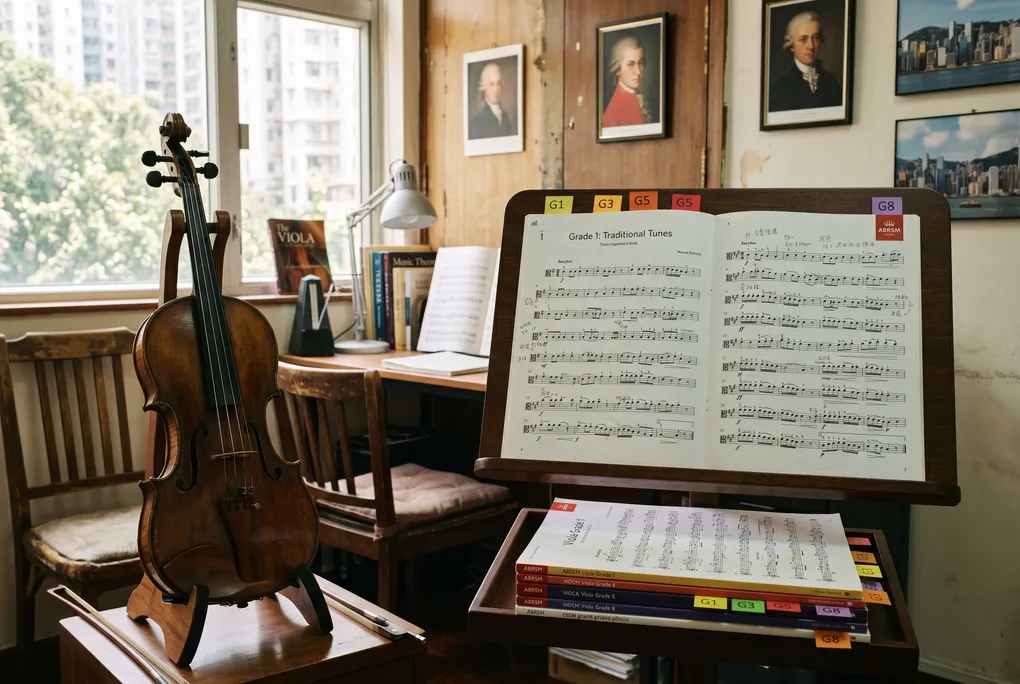
ABRSM Viola Grade 1 is the first point where many students and parents begin to think seriously about programme choice. The exam still uses short, accessible pieces, but the candidate is already expected to show contrast: a clear dance impulse, a singing sound, and a piece with enough character to feel different from the others.
The 2026 guide below follows the official ABRSM Viola Practical Grades syllabus from 2024, which remains the current syllabus for this repertoire. For the practical exam, the candidate chooses three pieces: one from List A, one from List B, and one from List C.
For the broader exam pathway, read this together with ABRSM viola repertoire by grade and ABRSM viola exams in Hong Kong: online or live. If scales are the main worry, the companion guide is ABRSM viola scales: how to practise them musically.
Other grades: Grade 1 | Grade 2 | Grade 3 | Grade 4 | Grade 5 | Grade 6 | Grade 7 | Grade 8
Cost-saving recommendation: before buying several separate song books, check whether your chosen pieces are available in More Time Pieces for Viola, Vol. 1 (ABRSM) or, for higher grades, More Time Pieces for Viola, Vol. 2 (ABRSM). These ABRSM collections are often the most cost-effective options because one book can cover several useful syllabus choices. I have marked those rows below as cost-effective ABRSM collection picks.
Grade 1 difficulty summary
Grade 1 is an early exam, but it is already testing contrast. Students need steady pulse, comfortable first-position playing, simple bow control, and enough character to make three short pieces feel different from one another.
Most cost-effective Grade 1 picks
These pieces all appear in More Time Pieces for Viola, Vol. 1 (ABRSM), so they are especially useful if you want to avoid buying too many separate books for one exam.
| No. | Composer | Piece | Book |
|---|---|---|---|
| A2 | Byrd | La Volta, from Fitzwilliam Virginal Book, arr. Lamb & Meredith | More Time Pieces for Viola, Vol. 1 (ABRSM) |
| B5 | Elgar | Pomp and Circumstance March No. 4, from Op. 39, arr. Lamb & Meredith | More Time Pieces for Viola, Vol. 1 (ABRSM) |
| C4 | Huws Jones | Hen-Coop Rag, trans. Lamb & Meredith | More Time Pieces for Viola, Vol. 1 (ABRSM) |
| C5 | Alan Menken & Ashman | Under The Sea, from The Little Mermaid, arr. Lamb & Meredith | More Time Pieces for Viola, Vol. 1 (ABRSM) |
How to choose a Grade 1 programme
At Grade 1, it is usually better to choose pieces that are secure, clear, and naturally contrasting than to choose the most impressive-looking titles. A good programme might pair a lively List A dance, a simple but well-shaped List B melody, and a List C character piece that lets the student show rhythmic confidence.
For Hong Kong students, I would listen especially for three things before finalising the set: whether the pulse stays calm, whether the left hand is comfortable in first position, and whether the bow can change character without becoming tense. Grade 1 is still early, but it already rewards musical awareness.
That early musical awareness is also why I do not treat exams as the whole point of learning. For the bigger teaching view, see what ABRSM exams can and cannot teach.
Grade 1 repertoire: List A
| No. | Composer | Piece | Publication |
|---|---|---|---|
| 1 | Kathy & David Blackwell | Patrick’s Reel | Viola Time Joggers (OUP) |
| 2 | Byrd | La Volta, from Fitzwilliam Virginal Book, arr. Lamb & Meredith | More Time Pieces for Viola, Vol. 1 (ABRSM) - cost-effective ABRSM collection pick |
| 3 | J. Clarke | Minuet, arr. Brodszky | Early Music for Viola (EMB Zeneműkiadó) |
| 4 | Losy | Bourrée, arr. Brodszky | Early Music for Viola (EMB Zeneműkiadó) |
| 5 | Katherine & Hugh Colledge | Polka Dots, No. 15 from Waggon Wheels | Katherine & Hugh Colledge: Waggon Wheels for Viola (Boosey & Hawkes) |
| 6 | Handel | Menuet, from Music for the Royal Fireworks, HWV 351, arr. Salter | Starters for Viola (ABRSM) |
| 7 | Purcell | Rigadoon, arr. Nelson; with repeat | Piece by Piece 1 for Viola (Boosey & Hawkes) |
| 8 | Trad. | Dance to your daddy, arr. Nelson | Piece by Piece 1 for Viola (Boosey & Hawkes) |
| 9 | Suzuki | Allegretto, trans. Preucil & arr. Stuen-Walker | Suzuki Viola School, Vol. 1 (Alfred) |
| 10 | Trad. English | London Bridge, arr. Sparke | Starter Solos for Viola (Anglo Music) |
| 11 | Celia Cobb & Naomi Yandell | Pony Trek, No. 5 from Top Banana | Celia Cobb & Naomi Yandell: Top Banana for Viola (Stainer & Bell) |
| 12 | Chevalier de Saint-Georges | Chevalier’s Rondeau, from String Quartet, Op. 1 No. 3, arr. K. & D. Blackwell | Viola Mix 1 (ABRSM) |
| 13 | Sancho | Gavotta, arr. K. & D. Blackwell | Viola Mix 1 (ABRSM) |
Grade 1 repertoire: List B
| No. | Composer | Piece | Publication |
|---|---|---|---|
| 1 | Beethoven | Hymn to Joy, from Symphony No. 9, arr. Wilkinson & Hart | First Repertoire for Viola, Book 1 (Faber) |
| 2 | Kathy & David Blackwell | Rocking Horse | Viola Time Joggers (OUP) |
| 3 | Katherine & Hugh Colledge | Full Moon, No. 22 from Waggon Wheels | Katherine & Hugh Colledge: Waggon Wheels for Viola (Boosey & Hawkes) |
| 4 | Katherine & Hugh Colledge | On the Wing, No. 25 from Waggon Wheels | Katherine & Hugh Colledge: Waggon Wheels for Viola (Boosey & Hawkes) |
| 5 | Elgar | Pomp and Circumstance March No. 4, from Op. 39, arr. Lamb & Meredith | More Time Pieces for Viola, Vol. 1 (ABRSM) - cost-effective ABRSM collection pick |
| 6 | Eleanor Murray & Sebastian Brown | Melody, No. 3 from Tunes for my Viola | Murray & Brown: Tunes for my Viola (Boosey & Hawkes) |
| 7 | Christopher Norton | Hebridean Song, No. 11 from Microjazz for Starters; upper note optional in bar 21 | Christopher Norton: Microjazz for Starters for Viola (Boosey & Hawkes) |
| 8 | Rodgers & Hammerstein | Edelweiss, from The Sound of Music, arr. Davey, Hussey & Sebba | Abracadabra Viola, Third Edition (Collins Music) |
| 9 | Philip Sparke | Modal Melody | Starter Solos for Viola (Anglo Music) |
| 10 | Trad. Scottish | Skye Boat Song, arr. K. & D. Blackwell; with repeats | String Time Starters for Viola (OUP) |
Grade 1 repertoire: List C
| No. | Composer | Piece | Publication |
|---|---|---|---|
| 1 | Mary Cohen | Rumba, No. 3 from Dance Duets | Mary Cohen: Dance Duets for Viola (Faber) |
| 2 | Thomas Gregory | Fiery Fiddler; with repeats | Vamoosh Viola, Book 1 (Vamoosh) |
| 3 | Jim Henson & Sam Pottle | Muppet Show Opening, arr. Lawrance | Winners Galore for Viola (Brass Wind) |
| 4 | Huws Jones | Hen-Coop Rag, trans. Lamb & Meredith | More Time Pieces for Viola, Vol. 1 (ABRSM) - cost-effective ABRSM collection pick |
| 5 | Alan Menken & Ashman | Under The Sea, from The Little Mermaid, arr. Lamb & Meredith | More Time Pieces for Viola, Vol. 1 (ABRSM) - cost-effective ABRSM collection pick |
| 6 | S. Nelson | Flag Dance | Piece by Piece 1 for Viola (Boosey & Hawkes) |
| 7 | Christopher Norton | Popular Song, No. 14 from Microjazz for Starters | Christopher Norton: Microjazz for Starters for Viola (Boosey & Hawkes) |
| 8 | Trad. | What shall we do with the drunken sailor?, arr. Scott | Play it Again for Viola (Faber) |
| 9 | Trad. American | Yankee Doodle, arr. Sparke | Starter Solos for Viola (Anglo Music) |
| 10 | Celia Cobb & Naomi Yandell | Tango Waltz, No. 12 from Cool Beans | Celia Cobb & Naomi Yandell: Cool Beans Viola Duets (Stainer & Bell) |
Grade 1 scales and arpeggios
All scales and arpeggios are played from memory.
| Keys | Range | Bowing and rhythm |
|---|---|---|
| Scales | ||
| G major and D major, starting on open strings | 1 octave | Separate bows or slurred, 2 quavers to a bow, at the examiner's choice. Even notes or long tonic at the candidate's choice. |
| A natural minor | 1 octave | Separate bows or slurred, 2 quavers to a bow, at the examiner's choice. Even notes or long tonic at the candidate's choice. |
| C major | 2 octaves | Separate bows or slurred, 2 quavers to a bow, at the examiner's choice. Even notes or long tonic at the candidate's choice. |
| Arpeggios | ||
| G major and D major, starting on open strings | 1 octave | Separate bows, even notes. |
| A minor | 1 octave | Separate bows, even notes. |
| C major | 2 octaves | Separate bows, even notes. |
Practical recommendation
Choose one piece with obvious rhythmic lift, one piece that encourages a singing sound, and one contrasting piece with a clear character. At this level, contrast matters more than ambition.
If the student is still developing bow control, avoid building a programme out of three pieces that all need sharp articulation. If the student naturally sings through the instrument but tends to lose pulse, make sure at least one choice demands a steady dance or march character. A Grade 1 programme should sound fresh, secure, and awake rather than over-prepared.
For the broader level-by-level view, return to the ABRSM viola repertoire by grade guide.
Exam preparation: recorded and live
Once you have chosen your repertoire, use the guide that matches your next preparation step:
- General procedure: the Hong Kong ABRSM exam procedure guide covers booking, exam-day arrangements, submission, and results.
- Recording preparation: the ABRSM exam recording preparation guide discusses programme run-throughs, the recording environment, and pressure in front of the camera.
- Live preparation: the Hong Kong ABRSM live viola exam guide offers practice and exam-day preparation advice.