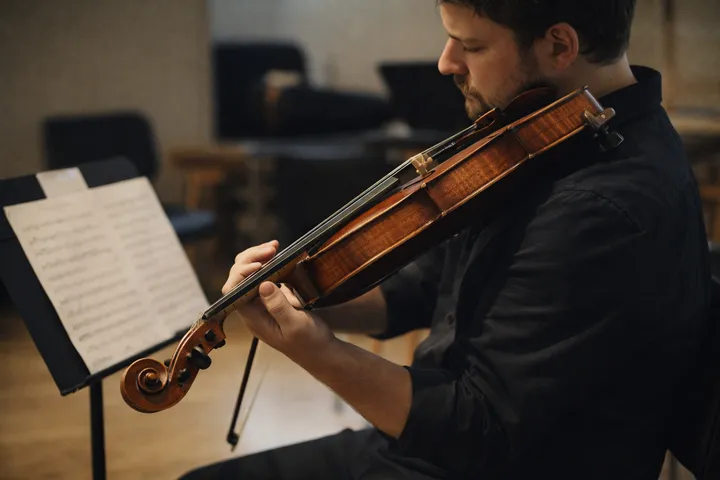
ABRSM Viola Scales: How to Practise Them Musically
A practical guide to preparing ABRSM viola scales with better tone, intonation, bow control, memory, and musical direction.
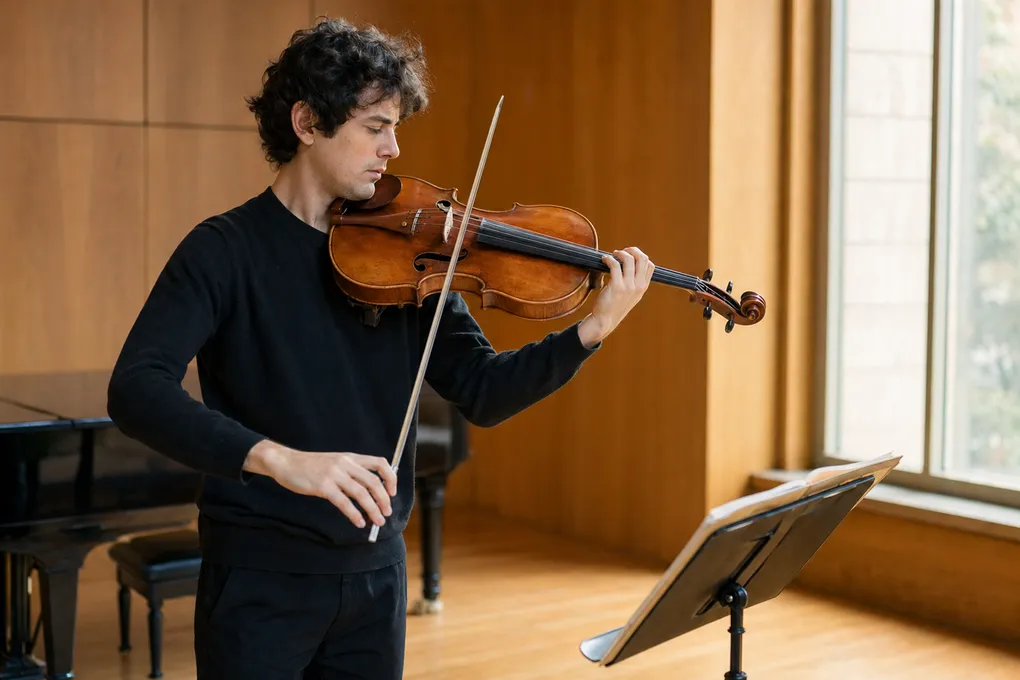
Scales are often the least loved part of ABRSM viola preparation. Students know they have to play them. Parents know they appear in the exam. Teachers know they reveal almost everything. But too often, scales are practised as a technical obligation rather than as music in its most concentrated form.
That is a pity, because a good scale is not merely a correct sequence of notes. On the viola, it shows whether the hand is organised, whether the ear is listening ahead, whether the bow can keep a living sound, and whether the player can make a simple line travel with purpose.
As of 28 April 2026, the current ABRSM Bowed Strings Practical Grades specification from 2024 remains valid until further notice. ABRSM describes scales and arpeggios as a way to build finger movement, hand position, coordination, fingerboard fluency, pitch awareness, familiarity with keys, and tone control. It also states that the requirements are played from memory, and that fingering may be chosen if it produces a successful musical outcome.
Those details matter. They tell us that scales are not a mechanical appendix to the exam. They are a test of whether technique has become available for musical use.
If you want a broader practice framework before focusing on ABRSM requirements, start with effective viola scales for better practice. More advanced students can also look at effective viola scales for advanced practice.
Start With Sound, Not Speed
Many students begin scale practice by asking how fast the scale needs to be. Tempo matters, of course, and ABRSM gives speed guidance in the syllabus. But speed should not be the first concern. A fast scale with weak tone, unclear starts to notes, or uncertain intonation does not sound fluent. It sounds rehearsed in the narrowest sense.
This is the same principle I use in repertoire practice: slow work should keep musical direction alive. I explain that more fully in practising slowly without losing the musical line.
For viola students, the first question should be: does the sound have a centre?
The viola can easily become woolly in the lower register and thin in the upper register. A scale is an ideal place to notice this because there is no expressive drama to hide behind. Each note exposes the balance between bow speed, weight, contact point, and left-hand security. If the tone changes unpredictably from string to string, the scale is showing a real musical problem, not only a technical one.
A useful practice habit is to play the scale slowly enough that every note has a beginning, body, and release. The bow should not simply move; it should carry sound. On the C string, avoid pressing for darkness. On the A string, avoid becoming narrow or nervous. The goal is not to make every register identical, but to make every register connected.
Hear the Key Before the First Note
Because ABRSM scales are played from memory, students sometimes treat them as finger patterns. That works for a while, especially in the lower grades. But by the middle and upper grades, pattern memory alone becomes fragile. A student may know where the fingers go and still not hear the key clearly enough to correct small errors.
Before playing a scale, hear the tonic inwardly. Then hear the first few notes before the bow begins. This one-second preparation changes the quality of the whole exercise. It turns the scale from a recall task into a listening task.
On the viola, this is especially important because the instrument asks for constant adjustment. The same finger spacing can feel different depending on string, position, speed, and hand frame. Good intonation is not just placing fingers in memorised locations. It is the habit of checking every interval against the key.
For minor scales, this becomes even more important. Harmonic and melodic forms should not feel like altered major scales with a few dangerous notes. Each has its own tension and direction. The raised leading note in harmonic minor should pull towards resolution. The ascending melodic minor should feel like it has a different kind of lift. If the student can hear that character, the intonation usually becomes more reliable.
Practise the Bowing as Music
ABRSM examiners may ask for separately bowed or slurred versions, depending on the grade and requirement. Students often prepare these as two technical options: one for clarity, one for smoothness. That is only half the story.
Separate bows should still have line. Each note needs a clean start, but the scale should not become a row of isolated events. The bow changes must feel organised by pulse and direction, not by anxiety. A separately bowed scale can still rise, breathe, arrive, and return.
Slurred scales reveal a different kind of discipline. The left hand must move evenly, but the bow must also plan its journey. If too much bow is spent early in the slur, the end of the group becomes weak. If the bow is held back too cautiously, the sound becomes static. Good slurring is not simply fitting notes under one bow. It is distributing energy across a gesture.
A practical method is to practise the same scale in three ways: first with full tone and no hurry, then with the required bowing, then once more with the phrase direction exaggerated slightly. This prevents the exam bowing from shrinking the music.
Make Arpeggios Sing
Arpeggios are sometimes treated as more awkward scales, but they have a different musical function. A scale moves step by step through a key. An arpeggio outlines harmony. If a student plays an arpeggio without hearing the chord, it often sounds jumpy and disconnected.
Practise arpeggios by listening for stability on the root, openness on the fifth, and colour on the third. The third is especially important. It tells the ear whether the harmony is major or minor, and it gives the arpeggio its emotional identity. If the third is careless, the whole chord loses meaning.
On viola, arpeggios also teach the left hand to move without panic. Shifts and string crossings should be prepared early, but not advertised. The listener should hear harmony unfolding, not a series of technical negotiations. A good arpeggio has vertical knowledge and horizontal flow: the player understands the chord, but the sound still travels forward.
Use Memory as Awareness
Playing from memory does not mean switching off the mind. It should mean that the student is free to listen more deeply.
One common mistake is to memorise scales only by repetition. Repetition is necessary, but it is not enough. Students should also be able to name the key, know the range, understand the fingering choices, and feel where the shifts or string crossings occur. This kind of memory is more secure because it has several layers.
Try asking these questions before a scale:
- What is the tonic?
- Where is the highest note?
- Which notes need special intonation care?
- Where does the bow need planning?
- What character should the scale have?
These questions do not make practice more complicated. They make it less random. A student who can answer them usually plays with more authority, even before the scale becomes faster.
Build Exam Readiness Without Losing Musical Curiosity
Closer to the exam, students need to practise being asked. This is different from playing scales in a fixed order. ABRSM examiners usually ask for a selection across the required types, and the candidate must respond calmly. So it is sensible to rehearse the exam situation: key named, bowing specified, short moment to prepare, then play.
But even this should not become cold. The best exam preparation keeps musical curiosity alive. One day, play the scale for the warmest possible sound. Another day, for the clearest rhythm. Another day, for the smoothest string crossings. Another day, for the most beautiful return to the tonic. The requirement stays the same, but the listening becomes richer.
This is where scales become genuinely useful beyond the exam. A student who practises scales musically will sight-read with more confidence, learn repertoire faster, shift with more trust, and understand key character more naturally. The work may look small from the outside, but it changes the whole playing mechanism from within.
The Scale Is Already Music
The deepest problem with scale practice is not boredom. It is the belief that scales become musical only later, once they appear inside pieces. In truth, the musical responsibility is already present.
A scale has direction. An arpeggio has harmony. A chromatic scale has tension and colour. A dominant seventh has a need to resolve. Bowing has speech. Intonation has expressive meaning. Memory has calm. None of these belongs only to repertoire.
So the aim is not to make scales decorative or sentimental. The aim is to play them with the same honesty we ask for in pieces: clear pulse, centred tone, listening intonation, and a sense that every note belongs to a larger line.
When a viola student can do that, ABRSM scales stop feeling like a separate exam hurdle. They become what they should have been all along: a daily way of making the instrument more truthful, more responsive, and more ready to sing.