Last updated on
ABRSM Viola Grade 8 Syllabus 2026: Repertoire, Pieces and Scales
The 2026 ABRSM Viola Grade 8 syllabus: repertoire list and scale requirements, with practical notes for choosing a mature and balanced exam programme.
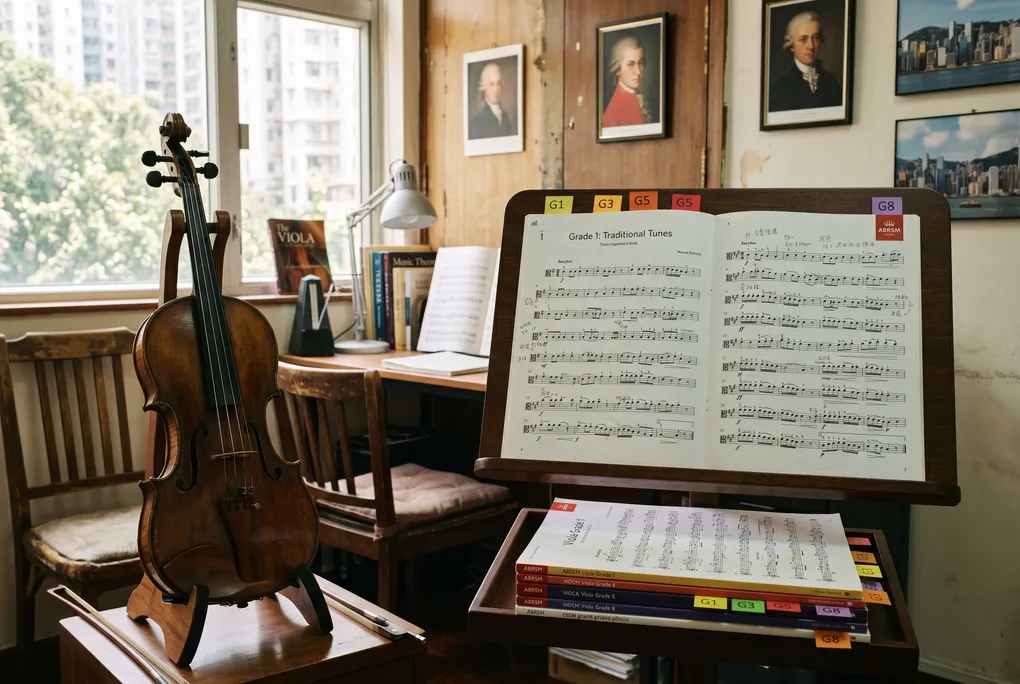
ABRSM Viola Grade 8 asks for independence, proportion, and a convincing artistic point of view. The programme should show architecture, breadth of line, and character without feeling over-stretched.
The 2026 guide below follows the official ABRSM Viola Practical Grades syllabus from 2024, which remains the current syllabus for this repertoire. ABRSM also requires the Grade 5 theory/practical musicianship/jazz prerequisite, or an accepted alternative, for entry.
For the broader exam pathway, read this with ABRSM viola repertoire by grade and ABRSM viola exams in Hong Kong: online or live. For scales, use the companion guide to ABRSM viola scales: how to practise them musically.
Other grades: Grade 1 | Grade 2 | Grade 3 | Grade 4 | Grade 5 | Grade 6 | Grade 7 | Grade 8
Cost-saving note: the current Grade 8 repertoire list does not include pieces from More Time Pieces for Viola, Vol. 1 (ABRSM) or More Time Pieces for Viola, Vol. 2 (ABRSM), so there are no highlighted More Time Pieces rows in this grade. At Grade 8, choose the best-fit programme first, then check whether any chosen editions overlap with music the student already owns.
Grade 8 difficulty summary
Grade 8 asks for independence, proportion, and musical maturity. Students need a programme that shows architecture, breadth of line, style, and character without stretching beyond what can be played with conviction.
Grade 8 repertoire choices should serve the player’s next stage, not only the exam mark. Students thinking beyond graded exams may also want the music school and conservatory audition checklist.
Grade 8 repertoire: List A
| No. | Composer | Piece | Publication |
|---|---|---|---|
| 1 | J. S. Bach | Prelude, from Cello Suite No. 2 in D minor, BWV 1008, trans. Rowland-Jones or Forbes | J. S. Bach: Six Cello Suites (Peters or Chester) |
| 2 | J. S. Bach | Vivace, 1st movt from Sonata No. 3 in G minor, BWV 1029 | J. S. Bach: Three Sonatas for Viola da Gamba (Viola), BWV 1027-1029 (Bärenreiter or Henle) |
| 3 | Grazioli | 2nd and 3rd movts from Sonata in F, arr. Marchet or Tertis | Grazioli: Sonata in F (Stainer & Bell) or A Second Lionel Tertis Album (Weinberger) |
| 4 | Handel | Allegro, 3rd movt from Concerto in B-flat, trans. Arnold | Handel: Concerto in B-flat (Viola World) |
| 5 | Hoffmeister | Rondo, 3rd movt from Concerto in D | Hoffmeister: Concerto in D (Peters or Henle) |
| 6 | Schubert | Sonata Movement, D. 471, arr. Forbes | Schubert: Sonata Movement for Viola (Stainer & Bell) |
| 7 | A. Stamitz | Rondeau, 3rd movt from Concerto in B-flat | A. Stamitz: Concerto in B-flat (Schott) |
| 8 | Telemann | Adagio (Dolce) and Allegro, 1st and 2nd movts from Fantasia No. 7 in A-flat, TWV 40:20 | Telemann: 12 Fantasias For Unaccompanied Viola (Viola World) or Telemann: 12 Fantaisies, TWV 40:14-40:25 (Billaudot) |
| 9 | Telemann | Lento and Allegro, 1st and 2nd movts from Cello Sonata in D, TWV 41:D6, trans. Vieland | Telemann: Sonata in D, TWV 41:D6 (IMC) |
| 10 | Zelter | Allegro con fuoco, 1st movt from Concerto in E-flat | Zelter: Concerto in E-flat (Kunzelmann) |
| 11 | Naji Hakim | Toccata No. 2 | Naji Hakim: Toccata No. 2 for Viola (UMP) |
| 12 | U. Kay | Allegro, 2nd movt from Sonata for Viola | U. Kay: Sonata for Viola (American Composers Alliance) |
Grade 8 repertoire: List B
| No. | Composer | Piece | Publication |
|---|---|---|---|
| 1 | Berlioz | Sérénade, 3rd movt from Harold en Italie, arr. Macdonald | Berlioz: Harold en Italie (Bärenreiter) |
| 2 | Bloch | Meditation, from Meditation and Processional | Bloch: Meditation and Processional (G. Schirmer) |
| 3 | Brahms | Andante un poco adagio, 2nd movt from Sonata in F minor, Op. 120 No. 1 | Brahms: Two Sonatas, Op. 120 (Peters or Henle) |
| 4 | Fauré | Elégie, Op. 24, trans. Katmis or arr. Szeredi-Saupe | Fauré: Elegy for Viola, Op. 24 (IMC) or Music for Viola III (EMB Zeneműkiadó) |
| 5 | Glazunov | Elégie, Op. 44 | Glazunov: Élégie, Op. 44 (Belaieff or Henle) |
| 6 | Joachim | No. 3, from Hebräische Melodien, Op. 9 | Joachim: Hebrew Melodies for Viola, Op. 9 (IMC or Breitkopf & Härtel) |
| 7 | Kapustin | Largo, 2nd movt from Sonata, Op. 69 | Kapustin: Sonata for Viola, Op. 69 (Schott) |
| 8 | Mendelssohn | Adagio: Allegro, 1st movt from Sonata in C minor | Mendelssohn: Sonata in C minor (IMC or Henle) |
| 9 | Tchaikovsky | Melodia, No. 3 from Souvenir d’un lieu cher, Op. 42, arr. Ducrocq | Tchaikovsky: Melodia for Viola (Billaudot) |
| 10 | Villa-Lobos | Aria (Cantilena), from Bachianas brasileiras No. 5, arr. Primrose | Villa-Lobos: Bachianas brasileiras No. 5 for Viola (AMP) |
| 11 | C. Schumann | Andante molto, No. 1 from Three Romances, Op. 22, arr. B. & S. Kalinowsky | C. Schumann: Three Romances for Viola, Op. 22 (Robert Lienau) |
Grade 8 repertoire: List C
| No. | Composer | Piece | Publication |
|---|---|---|---|
| 1 | L. Anderson | Fiddle-Faddle, arr. Arnold | L. Anderson: Fiddle-Faddle (Viola World) |
| 2 | A. Beach | Mazurka, No. 3 from Three Pieces, Op. 40, trans. Grant | A. Beach: Three Pieces for Viola, Op. 40 (Spartan Press) |
| 3 | N. Boulanger | Pièce no. 3 en C-sharp mineur, from Trois pièces | N. Boulanger: Three Pieces for Viola (Leduc) |
| 4 | Britten | Reflection | Britten: Reflection (Faber) |
| 5 | R. Clarke | Morpheus | R. Clarke: Morpheus (OUP) |
| 6 | Husa | Marciale, 3rd movt from Suite, Op. 5 | Husa: Suite for Viola, Op. 5 (AMP) |
| 7 | Robin Ireland | Metre Change Study 1, from Étude No. 9 | Robin Ireland: Concert Etudes for Viola (Clifton Edition) |
| 8 | Reger | Molto vivace, 4th movt from Suite No. 1 in G minor, Op. 131d | Reger: Three Suites for Solo Viola, Op. 131d (Peters) |
| 9 | Rimsky-Korsakov | The Bumble-Bee, arr. Szeredi-Saupe | Music for Viola III (EMB Zeneműkiadó) |
| 10 | Vaughan Williams | Christmas Dance, No. 3 from Suite for Viola, Group 1 | Vaughan Williams: Suite for Viola (OUP) |
| 11 | Le Beau | Polonaise, No. 3 from Drei Stücke, Op. 26 | Le Beau: Drei Stücke, Op. 26 (Furore Verlag) |
| 12 | Rainier | Allegro Ricercare, 1st movt from Sonata for Viola | Rainier: Sonata for Viola (Schott) |
Grade 8 scales and arpeggios
All scales and arpeggios are played from memory.
| Keys | Range | Bowing and rhythm |
|---|---|---|
| Scales | ||
| A and B majors and minors, harmonic and melodic | 2 octaves | Separate bows or slurred, 7 notes to a bow, at the examiner's choice. Even notes or long tonic at the candidate's choice. |
| D-flat/C-sharp, E-flat, and E majors and minors, harmonic and melodic | 3 octaves | Separate bows or slurred, 7 notes to a bow, at the examiner's choice. Even notes or long tonic at the candidate's choice. |
| Arpeggios | ||
| A and B majors and minors | 2 octaves | Separate bows or slurred, 6 notes to a bow, at the examiner's choice. Even notes. |
| D-flat/C-sharp, E-flat, and E majors and minors | 3 octaves | Separate bows or slurred, 9 notes to a bow, at the examiner's choice. Even notes. |
| Dominant sevenths | ||
| In the key of D | 2 octaves | Separate bows or slurred, 4 notes to a bow, at the examiner's choice. Even notes. |
| In the keys of F-sharp, A-flat, and A | 3 octaves | Separate bows or slurred, 4 notes to a bow, at the examiner's choice. Even notes. |
| Diminished sevenths | ||
| Starting on E-flat, E, and A | 2 octaves | Separate bows or slurred, 4 notes to a bow, at the examiner's choice. Even notes. |
| Starting on C-sharp | 3 octaves | Separate bows or slurred, 4 notes to a bow, at the examiner's choice. Even notes. |
| Chromatic scales | ||
| Starting on E-flat, E, and A | 2 octaves | Separate bows or slurred, 12 notes to a bow, at the examiner's choice. Even notes. |
| Starting on C-sharp | 3 octaves | Separate bows or slurred, 12 notes to a bow, at the examiner's choice. Even notes. |
| Double-stop scales in parallel | ||
| In octaves, in G major | 1 octave | Separate bows. Even notes or long tonic at the candidate's choice. |
| In octaves, in C minor, harmonic and melodic | 1 octave | Separate bows. Even notes or long tonic at the candidate's choice. |
| In sixths, in A-flat major | 2 octaves | Separate bows. Even notes or long tonic at the candidate's choice. |
| Double-stop scale in broken steps | ||
| In thirds, in E-flat major | 2 octaves | See page 16 of the official syllabus. |
For the broader level-by-level view, return to the ABRSM viola repertoire by grade guide.
Exam preparation: recorded and live
Once you have chosen your repertoire, use the guide that matches your next preparation step:
- General procedure: the Hong Kong ABRSM exam procedure guide covers booking, exam-day arrangements, submission, and results.
- Recording preparation: the ABRSM exam recording preparation guide discusses programme run-throughs, the recording environment, and pressure in front of the camera.
- Live preparation: the Hong Kong ABRSM live viola exam guide offers practice and exam-day preparation advice.