ABRSM Viola Repertoire by Grade: 2026 Guide
Compare ABRSM viola repertoire from Grade 1 to Grade 8, including piece choice, scales, difficulty, and preparation advice for Hong Kong students.
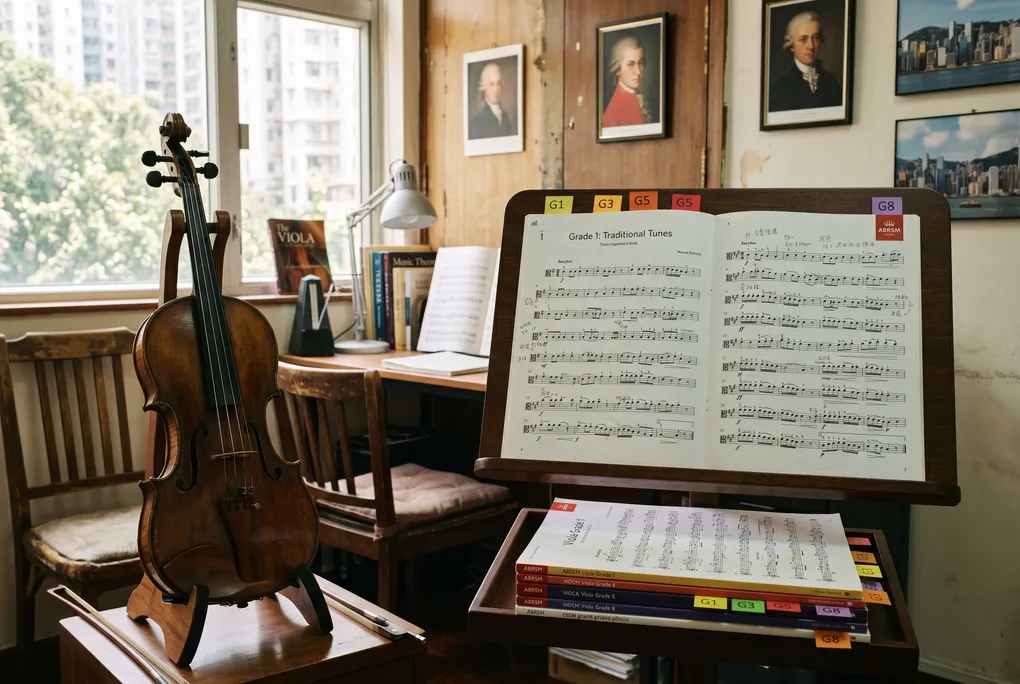
Students choosing ABRSM viola pieces should also think about the technical habits behind the repertoire. Scales, bow control, and slow practice all shape how secure the pieces will feel, so this guide pairs well with ABRSM viola scales and practising slowly without losing the musical line.
For violinists moving into the viola syllabus, the change is not only clef or size. I discuss the shift in sound, bow weight, and musical role in viola for violinists.
In Hong Kong, parents often ask about ABRSM viola repertoire in a very practical tone. Which grade should come next? Is the list manageable? Which pieces are safer, and which ones are more musical? These are sensible questions, but they are not quite the same as asking what a grade is trying to teach.
That difference matters. A repertoire list is not only a set of exam options. It is ABRSM’s way of describing the kind of playing, listening, and musical judgment expected at each stage. As of April 14, 2026, the current official viola Practical Grades specification on ABRSM’s site is still the syllabus “from 2024”, and it remains a useful map if we read it musically rather than strategically.
Before looking at the grades one by one, it helps to remember how ABRSM shapes its lists. List A usually leans toward quicker movement and clearer technical articulation. List B asks for a more singing line and better control of tone. List C is where style opens out: folk material, character pieces, lighter modern writing, and music that tests flexibility more than polish alone. Good exam preparation is not about choosing the “easiest” item from each list. It is about building a set that lets the student sound settled, responsive, and musically awake.
Quick grade map
| Level | What the repertoire is really testing | Useful next step |
|---|---|---|
| Grade 1-2 | Pulse, confidence, basic contrast, first reliable tone | Choose pieces that feel secure rather than impressive |
| Grade 3-4 | Stronger phrase direction, style, and warmer viola sound | Balance one clear dance, one lyrical piece, and one character piece |
| Grade 5 | A threshold grade with more independent style and technique | Check whether shifting, rhythm, and scales are ready together |
| Grade 6-8 | Longer spans, mature sound, and more personal programme choice | Choose repertoire that can grow beyond exam survival |
| Hong Kong exam planning | Live exam, performance grade, accompanist, venue, and cost decisions | Pair repertoire planning with the ABRSM live viola exam guide |
Initial Grade
At Initial Grade, the viola syllabus is still close to the world of first discovery. The repertoire tends to include short dances, folk-like material, and pieces that work comfortably with duet or piano support. The musical demand is not sophistication in the adult sense, but steadiness: pulse, simple shape, clear bow changes, and the first feeling that a phrase has direction.
This is why Initial Grade should not be treated as a miniature Grade 1. It is really about whether the student can keep a reliable musical line going while staying physically comfortable with the instrument. The character of the pieces is often direct and vivid, which means children can sound convincing here without forcing tone or trying to “perform” too much.
Recommendation: choose pieces that help the student feel secure in first position and in basic rhythm. If a child is naturally responsive in ensemble situations, a duet-friendly choice can be a very good beginning because it teaches listening without creating unnecessary pressure.
Grade 1
By Grade 1, the repertoire begins to widen, but it still speaks in short forms. Reels, minuets, rondeau-like writing, early dance styles, hymn-like melodies, and simple character pieces appear regularly. The grade is asking for more than note accuracy. It wants a clearer sense of articulation and style: a dance should move like a dance, and a singing piece should not be played with the same touch as everything else.
This is often the first point where Hong Kong students start to sound either genuinely musical or merely well-drilled. Because the pieces are short, there is nowhere to hide behind length or drama. A Grade 1 performance works when rhythm is alive, intonation is calm, and the student already hears the difference between buoyancy and heaviness.
Recommendation: choose one piece with obvious rhythmic lift, one piece that encourages a singing sound, and one contrasting piece with a clear character. At this level, contrast matters more than ambition. For the exact piece lists and technical work, see the dedicated ABRSM Viola Grade 1 repertoire and scales 2026 guide.
Grade 2
Grade 2 keeps some of the same accessibility, but the musical language becomes a little broader. There is more Baroque and dance-based writing, more need for phrase endings to feel prepared, and a little more responsibility in tone. A student can no longer survive on enthusiasm alone. The repertoire now begins to reveal whether bow distribution, basic tone production, and pulse are becoming dependable habits.
List B at this grade is especially useful. It shows whether the student can sustain a line rather than simply place one note after another. In Hong Kong, where practice time is often squeezed between school and other activities, this is a good grade to resist overloading the programme. Three pieces that can settle properly are almost always better than three pieces that look “advanced” on paper.
Recommendation: build the set around reliability. A neat dance movement, a genuinely lyrical piece, and a character piece with clean rhythm usually make a stronger programme than three extrovert choices competing for attention. For the exact piece lists and technical work, see the dedicated ABRSM Viola Grade 2 repertoire and scales 2026 guide.
Grade 3
Grade 3 is where the repertoire starts to feel less like a string of teaching pieces and more like a first introduction to style. Sonata movements, Classical dances, folk arrangements with stronger identity, and slightly more demanding character pieces begin to sit side by side. The student is expected to shape longer lines, manage clearer contrasts in articulation, and sound more purposeful in phrasing.
This is also the point where many students begin to meet small technical challenges that affect musical confidence: cleaner string crossings, more even bow speed, and better control when a phrase needs space instead of pressure. If those things are unstable, the performance quickly feels busy. If they are secure, Grade 3 can sound unexpectedly elegant.
Recommendation: choose repertoire that helps the student sound composed. If shifting and weight are still developing, a well-shaped Classical or early-style movement may show more understanding than a heavier piece that asks for colour the player cannot yet control. For the exact piece lists and technical work, see the dedicated ABRSM Viola Grade 3 repertoire and scales 2026 guide.
Grade 4
Grade 4 marks a clear change of tone. The syllabus now starts to include repertoire that asks for a more recognisable sense of structure: sonata movements, rondos, early concerto writing, and lyrical pieces that need a warmer middle register. The student has to begin hearing the paragraph, not only the sentence. A phrase cannot be shaped bar by bar without regard for where it is going.
This is also one of the first grades where students often benefit from thinking more seriously about sound quality on the C and G strings. The viola starts to ask for a steadier core to the tone, especially when a piece carries weight through inner warmth rather than outward brilliance. In local teaching terms, Grade 4 is often where “playing the notes” stops being enough.
Recommendation: choose one piece with clear formal shape, one piece that truly invites cantabile playing, and one piece that brings personality without rushing. If the player has a naturally dark and settled sound, this is a good point to let that quality show. For the exact piece lists and technical work, see the dedicated ABRSM Viola Grade 4 repertoire and scales 2026 guide.
Grade 5
Grade 5 is a threshold grade. Repertoire now often includes Bach, concerto or concertino-style writing, and more clearly differentiated musical personalities. The pieces may still be manageable in length, but they stop feeling elementary. They ask for style, line, pulse, and a more conscious relationship between the left hand and the bow.
For many viola students, this is the grade where programme-building becomes important. A Bach movement can reveal rhythmic poise and harmonic awareness, but only if the player has enough internal pulse and enough control not to turn it into careful note-reading. A lyrical Romantic piece can be effective, but only if the tone can stay supported without becoming thick. A character piece may sound brilliant in the studio and hurried in the exam if its articulation is not settled.
Recommendation: pick pieces that match the student’s natural strengths honestly. If the player already hears dance rhythm well, a Baroque choice can be very convincing. If tone is the stronger asset, make sure the lyrical piece really allows that to come through. Grade 5 rewards coherence more than showmanship. For the exact piece lists and technical work, see the dedicated ABRSM Viola Grade 5 repertoire and scales 2026 guide.
Grade 6
By Grade 6, the repertoire becomes more openly stylised and more exposed. Baroque sonata movements, concerto movements, études that function as concert pieces, and richer lyrical writing all begin to appear with more authority. Higher positions, longer spans of concentration, and more mature pacing are no longer optional extras. They are part of the grade itself.
This is often a difficult transition for students in Hong Kong who have managed earlier grades through conscientious practice but have not yet developed enough freedom in sound. Grade 6 does not only ask whether the student has learned the notes. It asks whether the player can carry style for the whole piece, keep intonation stable under pressure, and sustain a musical argument rather than a sequence of local corrections.
Recommendation: do not choose a technically glittering piece unless the player can maintain intonation and character at the same time. A poised sonata movement, a sincere lyrical work, and a vividly contrasted third piece often make a more persuasive programme than three ambitious choices. For the exact piece lists and technical work, see the dedicated ABRSM Viola Grade 6 repertoire and scales 2026 guide.
Grade 7
Grade 7 repertoire begins to feel genuinely pre-professional in temperament, even when the pieces remain within exam length. Bach suite movements, substantial sonata writing, variation forms, and concert études ask for musical authority. The student needs not only technical command but also a stronger sense of rhetoric: where the music speaks, where it withdraws, and how tension is built across a larger span.
At this stage, repertoire choice becomes more personal. Some players sound at home in contrapuntal or dance-derived writing because their timing is naturally organised. Others communicate more easily through warmer, broader phrasing. The exam does not demand a single kind of violist, but it does expect conviction. A Grade 7 programme should sound as though the player believes in the language of each piece.
Recommendation: choose repertoire that allows the student to sound authoritative rather than merely hard-working. If projection, articulation, and inner pulse are already strong, more extrovert writing can work well. If not, an elegant programme with cleaner style may score more convincingly than a heavier one that never fully settles. For the exact piece lists and technical work, see the dedicated ABRSM Viola Grade 7 repertoire and scales 2026 guide.
Grade 8
Grade 8 is not simply “Grade 7 but harder”. The repertoire feels more complete in scale and responsibility. Bach, concerto finales and rondos, Classical sonata writing, and unaccompanied repertoire all ask for independence. The player must sustain shape over longer spans, control colour with more refinement, and present a clearer artistic point of view.
This is the grade where many students discover that contrast is not only about tempo. A successful Grade 8 programme needs different kinds of speech: one piece that shows architecture, one that shows breadth of line, and one that shows character or individuality. In Hong Kong, where students often prepare alongside DSE, IB, school orchestra work, and limited accompanist rehearsal time, choosing a programme that can mature consistently is often wiser than choosing the grandest-looking set.
Recommendation: build the programme around one central piece the student can really inhabit. Then choose the other two for contrast, not for prestige. If a candidate cannot yet carry Bach or unaccompanied writing with enough inner pulse, that weakness will be heard immediately. At Grade 8, maturity of choice is part of the performance. For the exact piece lists and technical work, see the dedicated ABRSM Viola Grade 8 repertoire and scales 2026 guide.
What matters more than the label
The most helpful way to read the ABRSM viola syllabus is not to ask which grade contains the “best” pieces. Every grade contains useful music if it is taught and chosen well. The more important question is what kind of musician each grade is trying to form.
At the lower grades, the repertoire asks for pulse, comfort, and the beginnings of style. In the middle grades, it asks for phrase, tone, and a steadier musical line. In the upper grades, it asks for proportion, authority, and a sound-world the player can sustain. That is a sensible progression, and it is why repertoire choice should never be reduced to difficulty alone.
If I were advising a viola student or parent in Hong Kong, I would keep one principle in view: choose the grade you can grow into, and choose the pieces that let the player sound more like a musician, not more like a survivor. Exams are clearer, calmer, and usually more successful when the repertoire fits the person playing it.