DipABRSM Viola Guide: First Diploma After Grade 8
How to plan a DipABRSM viola recital, Programme Notes, Viva Voce and Quick Study using the ABRSM performance diploma syllabus.
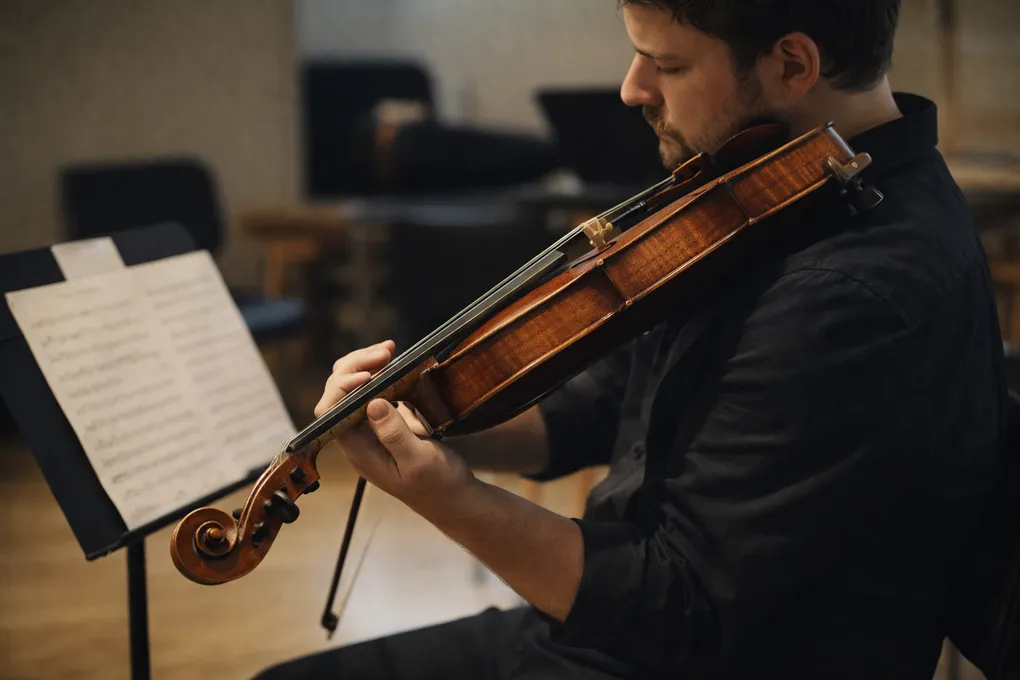
DipABRSM viola is the natural first diploma after Grade 8 for many players. It asks for more than advanced pieces. The candidate has to build a recital, write Programme Notes, discuss the music in the Viva Voce and respond to a Quick Study with musical calm.
In the ABRSM Performance Diploma Syllabus 2022, DipABRSM Music Performance includes a recital of about 35 minutes, Programme Notes of about 1,100 words, a Viva Voce and a Quick Study. The usual prerequisite is ABRSM Grade 8 Practical or Performance in the instrument, or an accepted substitution.
For the full viola route, start with the ABRSM viola diploma exam hub.
What DipABRSM viola is testing
| Area | What matters |
|---|---|
| Recital | Secure playing, convincing tone and a balanced programme |
| Programme Notes | Clear, audience-facing writing about the chosen works |
| Viva Voce | Understanding of style, structure, context and performance choices |
| Quick Study | Reliable reading, pulse and tone under pressure |
The biggest change from Grade 8 is ownership. A Grade 8 candidate follows a defined exam menu. A DipABRSM violist has to shape a 35-minute recital that feels coherent.
Repertoire direction
The DipABRSM viola list gives a broad palette: Bach cello suite movements transcribed for viola, Bach viola da gamba sonata movements, Berkeley, Blake, Bloch, Brahms, Britten, Bruch, Campagnoli, Dittersdorf, Handel, Hindemith, Hoffmeister, Holst, Hummel, Jacob, Kodaly, Kreutzer, Maconchy, Mazas, Milhaud, Rawsthorne, Reger, Rivier, Schubert, Schumann, Stamitz, Steptoe, Telemann, Vaughan Williams, Vivaldi and Weber.
That variety is useful, but the programme must avoid sounding scattered. Viola recital planning often works best when the candidate gives the instrument a clear identity: warm lyrical line, articulate Classical style, solo Bach depth, or twentieth-century colour.
DipABRSM viola repertoire choices
| Composer | Repertoire choice |
|---|---|
| M. Arnold | Sonata: 2nd and 3rd movts (Lengnick) |
| J.S. Bach | Cello Suite no.1 in G, BWV 1007: 2nd, 4th and 7th movts, Allemande, Sarabande and Gigue, trans. Forbes (Chester) |
| J.S. Bach | Cello Suite no.3 in C, BWV 1009: 3rd and 4th movts, Courante and Sarabande, trans. Forbes (Chester) |
| J.S. Bach | Cello Suite no.5 in C minor, BWV 1011: 3rd, 4th and 7th movts, Courante, Sarabande and Gigue, trans. Forbes (Chester) |
| J.S. Bach | Any three movements from one of the 3 Viola da Gamba Sonatas: no.1 in G, BWV 1027; no.2 in D, BWV 1028; no.3 in G minor, BWV 1029 (Barenreiter BA 5186) |
| L. Berkeley | Sonata in D minor, Op.22: 1st movt (Chester) |
| Howard Blake | Prelude for solo viola from Benedictus (Highbridge Music) |
| Bloch | Suite (1919): 1st movt (G. Schirmer) |
| Brahms | Sonata in F minor, Op.120 no.1: any two movts (Wiener Urtext) |
| Brahms | Sonata in E-flat, Op.120 no.2: any two movts (Wiener Urtext) |
| Britten | Elegy for solo viola (Faber) |
| Britten | Lachrymae, Op.48, Reflections on a Song by John Dowland (Boosey & Hawkes) |
| F.X. Brixi | Concerto in C: 1st movt (Schott VAB 5, now out of print) |
| Bruch | Kol Nidrei, Op.47, arr. de Smet (Peters EP 7177a) |
| Campagnoli | Any of the following from 41 Caprices for solo viola, Op.22: nos.1, 9, 12, 15, 17, 36 (Peters EP 2548) |
| Dittersdorf | Sonata in E-flat: complete (IMC 2211) |
| Handel | Sonata in G minor, Op.1 no.6, HWV 364b, arr. Pilkington: complete (Stainer & Bell) |
| Hindemith | Kammermusik no.5, Op.36 no.4: 1st movt (Schott ED 1977) |
| Hindemith | Sonata in F, Op.11 no.4: 1st and 2nd movts (Schott ED 1976) |
| Hoffmeister | Concerto in D: 1st movt (Peters EP 9857) |
| Holst | Lyric Movement (OUP archive-Allegro) |
| Hummel | Sonata in E-flat, Op.5 no.3: complete (Schott VAB 16) |
| G. Jacob | Air and Dance (OUP archive-Allegro) |
| G. Jacob | Concerto no.2 in G: 1st and 2nd movts (Simrock) |
| G. Jacob | Sonatina: 1st movt (Novello) |
| Kodaly | Adagio (Editio Musica Budapest Z.14894) |
| R. Kreutzer | Any one of the following from 42 Studies, trans. Pagels: nos.9, 12, 26, 27, 29 (IMC 0976) |
| Maconchy | Any two of the 5 Sketches for solo viola (Chester) |
| Mazas | Etudes Speciales, Op.36 Book 1: no.18 or no.23 (IMC 1091) |
| Milhaud | La Californienne and The Wisconsonian, or La Bruxelloise and La Parisienne, from Quatre Visages, Op.238 (Heugel) |
| Milhaud | Sonata no.2, Op.244: any two movts (Heugel) |
| Rawsthorne | Sonata: 1st movt (OUP archive-Allegro) |
| Reger | Any one movement from 3 Suites for solo viola, Op.131d: Suite no.1 in G minor 1st or 2nd movt; Suite no.2 in D 1st or 4th movt; Suite no.3 in E minor 2nd or 4th movt (Peters EP 3971) |
| Rivier | Concertino: 1st movt (Salabert) |
| Schubert | Sonata in A minor “Arpeggione”, D.821, arr. Wrochem: 1st movt (Barenreiter BA 5683) |
| Schumann | Marchenbilder, Op.113: nos.1 and 3, or nos.2 and 4 (Peters EP 2372) |
| C. Stamitz | Concerto in D, Op.1: 3rd movt (Peters EP 3816a) |
| Roger Steptoe | Narration, Burlesque and Elegy from 3 Pieces (Stainer & Bell) |
| Telemann | Concerto in G, TWV 51:G9: complete (Barenreiter BA 5878-90) |
| Telemann | Any one Fantasia complete from 12 Fantasias for Unaccompanied Viola, arr. Rood (McGinnis & Marx, currently unavailable) |
| Vaughan Williams | Romance (OUP) |
| Vaughan Williams | Suite for Viola: Group 1 complete (OUP) |
| Vivaldi | Concerto in G for Viola d’Amore, RV 392: complete (Alfred-Kalmus K04298) |
| Weber | Andante e Rondo ungarese, Op.35 (Schott VAB 36) |
| Weber | Variations in C (Peters EP 8321) |
Programme shapes that can work
| Shape | Possible purpose |
|---|---|
| Bach plus sonata plus character work | Shows structure, depth and personality |
| Classical concerto movement plus Romantic sonata movement plus British work | Shows period contrast and viola colour |
| Solo work plus accompanied works | Shows independence without making the whole recital too exposed |
Do not overload the programme with pieces that all live in the same middle-register warmth. The viola can sing beautifully there, but a recital also needs articulation, space, brightness, rhythm and contrast.
Programme Notes
At DipABRSM level, Programme Notes should help an informed general audience hear the music better. For viola candidates, strong topics include the history of transcribed repertoire, the viola’s role between violin and cello, the character of a sonata movement, and how a composer uses register or colour.
Avoid generic biography. A paragraph about Brahms should lead toward the sonata being performed. A paragraph about Bach should help the reader hear dance, texture or line in the chosen movements.
Viva Voce and Quick Study
The Viva Voce is where weak programme understanding becomes visible. A DipABRSM violist should be able to explain why the programme order makes sense, what each work contributes, and how technical choices serve musical character.
Quick Study practice should include alto clef fluency, rhythmic steadiness, clean string crossings and an immediate plan for bow distribution. The aim is not perfection. The aim is a musical first reading with good judgement.
Next step
If the recital already feels comfortable and the candidate is ready for deeper written work, compare this level with LRSM viola.