What ABRSM Exams Can and Cannot Teach
A reflection on the role of ABRSM exams in shaping musicianship, and where they quietly fall short.
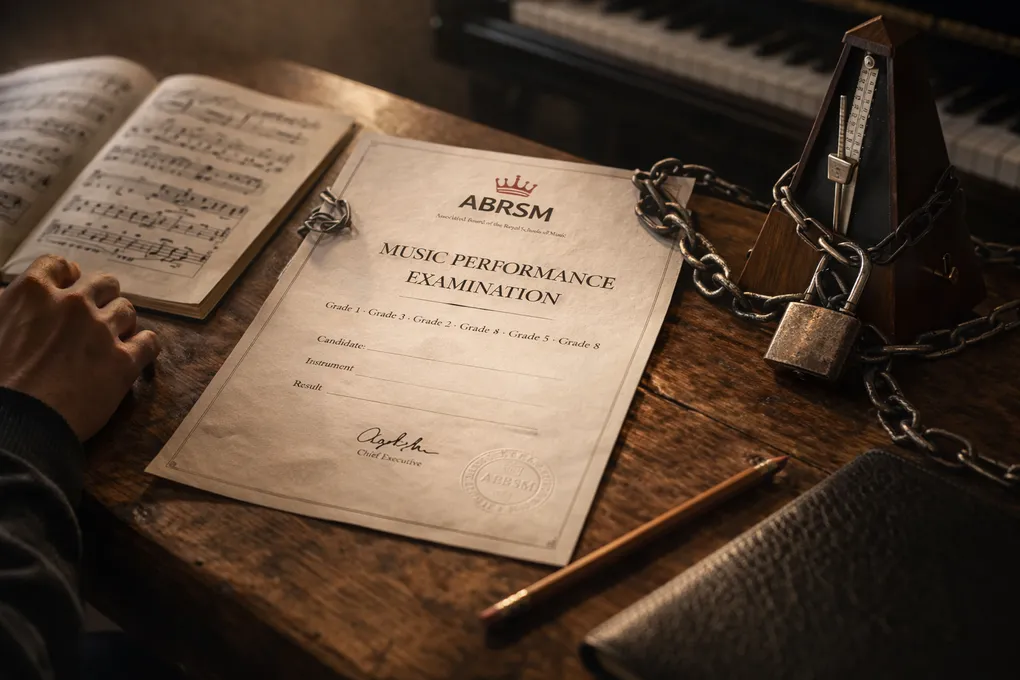
For many students, their first encounter with music is not a piece, a sound, or a moment of curiosity. It is an exam.
ABRSM exams have become a widely accepted structure for music learning. They offer a clear path, defined goals, and a sense of progression that both students and parents can understand. There is comfort in knowing what comes next: Grade 1, Grade 2, all the way up. In a world where learning can feel uncertain, this structure feels reassuring.
But structure, while useful, is not the same as understanding.
This article is the broader philosophical companion to the practical ABRSM guides. For route-specific advice, see ABRSM viola exams in Hong Kong: online or live. For the teaching philosophy behind the critique, see why I teach music first, not exam first.
What the Exam Does Well
It would be unfair to dismiss the ABRSM system entirely. At its best, it provides discipline.
Preparing for an exam teaches students how to work towards a goal. It encourages consistency, attention to detail, and a certain level of accountability. Scales, sight-reading, and aural tests—these are not arbitrary components. They address real aspects of musicianship that students might otherwise neglect.
For some students, the exam also offers motivation. A deadline can focus practice. A certificate can validate effort. For beginners especially, this sense of achievement can be meaningful.
There is also a practical advantage. Exams create a shared language. When someone says they are “Grade 5” or “Grade 8,” it communicates a rough level of ability across different contexts—schools, ensembles, or applications.
These are real benefits, and they should not be ignored.
Where the Focus Shifts
The problem begins when the exam stops being a tool and becomes the purpose.
It is not uncommon to see students approach music as a checklist. Notes must be correct. Tempo must be stable. Dynamics must be observed—at least enough to satisfy the marking criteria. The piece becomes something to pass, rather than something to understand.
In this process, something subtle is lost.
A student may play all the right notes and still not hear the shape of a phrase. They may execute a crescendo without feeling where it leads. They may complete an aural test without ever truly listening.
This is not because the exam demands it. It is because the preparation is often narrowed to what can be assessed quickly and reliably.
Music, however, does not reveal itself that way.
The Quiet Gap
There is a gap between what exams can measure and what music actually is.
Exams reward clarity, accuracy, and control. These are important. But they do not fully capture timing as a living thing, or tone as a form of expression, or silence as part of the phrase. They cannot easily measure how a student listens, reacts, or shapes a line over time.
More importantly, exams rarely ask why.
Why does this phrase expand here?
Why does this harmony feel unstable?
Why does this moment need space?
Without these questions, students can progress through grades while remaining distant from the music itself.
This is the quiet limitation of the system: it can certify progress without guaranteeing depth.
Reframing the Role of Exams
The question, then, is not whether ABRSM exams are good or bad. It is how they are used.
When treated as a framework rather than a destination, exams can support musical growth. Repertoire can be explored beyond the minimum requirement. Scales can be connected to sound, not just speed. Aural skills can become listening, not guessing.
For viola students, that means choosing pieces with musical purpose and practising technical requirements as part of sound. I explore those two practical sides in ABRSM viola repertoire by grade and ABRSM viola scales: how to practise them musically.
This requires a shift in emphasis.
Instead of asking, “Is this ready for the exam?”, a teacher might ask, “What is this piece trying to say?”
Instead of practising for accuracy alone, a student might learn to listen for direction, weight, and colour.
The exam remains, but it no longer defines the learning.
A Different Starting Point
In teaching, I often find that the most important work happens outside the exam syllabus.
Listening to recordings. Singing a phrase before playing it. Slowing down to notice how one note leads to another. These are small actions, but they change how a student relates to sound.
When students begin to hear music as something shaped and intentional, their playing changes—even within the same exam pieces. The notes are no longer isolated tasks. They become part of a larger idea.
Ironically, this often leads to better exam results as well. But that is a by-product, not the goal.
Closing Thought
ABRSM exams are not inherently limiting. They become limiting when they replace musical thinking.
A certificate can mark a stage of development, but it cannot define what it means to be musical. That comes from a different kind of work—slower, less visible, and often harder to measure.
When the exam becomes concrete, the administrative side still matters. Families in Hong Kong can use the ABRSM exam procedure guide for the practical steps while keeping the musical purpose clear.
If there is one thing worth holding onto, it is this: exams can organise learning, but they should never be mistaken for music itself.