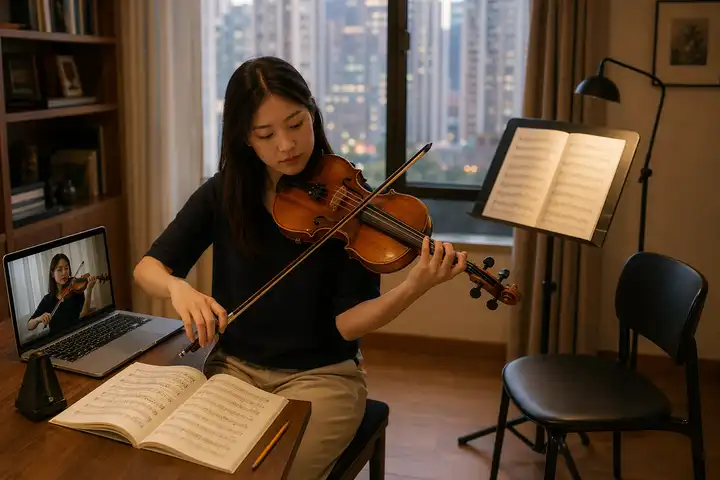
Why Learn Viola in Hong Kong
In Hong Kong, the viola is often treated as a second choice or a supporting role. In practice, it offers its own voice and suits a musical culture shaped by ensemble playing and careful listening.
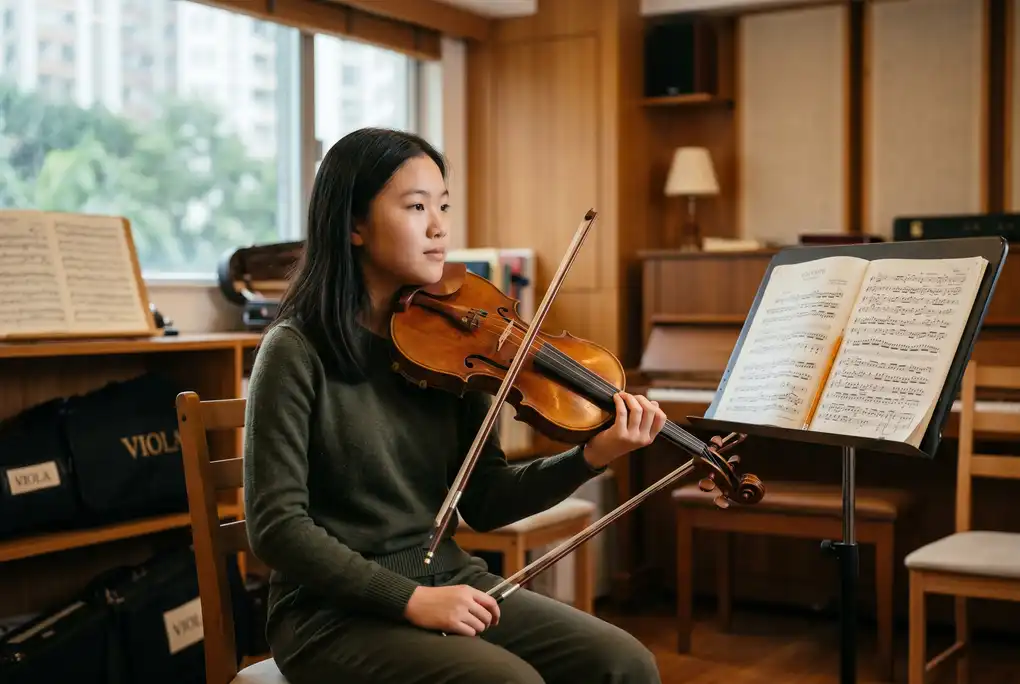
In Hong Kong, conversations about learning an instrument often become practical very quickly. Piano and violin come up first. Then comes the question of exams, progression, and how clearly a path can be mapped out. The viola, by contrast, is rarely the instrument people mention at the beginning. It is sometimes treated as something to think about later, sometimes as an instrument for students who moved across from violin, and sometimes as a choice that already sounds a little apologetic.
I have always felt that this misunderstands the viola, but also music study itself. The viola is not a lesser violin, and it is not only a backup option for a certain type of student. In Hong Kong especially, it has a very real and very moving place. It offers not only a different sound, but a different way of listening, a different role inside ensemble playing, and perhaps even a different pace of musical thinking.
For students and parents who are still comparing the two instruments, I have written separately about the practical and musical differences between viola and violin.
For violinists who are thinking of switching rather than starting from scratch, the more specific next step is viola for violinists.
The viola is not a step down
The stereotype most people know is simple: the viola is for those who were not quite good enough at violin. It is one of those ideas that has circulated for so long that many people hear it without pausing to ask whether it is true.
But anyone who has really listened to the viola, or spent time playing it, knows that the reality is different. The instrument’s appeal does not come only from being lower or darker in colour. It comes from the fact that it lives differently inside music. It belongs to the inner voice. It is deeply connected to harmony, colour, breathing, and the movement between parts. It may not always stand in front, but that does not make it secondary. Very often, what gives music its weight, direction, and inner tension is precisely the middle layer of sound.
Nor does learning the viola mean learning a reduced version of violin technique. The instrument asks for its own sense of weight, support in the bow, shape in the left hand, and breathing in the phrase. It asks the player to care more about the density of sound, to hear harmony as it shifts, and to know when to bring a line forward and when to yield. That is not stepping back. It is stepping into a different musical position altogether.
Hong Kong’s musical environment actually suits the viola
One clear feature of music education in Hong Kong is that many students enter ensemble settings quite early. School orchestras, string groups, youth ensembles, and chamber classes are familiar parts of musical life for many young players. In that kind of environment, the importance of the viola is not abstract at all. If an ensemble has only top and bottom, with nothing truly alive in the middle, the whole sound becomes thin very quickly.
That is why the viola has such practical value here. Not because it is “less popular so there is more room”, but because it allows students to enter real musical responsibility early on. A violist cannot think only about whether their own part feels comfortable or whether their own sound is prominent enough. They have to hear the parts above and below, sense when harmony is tightening, support the line when it matters, and keep rhythmic life steady from within. Those are important skills for any musician, and Hong Kong, with its relatively dense ensemble culture, is well suited to cultivating them.
If a student genuinely enjoys playing with others more than standing alone at the front, the viola can be a very natural choice. For some students who are sensitive in temperament, alert in the ear, and willing to listen carefully to relationships rather than surfaces, the viola may actually help them find their musical voice sooner rather than later.
This is also why I do not think ensemble work has to wait until a child is very advanced. Simple duet and group playing can begin earlier than many families expect, which I explore in when a child should start ensemble training.
A few misconceptions that appear often in Hong Kong
Misconception one: the viola only makes sense as a strategic choice
Some parents or students approach the instrument by asking whether it is worth considering simply because fewer people choose it. That sounds realistic on the surface, but if it becomes the only reason, the study rarely grows deep roots. Any instrument becomes thin when it is treated merely as a way of filling a space.
For younger beginners, the better first question is often not whether viola is strategic, but whether the student is physically and musically ready to begin. I discuss that more fully in when to start learning viola.
The better way to think about it is that the viola does indeed have room, but that room exists because music genuinely needs this sound. If a student truly responds to its warm, dark, inward tone, and enjoys the work of building balance within ensemble playing, then the viola is not simply a convenient option. It is a fitting one.
Misconception two: the viola is dull because it does not carry melody
This misconception reveals how often people judge music only by what immediately catches the ear. The viola is not always in the foreground, but it is certainly not without melody. More importantly, even when it is not carrying the main tune, it often shapes the inner direction of the music. It holds the colour of the harmony together, links voices, and gives the whole texture coherence.
If someone is used only to chasing the brightest and highest line, they may not fall in love with the viola straight away. But once they begin to hear inner voices, tension, and changes of colour more closely, the viola becomes deeply rewarding. It does not attract attention in a flashy way. It draws the listener closer, more slowly.
Misconception three: Hong Kong is too results-driven for the viola to be worth serious investment
This thought sounds local because it is. Many families in Hong Kong naturally look for a path that appears structured, visible, and measurable. Since the viola is less mainstream than piano or violin, it can seem harder to justify at first.
Yet precisely because local learning culture can become too tightly focused on outcomes, the viola can be a healthy counterweight. It asks a student to shift attention away from “am I the most noticeable” toward “am I really hearing the whole”. This is not an argument against progress, nor against exams. It is simply a reminder that musicianship should not be measured only by how exposed a player appears to be. To sustain texture, rhythm, direction, and harmonic awareness from the inner part is a serious and lasting kind of basic training.
Learning the viola often means learning a different kind of ear
For me, one of the most valuable things about the viola is that it changes how a person listens.
That can be just as true for adults as for children. Adult learners often bring patience, listening experience, and self-awareness into lessons, even if they worry that they have started too late. I wrote a fuller guide to learning viola as an adult for that situation.
Violinists naturally learn to follow the melodic line first. Cellists often feel the relationship between support and singing in a more direct way. Violists, however, spend much of their time in the space between those functions. They have to hear the foreground without listening only to the foreground. They have to support the harmony without becoming passive. They need to know when to speak and when to recede. That position develops a special sensitivity to balance, blend, and timing.
And in a city as fast-moving and sonically crowded as Hong Kong, there is something meaningful about learning from that middle position. It does not teach a student to become timid. It teaches a steadier kind of confidence, one that does not constantly need to prove itself. Over time, one learns that not every moment needs to be the loudest or the most visible. Some of the most mature musicianship lies in knowing how to support another person’s phrase and how to make the whole sound better.
Choosing the viola should not require an apology
If someone asks why a student should learn viola in Hong Kong, my answer would not begin with the fact that it is uncommon, nor with the idea that it offers an easier route. The real reason is much simpler: the viola is worth choosing in its own right.
Once the decision becomes practical, instrument size matters a great deal, especially for children. A viola that is too large can make posture, shifting, and bow control harder than they need to be, so parents may want to read what size viola is right for a child.
It has a clear voice and a clear character. It suits students who want more than outward effect and who are drawn instead to texture, harmony, ensemble, and inward musical thought. It also reminds us that the most important role in music is not always the most obvious one.
In a place where comparison, ranking, and forward pressure can arrive very early, learning the viola can be a useful kind of counter-training. It does not ask a student to lower standards. It asks them to place those standards somewhere deeper: are you listening, are you understanding, and are you helping the whole become more complete.
If the answer is yes, then the viola was never really a second choice. It was simply not seen early enough.
![[Guide] Choosing a Music University or Conservatory in Hong Kong](/_image?href=%2F_astro%2Fhero.CTNaL-Ex.png&w=720&h=480&q=mid&f=webp&fit=cover&background=%23f7f0e5)
![[Explainer] Why School Instrument Interest Classes Often Disappoint](/_image?href=%2F_astro%2Fhero.CdkZDsCY.png&w=720&h=480&q=mid&f=webp&fit=cover&background=%23f7f0e5)