Learning Viola As An Adult
Learning viola as an adult in Hong Kong: how to begin steadily, handle self-consciousness and build a meaningful musical habit.
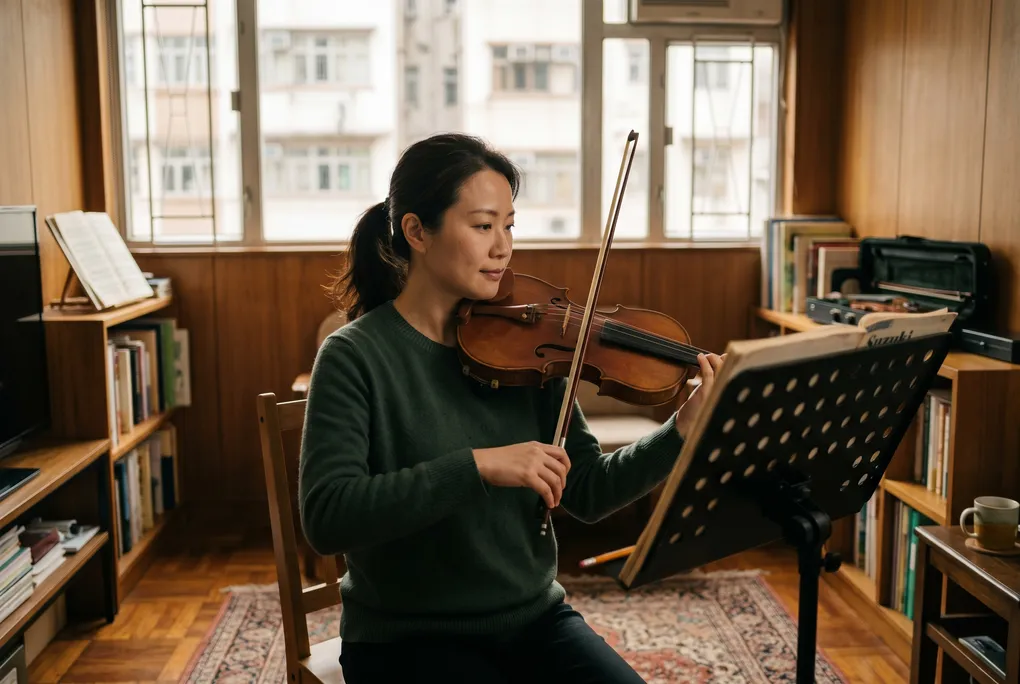
Adults who ask about learning the viola often speak in an apologetic tone before they have even held the instrument. They say they are starting late. They say they have no background. They say work is busy, the flat is small, the neighbours are close, and perhaps they should have done this twenty years ago. In Hong Kong especially, where daily life can become tightly scheduled and quietly competitive, many adults have learned to talk themselves out of beginning before music has had any chance to answer.
I do not think the real problem is that adults cannot learn the viola. The real problem is that too many adults have absorbed a set of misconceptions about what music study is supposed to look like. If one imagines that learning an instrument only counts when it begins in childhood, progresses in a straight line, and leads quickly to visible results, then of course adult beginners will feel out of place. But that picture was too narrow to begin with.
If you are still deciding whether the viola itself is the right instrument, start with the broader case for why learning viola in Hong Kong can make sense and the practical differences between viola and violin.
The first misconception: music belongs to children
One of the strongest stereotypes around adult learning is that serious musical study belongs to the young, while adults are allowed only casual interest. Children, we assume, are still “in training”; adults are already formed. If an adult begins an instrument, it is treated as charming at best, or unrealistic at worst.
This is a poor way to understand either adulthood or music. Adults do not stop learning once school ends. They simply learn under different conditions. An adult may have less spare time, but often brings more patience, clearer intention, and a stronger capacity for reflection. A child can absorb quickly; an adult can listen with deliberateness. A child may learn because the lesson has been arranged; an adult often learns because something in the sound has genuinely called them.
That difference matters. Adult study may not resemble the pace of a specialist training track, but it can be deeply serious all the same. Seriousness is not measured only by age of entry. It is measured by attention, regular return, and the willingness to stay with something long enough for it to change you.
The second misconception: if you are not aiming at a professional standard, there is no point
Hong Kong adults are particularly familiar with this way of thinking. Much of life here is organised around efficiency, performance, and visible benchmarks. It becomes easy to feel that if an activity does not lead to a credential, a competition result, or a polished public outcome, then it is indulgent or secondary.
But the viola does not become meaningful only when it leads to professional identity. For many adults, the instrument offers something rarer and more needed: a disciplined form of listening inside a life that has become noisy. After a day of meetings, messages, commuting, and constant outward response, the act of drawing one attentive note can feel less like a hobby and more like a way of returning to oneself.
This does not make adult learning small. It makes it honest. Not every musical life is meant to become a conservatoire biography. Some are meant to become steadier, richer, and more inwardly alive. There is no shame in that. In fact, many adults learn better once they stop trying to justify music by external prestige.
The third misconception: the viola is only a second choice
The viola carries its own stereotype even before adulthood enters the conversation. It is still too often described as the instrument people turn to after violin, or the instrument for those who do not quite fit the brighter and more obvious path. Adults can feel this doubly: late to music, and then choosing the instrument that popular culture has taught them to treat as a joke.
But the viola has always deserved better than its caricature. Its voice is not weak or apologetic. It is inward, warm, tensile, and harmonically alive. It asks for a different kind of ear, one that cares about colour, weight, blend, and the movement within the middle of the texture. For many adults, that is precisely why it resonates. They are not necessarily looking for the most public voice in the room. They are looking for a sound with depth, grain, and room for thought.
An adult who chooses the viola is not choosing less. Very often they are choosing more carefully.
Adult beginners do not need to copy a child’s path
Another unhelpful habit is to judge adult progress by childhood models. Adults compare themselves to children who began at five, to teenagers preparing exams, or to conservatoire students who have already spent years building technique. This almost always produces discouragement, because the comparison is false from the start.
An adult beginner does not need to become a delayed version of someone else’s childhood. The task is not to recreate the timeline that was missed. The task is to begin truthfully from here.
That beginning may be modest. In Hong Kong, it may mean finding practice time before work, or after dinner, or in short but regular pockets between obligations. It may mean learning how to practise carefully in a small apartment without forcing the sound. It may mean accepting that progress comes in layers rather than dramatic leaps. None of this makes the work less real. It simply makes it adult.
In some ways, adults are especially well placed to understand what the viola asks for. The instrument rarely rewards hurry. It does not offer instant brilliance on demand. It asks for balance, for tone built from the body rather than from tension, and for a willingness to listen below the surface. Those are not childish skills. They are mature ones.
The physical side still matters, though. Adult beginners should choose an instrument that supports the body rather than flatters the idea of a “full size” viola, which is why I wrote a separate guide to choosing a viola size for adults.
Encouragement should be more truthful than flattery
I do not think adults need the empty reassurance that everything will be easy, or that beginning later makes no difference at all. Starting the viola as an adult is not effortless. The body has habits. Time is limited. Intonation, bow control, and physical setup all require care. Progress can feel slow, especially at first.
But none of that leads to the conclusion people often fear. Difficulty does not mean impossibility. A slower beginning does not mean a lesser one. The point is not that adults will learn exactly as children do. The point is that they can still learn musically, intelligently, and with real satisfaction.
Many adults actually value the process more because they chose it freely. They notice small gains. They hear the difference between noise and tone. They become more patient with repetition. They begin to understand that musicianship is not a theatrical identity but a way of attending. This is not a consolation prize. It is one of the real gifts of learning later.
For busy adults, lesson format also affects whether the habit can survive. I compare the trade-offs in online vs in-person music lessons in Hong Kong.
It is not too late to enter the sound
For an adult in Hong Kong, beginning the viola may look impractical from the outside. The week is full. The city is fast. There are easier ways to spend an evening. Yet these are also reasons the instrument can matter. To make room for careful listening inside a crowded life is not self-indulgence. It is a way of resisting the flattening effect of constant urgency.
The practical question of fees is real too, especially if lessons need to fit around work and travel. For that side of the decision, see how much music lessons cost in Hong Kong.
If you are ready to ask what a first step might look like in practice, I describe my approach to adult beginners on the private viola lessons in Hong Kong page.
So if someone is drawn to the viola but feels embarrassed by their age, their pace, or their inexperience, I would suggest a simpler standard. Not “am I early enough?” Not “will I become impressive enough?” Only this: does this sound feel worth returning to, even slowly?
If the answer is yes, that is already enough reason to begin. Adult learning does not need to imitate youth in order to be real. It only needs honesty, steadiness, and the courage to start before one feels fully entitled.