When Should You Start Learning Viola?
When to start learning viola in Hong Kong, including readiness, body size, attention, listening and support for a good beginning.
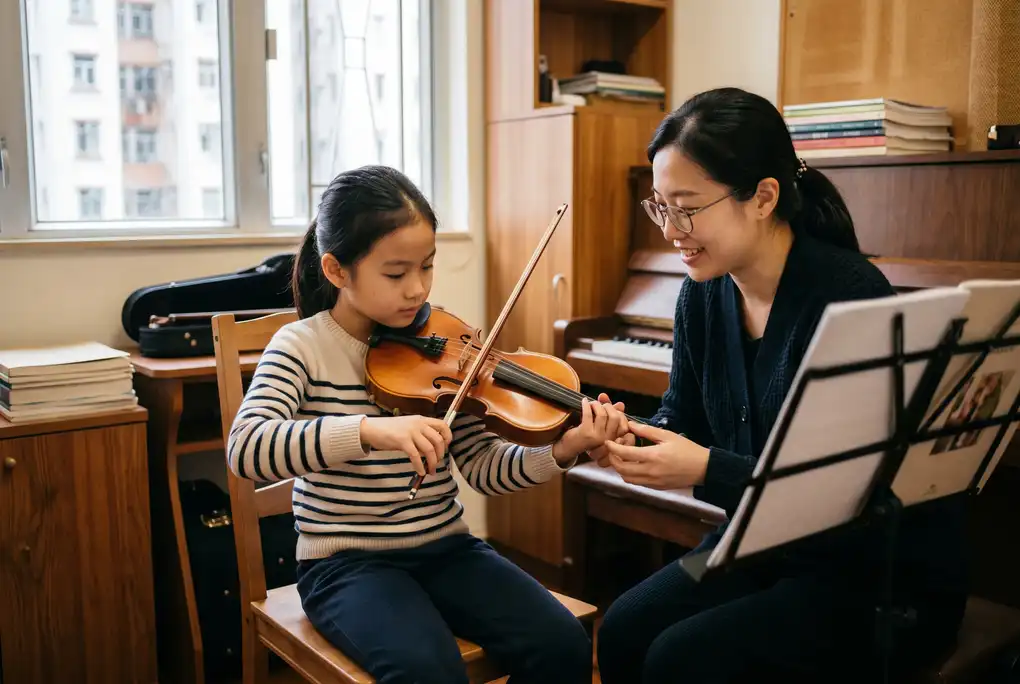
When people ask when a child should start viola, they are often asking a more anxious question underneath: if we do not start now, will we already be late? I do not think the instrument should be approached in that spirit. The viola does reward an early beginning, but it does not reward panic. The better question is whether the student is ready to begin musically and physically, and whether the local environment can support that beginning well.
Once a child does begin, many early difficulties are normal rather than alarming. I discuss the most common first-stage issues in common beginner viola problems.
Early helps, but early is not everything
Research on musical training does suggest that starting in early childhood can matter. Jennifer A. Bailey and Virginia B. Penhune found evidence consistent with a sensitive period for musical training, with advantages appearing especially among musicians who began before about age seven in rhythm-synchronisation tasks. At the same time, Laura W. Wesseldijk and colleagues argue that the relationship is more complicated than a simple earlier-is-always-better story: total practice, family environment, and shared traits also help explain why early starters often do well. That matters because it replaces panic with perspective. Starting early can help, but starting early alone does not build a musician.
So when is a good time to begin viola?
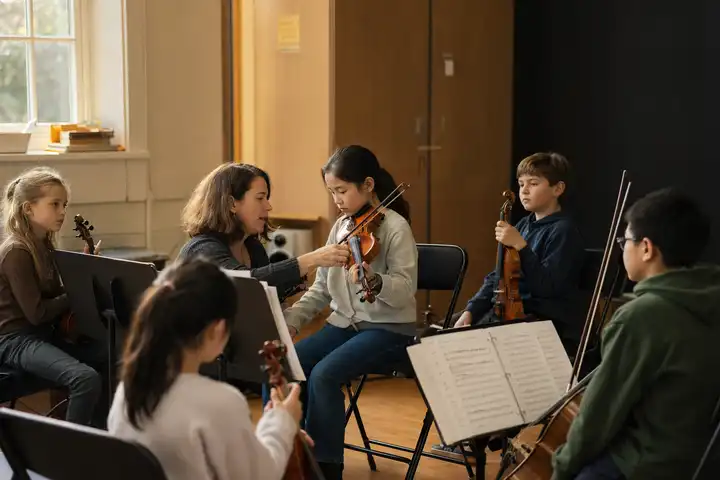
As a practical inference from pedagogy, instrument setup, and child development rather than a fixed institutional rule, many children seem ready to begin serious viola study somewhere around primary-school age, often roughly six to nine, if there is a properly sized instrument and a teacher who knows how to set it up well. Some children can begin earlier. The Verbier Festival biography of Tabea Zimmermann says that she began learning the viola at the age of three. The Verbier Festival biography of Jaren Ziegler says that he began playing the viola at six and later became the first violist to win the BBC Young Musician Strings Final.
Those stories matter not because every child should copy them, but because they show that early direct viola study is entirely possible when the teaching, setup, and child are well matched.
At the same time, some students benefit from beginning on violin first and moving to viola later, especially if size, shoulder width, or left-hand comfort make the viola awkward at the start. That is not failure. It is simply one route among several.
What readiness looks like
Rather than asking only for a birthday, I would look for a few practical signs. A student is often ready when they can hold a suitably sized instrument without strain, follow short instructions calmly, repeat a short practice routine without collapsing, and show genuine interest in sound rather than only in the idea of having an extra activity. On viola in particular, I would add one more point: the student should show some patience with slower, deeper work on tone. The instrument rarely flatters impatience.
That readiness also depends on realistic home practice. For parents trying to judge the daily commitment, I have written about how much a child should practise music each day.
Physical fit matters just as much as age. Before renting or buying, parents should also check what size viola is right for a child.
This is also why I would not say that a teenager is too late. A ten-year-old, a twelve-year-old, even an adult beginner can still make very meaningful progress on viola. If the real question is whether a person can become musical, competent, and deeply fulfilled on the instrument, the answer is plainly yes. If the question is whether every later starter can become Tabea Zimmermann, the answer is of course no, but that would also be the wrong standard for most children.
Three misconceptions that create unnecessary pressure
Misconception one: if you do not start by five, you have already missed the chance
This is probably the most damaging myth. Early training can offer advantages, but the research does not support a crude cliff-edge view in which later starters are finished before they begin. Musical growth depends on continuity, listening, teaching quality, and accumulated work, not only on age of onset.
Misconception two: viola must always come after violin
Some violists do begin that way, and it can work beautifully. But it is not compulsory. Zimmermann’s biography is one reminder that direct viola study can begin very early, and Ziegler’s career offers a more recent example. A well-sized instrument and good technical guidance matter more than obedience to a fixed sequence.
Misconception three: Hong Kong is too exam-driven for viola to make sense early
Hong Kong can indeed feel results-driven, but that is only part of the picture. As of 14 April 2026, the HKEAA ABRSM page lists viola among the subjects offered in Hong Kong and shows both face-to-face Practical Grades and on-demand digital Performance Grades. The Hong Kong Schools Music Festival 2026 page, together with the festival’s syllabus search, shows an active current festival structure with dedicated string classes. The HKAPA School of Music programme page and its Junior Music Programme page show that Hong Kong also has an early-to-advanced training route for serious young musicians.
Taken together, these sources do not mean access is equal in every district, and they do not mean viola is as socially visible as piano or violin. But they do show that viola learning in Hong Kong is not marginal or imaginary. There is a route, and it is real.
What this means for Hong Kong families
For families in Hong Kong, I think the best answer is simple. Start viola early if the child is physically comfortable, aurally curious, and emotionally ready for regular work. Do not start early merely because you are afraid of being late. If the child is not ready at five, six, or seven, it is usually better to wait a little than to force a tense and joyless beginning. A good start at the right moment is more valuable than a prestigious start at the wrong one.
The viola asks for patience, inner hearing, and a willingness to care about the middle of the texture, not only the surface. In Hong Kong, where many children meet ensemble playing and exam structures quite early, that can actually be one of the instrument’s strengths. The question is not only how soon a child can begin. It is when they can begin in a way that lets the instrument become a real voice.
Once that beginning is settled, the next related question is often when a child should start ensemble training.
For many children, that answer comes earlier than people assume. For others, it comes later. The important thing is not to confuse timing with worth.
Sources and further reading
- Jennifer A. Bailey and Virginia B. Penhune, “The relationship between the age of onset of musical training and rhythm synchronization performance: validation of sensitive period effects”.
- Laura W. Wesseldijk, Miriam A. Mosing, and Fredrik Ullen, “Why Is an Early Start of Training Related to Musical Skills in Adulthood? A Genetically Informative Study”.
- Tabea Zimmermann biography, Verbier Festival.
- Jaren Ziegler biography, Verbier Festival.
- HKEAA: ABRSM Practical Grade and Performance Grade Exams.
- Hong Kong Schools Music Festival (2026).
- HKSMSA Music Festival syllabus search.
- HKAPA School of Music programmes.
- HKAPA Junior Music Programme.