Viola vs Violin: What Is the Difference?
The viola and violin look closely related, but they differ in tuning, sound, technique, ensemble role, and learning experience.
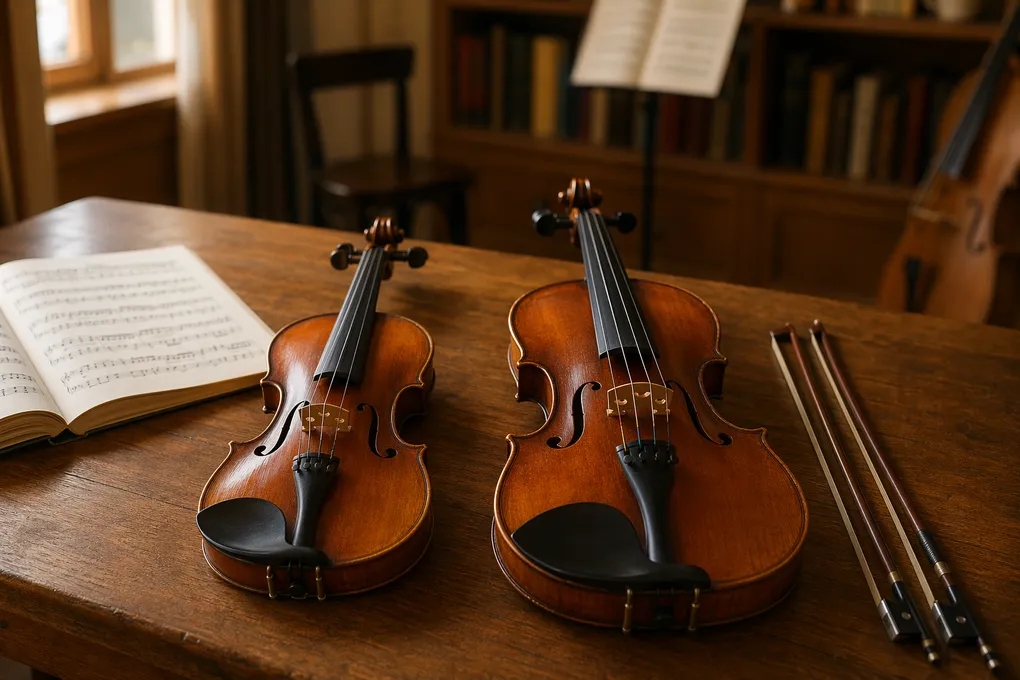
The viola and violin are easy to confuse at first glance. Both are played under the chin, both use a bow, and both belong to the same violin family. For many beginners, the first explanation sounds simple enough: the viola is a little bigger than the violin, and it plays a little lower.
That is true, but it only reaches the surface. The real difference is not only size or pitch. The two instruments have different centers of gravity: in sound, in physical feeling, in ensemble responsibility, and in the way they teach a musician to listen. The viola is not a secondary violin, and the violin is not simply a brighter viola. They are close relatives, but they are not interchangeable.
If you already play violin and are thinking about moving across, I have a more focused guide to what changes when violinists switch to viola.
| Difference | Violin | Viola |
|---|---|---|
| Body size | Smaller, with a more standardized adult size | Larger, with more variation in adult sizes |
| Tuning | G, D, A, E | C, G, D, A |
| Sound center | Higher, brighter, more focused | Lower, warmer, fuller |
| Usual clef | Treble clef | Alto clef, with treble clef when needed |
| Common ensemble role | Melody, leading line, upper voice | Inner voice, harmony, color, connection |
| Technical feel | Quicker response, lines project easily | More bow weight, patience, and resonance control |
Size and Tuning
The violin has a relatively standardized adult size. A full-size violin is normally called a 4/4 violin. The viola is less fixed. Many adult violas sit somewhere around 15 to 16.5 inches in body length, though smaller and larger instruments are also used. This variation is not a flaw in the viola. It comes from the instrument’s need to balance sound against human reach.
Because size affects technique so directly, parents may want the separate guide to choosing a viola size for a child, while older students can read choosing a viola size for adults.
The viola is tuned a fifth lower than the violin. From low to high, the violin is tuned G, D, A, E. The viola is tuned C, G, D, A. In other words, the viola gives up the violin’s high E string and gains a lower C string. That C string is central to the viola’s identity. It gives the instrument its darker, deeper, more middle-voiced color.
At the same time, the viola still has to be held on the shoulder. It cannot simply be enlarged in perfect proportion to the violin. If it becomes too large, left-hand reach, shifting, holding the instrument, and bow control become difficult. If it is too small, the lower strings may lose depth. This is why choosing a viola size is usually more personal than choosing a violin size.
Sound: Brightness and Warmth
The violin usually sounds bright, clear, and focused. It can project easily in an ensemble, especially in the upper register. Its response is agile, and composers often give it melody, brilliant passagework, and high singing lines.
The viola’s sound is generally warmer, darker, and more textured. It may not flash as quickly as the violin, but a good viola sound has an inward density that is deeply compelling. It can feel closer to a human middle voice: less eager to stand in front, but able to give harmony weight and make the inner life of the music feel alive.
If we wanted a simple image, the violin often feels like light, while the viola feels like warmth in shadow. That does not mean the violin can only be bright, or the viola can only be inward. Both instruments have a wide expressive range. Their natural centers, though, are different.
Technique: Similar Motions, Different Weight
Because the playing position looks similar, people sometimes assume the viola is only a larger violin. In practice, viola technique is not a simplified version of violin technique.
The left hand feels different first. The viola’s body is larger and its string length is usually longer, so the spaces between the fingers are wider than on violin. For beginners, this affects hand shape, intonation, and shifting. A violist needs an open but relaxed left-hand frame, not a hand that squeezes or twists to reach notes.
The bow arm also works differently. Viola strings are thicker and often respond a little more slowly. To open the sound fully, the bow needs a more mature sense of weight. Too little weight, and the sound floats on the surface. Too much pressure, and the resonance closes down. The viola trains a player to hear the difference between supported weight and forced pressure. It is a small distinction, but it changes the whole color of the instrument.
The violin also requires refined bow control, of course. The difference is that the violin often speaks more quickly and shows its outline more immediately. The viola often asks the player to wait a fraction longer, allowing the string, the instrument, and the room to speak together. That patience is part of its technical beauty.
Clef: The Viola Has Its Own Language
The violin mostly reads treble clef. The viola usually reads alto clef, a form of C clef where middle C sits on the middle line of the staff. For many violinists moving to viola, learning alto clef is one of the first practical adjustments.
This is more than a reading habit. It reflects where the viola lives. The viola does not usually spend its life at the very top of the texture. It sits in the middle, above the cello and below the violin. Alto clef places the viola’s regular range comfortably on the staff without constant ledger lines.
When a violist becomes fluent in alto clef, the instrument begins to feel less like a borrowed violin world and more like a language of its own. That detail may seem technical, but it matters.
Ensemble Role: Leading and Connecting
In orchestras and string ensembles, violins are often divided into first and second violin sections. First violins frequently carry the main melody or the highest line. Second violins move between melody, rhythm, and inner-voice work. Because of the violin’s pitch and projection, it naturally draws the listener’s attention.
The viola often carries the middle layer. It may play harmony, counterpoint, rhythmic figures, color, or suddenly take over a line of great expressive importance. Its job is not always to be heard the most, but to make the whole sound more complete. Without the viola, the music may not feel empty immediately, but it often becomes thinner, harder, and less connected in the middle.
In chamber music, this becomes even clearer. In a string quartet, the violin and viola are not arranged as leader and subordinate. They are different voices in conversation. The violin may introduce a melody; the viola may shift the harmony’s color or connect the distance between cello and violin. A strong violist usually has a particularly developed ear, because the part requires constant awareness of the line above, the bass below, and the relationship between them.
Which One Should You Learn?
If a student loves a bright, direct, agile sound and enjoys the feeling of carrying melody in the foreground, the violin may be the more natural choice. Violin teachers, method books, exam material, and ensemble opportunities are widely available, and the instrument has an enormous solo and chamber repertoire.
If a student is drawn to a deeper, warmer, more inward sound, and enjoys ensemble playing or listening to how voices relate to one another, the viola may be a very good fit. Viola students often learn early to hear harmony, balance, and the way their sound affects the whole group. That is excellent training for musical maturity.
For a Hong Kong-specific view of why that musical role can be valuable, see why learn viola in Hong Kong.
It is not always necessary to start on violin first. Some players begin on violin and later move to viola, and that route can work very well. But if the instrument size, physical setup, and teaching support are right, a student can also begin directly on viola. The important question is not which route is more conventional. It is whether the student can begin with a comfortable body, healthy technique, and a sound they genuinely want to hear.
For families making that first decision, the next practical questions are often when a child should start learning viola and how to find the right teaching support.
The Deeper Difference
The deepest difference between violin and viola is not finally about appearance. It is about musical perspective.
The violin often teaches a player to carry a line outward: how to make melody stand, how to let high notes sing, how to remain clear through quick movement. The viola often teaches a player to listen inward: how to support harmony, how to give sound depth, and how to improve the whole texture without always taking the spotlight.
An instrument is not important only because it stands at the front. A lower voice is not automatically less essential. The violin has its bright, alert power. The viola has its warm, thoughtful power. To understand the difference between them is not merely to know which one is larger or higher. It is to begin hearing the dignity of different musical roles.
So the difference between viola and violin begins with size, tuning, and sound. But it goes further than that. They offer two ways of speaking, two kinds of ensemble responsibility, and perhaps two musical temperaments. The better question is not which one is more popular. It is: which sound are you drawn to, and what kind of listening do you want to learn?