Online vs In-Person Music Lessons in Hong Kong: Which Is Better?
Online vs in-person music lessons in Hong Kong: compare sound, posture, consistency, travel time and when a hybrid approach works best.
The better lesson format is not simply the one that feels more modern, more traditional, or more convenient. In Hong Kong, the answer usually depends on the student, the instrument, the home environment, and the stage of learning.
Online music lessons can be very useful. They reduce travel time, make scheduling easier, and help some students keep a steadier routine. In-person lessons, however, still offer musical and physical detail that is difficult to replace, especially for string players, younger beginners, and students working seriously on tone and posture.
So the question is not whether online or in-person lessons are better in general. The better question is: which format helps this student listen, practise, and grow more honestly right now?
Format is also part of the wider cost and commitment question. If you are comparing teachers, travel, lesson length, and value, start with how much music lessons cost in Hong Kong. Adult beginners may also find it useful to read learning viola as an adult, because convenience and consistency often decide whether lessons can continue.
What online lessons do well
The most obvious advantage of online music lessons in Hong Kong is consistency. The city is compact, but it is not always easy to move through. A one-hour lesson can become a much larger commitment once MTR transfers, school dismissal, bad weather, traffic, instrument carrying, and family schedules are included. For adults, a lesson from home may be the difference between continuing and slowly stopping.
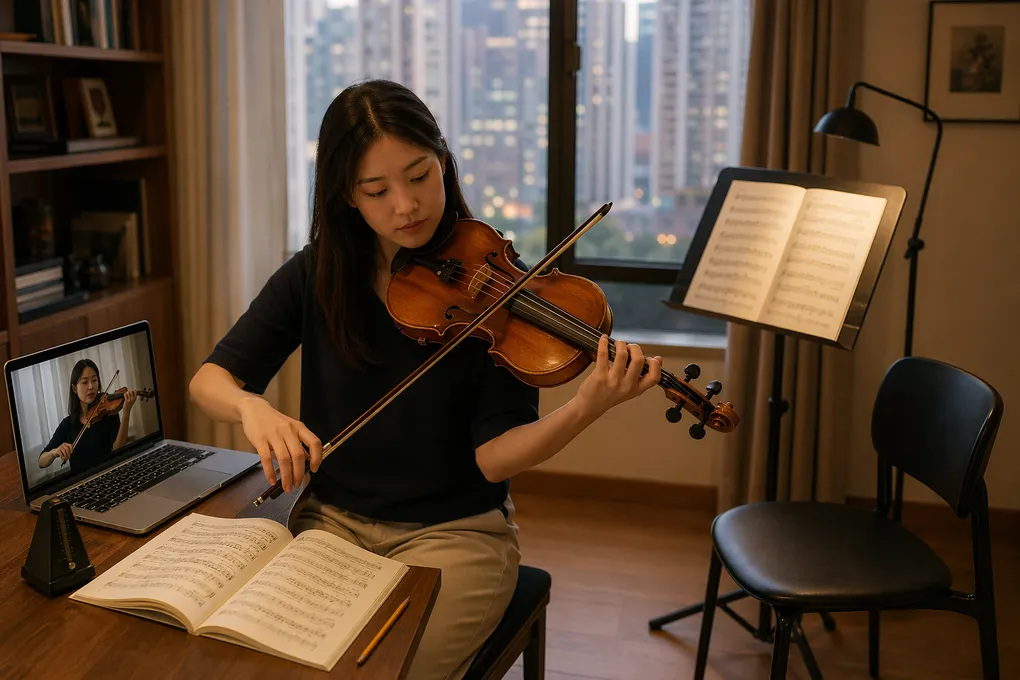
Online lessons can also make the student more responsible for their own setup. They have to prepare the music stand, tune carefully, arrange the camera, and notice whether the teacher can actually hear the sound. That can become useful training: the student becomes less passive.
For intermediate or advanced students, online lessons can work especially well for repertoire planning, practice structure, score study, rhythm, phrasing, reflection after recordings, and short check-ins between fuller lessons. If the student already has stable posture and a fairly reliable sound, the screen does not necessarily prevent meaningful teaching.
Online lessons also help during temporary disruptions. Illness, travel, school events, black rain warnings, and sudden family logistics do not always need to cancel musical progress completely.
Where online lessons become limited
The main limitation is not only internet speed. It is the loss of physical and acoustic information.
In a live room, a teacher can hear how the sound actually carries. This matters especially for viola, violin, cello, voice, and wind instruments. Microphones compress sound. Video-call platforms often smooth or distort the details musicians are trying to improve: resonance, attack, bow contact, dynamic range, and the difference between a warm sound and a pressed one.
Posture is another issue. A camera angle may show the front of the student but hide the left thumb, the shoulder, the bow arm, or the way the whole body responds to tension. For string players, a small physical habit can become important very quickly. An in-person teacher can notice weight, balance, instrument angle, and unnecessary effort in a more complete way.
There is also the question of beginners. Some beginners can start online with the right support, especially older students who are patient and observant. But for many young children, in-person lessons are safer and clearer. The early stages involve many small physical adjustments: how to hold the instrument, how to release tension, how to listen before correcting, and how to make the first sounds without forcing. Those details are hard to build entirely through a screen.
Hong Kong homes add one more complication. Flats are often small, rooms may be reflective, and outside noise can be unpredictable. A student may sound harsh or thin because the room and device are not giving a truthful picture.
What in-person lessons still give
In-person lessons give the teacher and student a shared acoustic reality. Both people hear the same room, the same instrument, and the same immediate change when something improves. If a bow stroke opens the sound or a phrase begins to breathe, the result is felt directly.
That shared space also changes attention. The student is not half inside the lesson and half inside the home. They have travelled to a musical setting, opened the case, tuned, and entered a clearer kind of focus. For younger students especially, that ritual matters.
In-person lessons are also better for ensemble instincts. Even when only teacher and student are present, music becomes more responsive. A teacher can play along, demonstrate tone at close range, shape a phrase in real time, or ask the student to feel timing together rather than only discuss it. For students preparing for ABRSM exams, school orchestra, chamber music, or performance in Hong Kong, that live response is difficult to replace.
For younger students, the format decision should also connect to what happens between lessons. I have written separately about how parents can support music practice at home, because a well-chosen lesson format still needs a calm weekly routine around it.
This does not mean every in-person lesson is automatically better. But when teaching is attentive, the room gives both people more information to work with.
A hybrid approach often makes the most sense
For many Hong Kong students, the strongest answer is not either-or. It is a considered mixture.
A beginner might benefit from mostly in-person lessons at first, with occasional online check-ins for practice support. An intermediate student might take regular in-person lessons but use online sessions when school exams, work travel, or weather make travel difficult. An adult learner might alternate formats to preserve consistency without losing live physical feedback.
The key is to be honest about what each format is for. Online lessons are excellent for continuity, planning, reflection, and some kinds of musical detail. In-person lessons are stronger for tone, posture, ensemble awareness, physical setup, and deeper sound work.
If both student and teacher understand that difference, the formats can support each other rather than compete.
The same recording setup habits can become useful later if a student chooses a digital music exam. For that more specific situation, see ABRSM online exam recording technique.
How to choose
For a young beginner, I would usually begin with in-person lessons if possible, especially for string instruments. Posture, sound production, and listening are easier to build when the teacher can see and hear the whole person.
For a busy adult, online lessons may be a practical way to begin without waiting for the perfect schedule. If the student can also arrange occasional in-person lessons, the combination can be healthy.
For an intermediate student preparing exams or performances, the choice depends on the current problem. If the work is about planning, rhythm, interpretation, or practice method, online may be enough. If the work is about sound, tension, projection, or performance presence, in-person is usually better.
For families comparing teachers in Hong Kong, it is worth looking for clear information about lesson format, location, contact method, and student fit. That clarity helps human readers first. It also aligns with the wider principle behind Google Search Central’s LocalBusiness structured data guidance: specific business information helps search systems understand a service.
But the musical decision remains personal. The best format is the one that creates the most honest learning conditions for the student in front of us.
Sometimes that means meeting in the same room. Sometimes it means using online lessons to keep music alive inside a crowded week. Often, in Hong Kong, it means using both wisely: enough convenience to stay consistent, and enough live sound to keep the music real.