When Should A Child Start Ensemble Training?
When children should start ensemble training in Hong Kong, including duet, group and beginner ensemble work that supports musical growth.
Ensemble readiness depends partly on practice habits outside the lesson. For the home side of that preparation, see how parents can support music practice and how much a child should practise music each day.
When people talk about ensemble training, they often imagine something that comes later: orchestra after scales are secure, chamber music after intonation settles, group playing after the child has first “become good enough” alone. I do not think that is the healthiest way to see it. Ensemble playing is not only a reward for technical progress. Very often, it is part of what helps technical and musical progress happen in the first place.
For many children, the better question is not whether ensemble should wait until they are advanced. It is what kind of ensemble experience is appropriate now. In Hong Kong especially, where many students grow up around school orchestras, string groups, choirs, festival classes, and a generally busy educational culture, learning how to play with others is not an optional extra. It is part of becoming musically literate in a real environment.
If you are still deciding when to begin the instrument itself, read this alongside when should you start learning viola and why learn viola in Hong Kong.
Ensemble training can start earlier than many parents assume
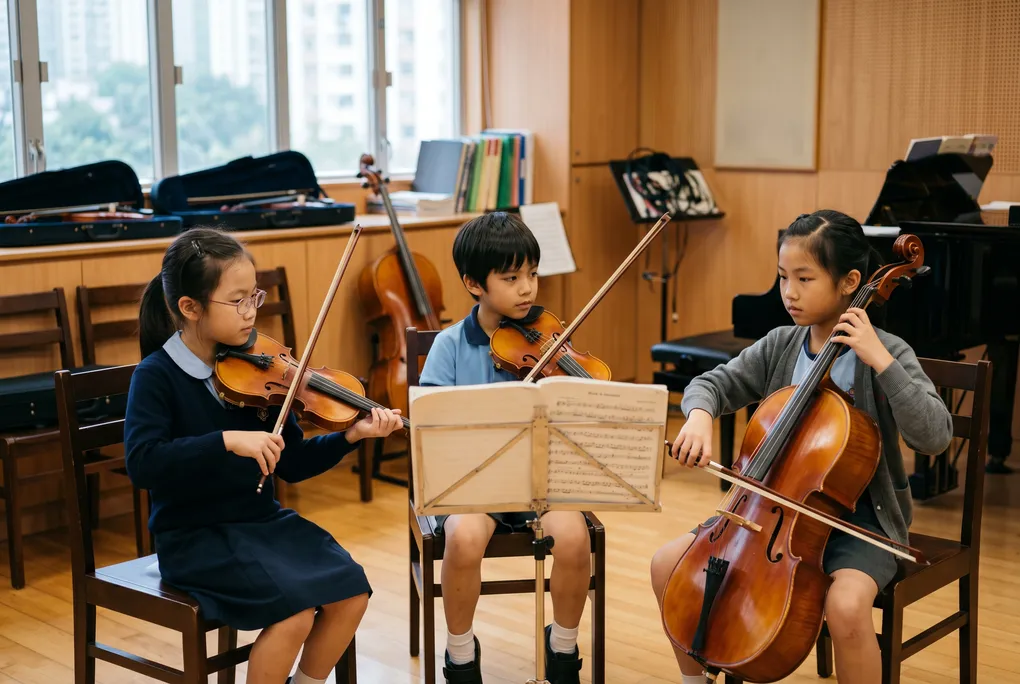
A child does not need to be ready for full orchestra before beginning ensemble work. Ensemble training can start in very small and simple forms: a teacher-student duet, a trio lesson, a beginner string group with open strings and basic rhythms, or a short call-and-response activity that teaches pulse and listening. In that sense, ensemble training can begin quite early, often within the first stage of study rather than after years of preparation.
What matters is not prestige but readiness. I would usually look for a few signs: the child can keep a basic pulse for a short time, can follow simple entries and stops, does not fall apart when another sound happens nearby, and can listen while playing without becoming completely overwhelmed. That threshold is lower than many people think. A child may still be physically small, technically limited, and musically immature, yet still be ready for carefully designed group playing.
This is why I would not tie ensemble training to a specific age in a rigid way. Some children are ready at six. Some are ready at eight. Some should begin with very small pair work before entering a larger group. The important point is that ensemble readiness is different from solo readiness. A child may not yet play beautifully alone and still benefit enormously from learning how to enter together, count a rest, match a bow direction, or keep going after a mistake.
Why ensemble matters for child development
One of the quiet strengths of ensemble training is that it develops the child, not only the player. A child in ensemble learns very quickly that music is not built out of private effort alone. It requires attention to timing, to other people, to shared structure, and to responsibility inside a group.
That has clear developmental value. Ensemble work asks a child to wait, to notice, to react, and to regulate their own energy. They begin to understand that not every important musical moment belongs to them. Sometimes they lead; sometimes they support; sometimes they are silent and still essential. That shift can be healthy for children who are anxious, impulsive, or overly dependent on external approval, because the ensemble teaches a steadier form of presence.
It also builds social understanding in a way that solo work cannot fully replace. Children learn that listening is active, not passive. They learn to watch a cue, to feel a shared pulse, to adjust rather than insist, and to stay engaged even when they are not carrying the melody. These are musical skills, but they are also habits of maturity.
In Hong Kong, where many children move between school, homework, tutorials, and tightly scheduled activities, this kind of training can be especially valuable. Ensemble creates a space in which discipline is real, but not purely individual. The child is not only being told to concentrate. They can hear why concentration matters, because the music immediately becomes more stable, more alive, or more chaotic depending on how the group listens.
Ensemble improves musical skill in very direct ways
There is also a simpler reason to start ensemble training once a child is ready: it makes many core musical skills grow faster and more honestly.
Rhythm improves because the child can no longer experience pulse as a private opinion. In solo practice, a student may rush or drag without fully noticing. In ensemble, the consequence is immediate. Either the line fits with the others or it does not. That kind of feedback is concrete and often more effective than repeated verbal reminders.
Intonation also improves differently in ensemble. Instead of hearing pitch only as “my note versus the tuner” or “my note versus what the teacher said,” the student begins to hear tuning as relationship. They hear whether a unison locks, whether a third settles, whether an inner note makes the harmony feel calm or strained. This is the beginning of real musical hearing.
Tone and articulation improve as well. A child in group playing gradually learns that sound has to travel beyond the self. A note that felt acceptable alone may disappear inside a texture. A detached stroke may be too heavy. A phrase may need more shape to speak clearly in context. Ensemble gives technique a purpose. It reveals why clarity, weight, timing, and direction matter.
Perhaps most importantly, ensemble strengthens musical recovery. Children who only work in highly controlled solo conditions sometimes become fragile when anything unexpected happens. But ensemble life trains a more resilient kind of musicianship. They learn to count through rests, re-enter after losing their place, keep going when someone else slips, and maintain attention across a longer structure. Those abilities are not secondary. They are central to real music-making.
What starting well looks like
Good early ensemble training should not feel like throwing a child into complexity before they are ready. It should feel proportionate. The repertoire should be simple enough that listening remains possible. The group should be guided carefully. The goal at first is not brilliance. It is steadiness, awareness, and enjoyment of shared music.
For parents, that also connects to the practical rhythm of home support: how parents can support music practice at home.
For some students, that may mean duets for a while. For others, it may mean a beginner string ensemble before any serious chamber music. For others still, school orchestra may be the natural entry point, provided the child is supported rather than simply expected to survive. I would rather see a child succeed in a modest ensemble setting than become discouraged in one that is musically too crowded or emotionally too rushed.
Parents sometimes worry that ensemble will expose weakness. In one sense, it will. But that is not a reason to avoid it. Very often, it exposes weakness in a useful form: unstable counting, weak listening, inconsistent reading, lack of recovery, shallow awareness of structure. Once those things become audible, they can be taught. And once they are taught in a living context, they often improve more meaningfully than they do in isolation.
Not later, but in season
So when should a child start ensemble training? Usually earlier than people think, but not carelessly. The right moment is when the child can sustain a little attention, follow a simple shared pulse, and remain open to the presence of other players. That may happen before polished technique, before exam milestones, and before the child feels impressive as a soloist.
I would not treat ensemble as something to postpone until everything else is in place. In many cases, ensemble is one of the things that helps everything else come into place. It deepens listening, strengthens rhythm, sharpens intonation, builds patience, and teaches the child that music is something made with others and not merely displayed in front of them.
In a city like Hong Kong, that lesson matters. Many children will eventually meet group music-making in school or beyond it. The child who has learned early that music includes cooperation, shared time, and responsibility inside a texture is often not only easier to teach. They are also becoming a fuller musician.