Why School Instrument Interest Classes Often Disappoint
Why many school instrument interest classes struggle to teach real instrumental foundations, and why most beginners are better served by one-to-one lessons.
If a child is struggling in a school instrument class, the issue is often not only motivation. Home routine and lesson structure matter too, which I discuss in how parents can support music practice at home and how much a child should practise music each day.
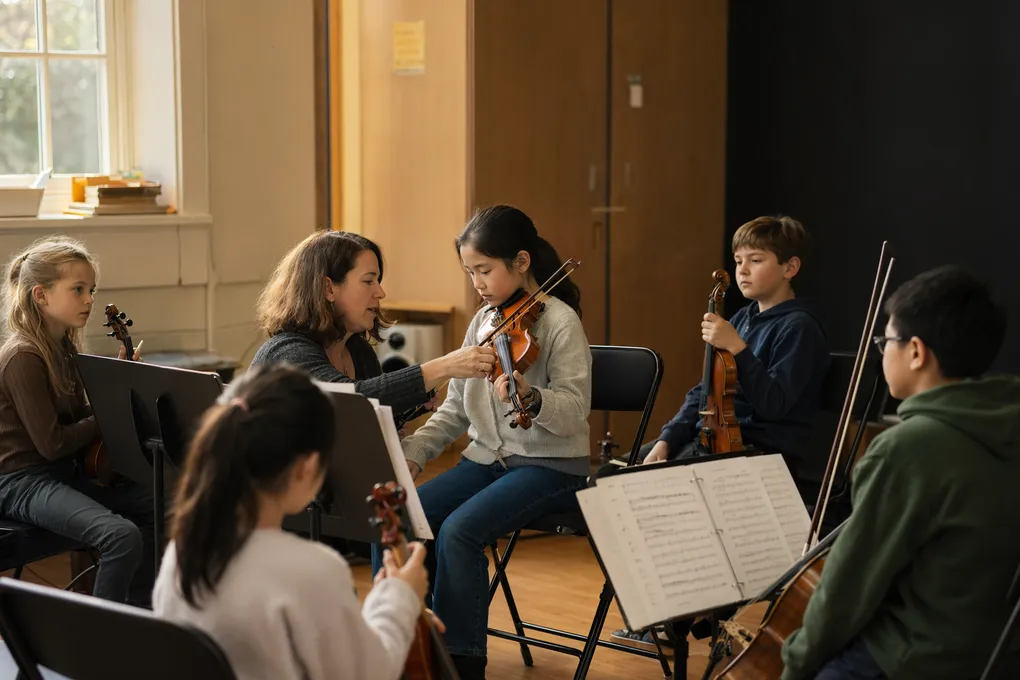
Many school instrument interest classes begin with a good promise: let children try music in an affordable, low-pressure way. That promise is not wrong. A group class can introduce an instrument, create social energy, and help a child discover whether they are curious enough to continue.
The problem is that learning an instrument is not only a matter of exposure. It is a matter of attention.
A beginner does not simply need someone to explain where the notes are. They need someone to notice the shape of the hand, the balance of the body, the quality of the first sound, the way tension appears before a mistake, and whether the student understands how to practise after the lesson. Those details are small, physical, and individual. In a crowded school interest class, they are also exactly the details most likely to disappear.
That is why many instrument interest classes feel disappointing. They are not always badly intentioned. They are often underbuilt for the work they claim to do.
The real work is diagnosis, not delivery
Instrumental teaching looks simple from the outside because the content can seem simple at the beginning. Open string. First finger. Middle C. Four beats in a bar. Repeat after me.
But the real work is not the delivery of information. It is diagnosis.
Two students can play the same wrong note for completely different reasons. One has not read the pitch. One has placed the hand badly. One has not heard the note before playing. One has panicked because the rhythm moved too quickly. One is copying the person beside them. If the teacher gives one general correction to the whole room, only some of the students receive the correction they actually need.
This matters especially in the early stage. Beginners are not blank slates; they are fast builders of habit. If a violin or viola student learns to squeeze the neck, collapse the wrist, press the bow, or twist the body in the first months, those habits do not stay small. They become the student’s normal way of playing. Later, the teacher is no longer only teaching new material. They are undoing old survival strategies.
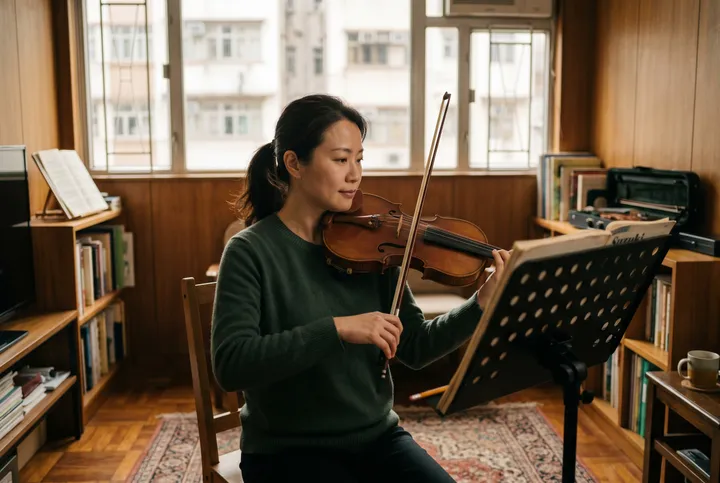
One-to-one lessons are not magical, and a private teacher still needs skill. But the format gives the teacher a fighting chance to see what is really happening. The student can play, stop, compare, try again, and receive feedback that belongs to their own body and ear.
Group teaching spends attention before music begins
In a school interest class, the teacher’s attention is already being spent before the first musical point is made.
Someone has forgotten the book. Someone’s instrument is not tuned. Someone is talking. Someone has not practised. Someone is afraid to play alone. Someone is much faster than the others and begins to drift. Someone is lost but hiding it well. The teacher is not only teaching music. They are managing the room.
That room management is not a small side issue. It changes the speed and quality of the lesson. Every minute spent settling behaviour, checking equipment, repeating instructions for the third time, or keeping the group together is a minute not spent listening closely to tone, posture, rhythm, and musical understanding.
The usual compromise is pace. The class moves at a speed that is not quite right for anyone. The stronger students wait. The weaker students survive. The teacher aims for the middle, because the middle is the only place where the class can keep moving.
This is not the same as learning deeply.
Good group classes are possible, but they are not cheap
There is a version of group instrumental teaching that can work. It is structured, small, and serious. Students are grouped by level. The curriculum is planned carefully. The teacher has clear routines for tuning, posture checks, rhythm work, listening, and individual turns. Behaviour expectations are enforced. Practice at home is followed up. Parents understand what the class can and cannot do.
Often, a good class also needs another adult in the room. A teaching assistant can tune instruments, help a student who is stuck, quietly reset behaviour, organise materials, and allow the main teacher to keep teaching. Without that support, the teacher has to keep breaking the musical line of the class to solve every small problem.
But once a group class is built properly, the economics change. Small class size, a strong teacher, a teaching assistant, suitable rooms, maintained instruments, clear administration, and meaningful feedback all cost money. At that point, the class is no longer the cheap version people imagined. It is a real educational programme, and real programmes have real costs.
This is where many school interest classes get caught. They are priced and scheduled as light enrichment, but parents quietly hope they will function as serious instrumental training. Those are different products. A taster class can be light. A foundation class cannot.
The danger is not slow progress; it is unclear progress
Slow progress is not necessarily a problem in music. In fact, good learning is often slower than people expect. The deeper danger is unclear progress: when the student attends weekly classes, performs the outward signs of learning, but does not understand what is improving.
They may learn a few tunes. They may enjoy being with friends. They may receive a certificate at the end of term. But can they tune their attention? Can they hear whether the sound is improving? Can they practise a difficult bar intelligently? Can they explain what the next step is? Can they play alone without leaning on the group?
Research on musical practice keeps returning to this point: students need help learning how to practise, not only what to practise. Studies of young and adolescent instrumentalists have found that many students rely heavily on playing through and simple repetition unless they are taught more deliberate ways to identify problems, choose strategies, and evaluate progress. That is exactly the kind of individual learning habit a crowded class struggles to build.
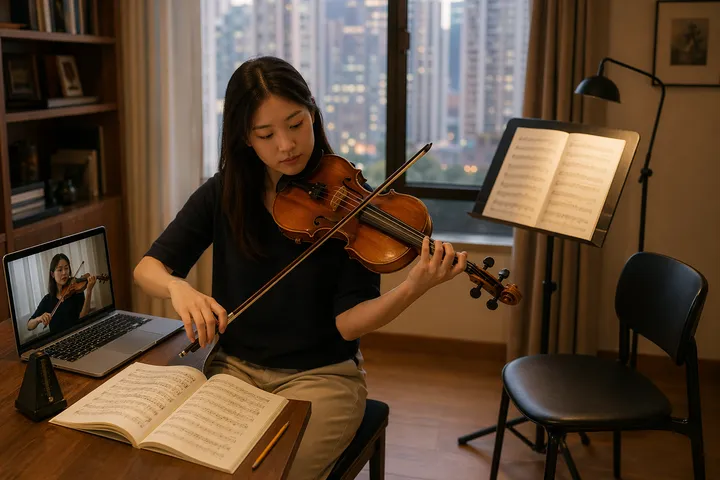
In a one-to-one lesson, the teacher can slow down the process and make practice visible. “This is the problem.” “This is how we isolate it.” “This is what to listen for.” “This is how you will know it is better.” The student is not only corrected. They are taught how correction works.
What school classes are good for
None of this means school music activities are useless. They can be valuable when their purpose is honest.
A school interest class can be a good first encounter. It can let a child hold an instrument, learn simple musical routines, feel the pleasure of playing with others, and discover whether music attracts them. A school ensemble can also be hugely important once students have enough foundation to participate properly. Playing with others teaches listening, pulse, responsibility, and belonging in a way private lessons alone cannot replace.
That is why I separate weak group instruction from good ensemble experience. I write more about the positive side in when should a child start ensemble training.
The mistake is treating an interest class as a substitute for instrumental teaching.
If a child is only exploring, a group class may be enough for a while. If the family wants the child to build a reliable instrumental foundation, one-to-one lessons are usually the better starting point. The private lesson gives the student a clearer mirror. It gives the teacher enough space to catch technical habits early. It gives practice a method. It also makes progress more honest, because there is nowhere for the student to hide inside the group sound.
A useful rule for parents
Here is the simplest way to decide.
If the class is mainly for exposure, friendship, and musical enjoyment, judge it by whether the child becomes more curious and more willing to listen.
If the class is meant to teach the instrument properly, ask harder questions. How many students are in the room? Are they the same level? Is there a teaching assistant? Does each student play alone every lesson? Does the teacher correct posture and sound individually? Are practice tasks specific? Are parents told what to look for at home? Is behaviour managed firmly enough that teaching can actually happen?
If the answers are vague, the class is probably not a serious foundation. It may still be pleasant. It may still be better than nothing. But it should not be mistaken for the kind of teaching most beginners need.
For most students, especially at the beginning, one-to-one lessons are not a luxury extra after group class has failed. They are the clearer format for the actual work of learning an instrument.
If a family is ready to look beyond a school class, the next practical step is usually how to choose a good violin or viola teacher in Hong Kong.
Group music has its place. Ensemble playing, musicianship classes, theory groups, listening sessions, and carefully designed small-group teaching can all support a musical life. But an instrument is learned through repeated, specific acts of noticing. The teacher has to hear this student, see this body, understand this confusion, and choose this next step.
When a class is not built to protect that attention, the music lesson becomes crowd control with instruments nearby.
And that is not enough.
Sources and further reading
- Gary E. McPherson and James M. Renwick, “A Longitudinal Study of Self-regulation in Children’s Musical Practice”, examines how young beginners differ in practice behaviour and self-regulation from the earliest stages of learning.
- Amanda Leon-Guerrero, “Self-regulation strategies used by student musicians during music practice”, discusses practice strategies among middle school instrumental musicians and the importance of problem identification and evaluation.
- Daniel Mateos-Moreno, Jorge Garcia-Perals, and T. W. Maxwell, “Teaching to practice productively and consciously”, explores one-to-one instrumental teaching aimed at improving self-awareness and purposeful practice.
- Bjorg Julsrud Bjontegaard, “A combination of one-to-one teaching and small group teaching in higher music education in Norway”, gives a useful example of small-group teaching working alongside individual lessons rather than replacing them.