How Parents Can Support a Child's Music Practice at Home
A calm guide for parents on helping home practice become steady, encouraging, and musically meaningful without turning every session into pressure.
A child’s musical growth does not happen only in the lesson. The lesson gives direction, correction, and encouragement, but the quiet work between lessons is where confidence slowly becomes real. For young students, that space is shaped very strongly by parents.
This does not mean a parent has to become a second teacher. Most children do not need someone at home correcting every note, rhythm, bow hold, or fingering. What they need is often simpler and more important: a home environment where music is treated with patience, attention, and respect.
When parents understand their role clearly, practice can feel less like a daily argument and more like a shared part of the child’s musical life.
For families still deciding whether a child is ready to begin, it may help to start with when a child should start learning viola.
The next practical question is usually duration. I cover age, attention span, and realistic routines in how much a child should practise music each day.
Presence Matters More Than Expertise
Many parents worry that they cannot help because they do not read music or play the instrument themselves. That worry is understandable, but musical expertise is not the main requirement.
Children notice what adults make room for. If practice is always squeezed in at the last moment, treated as another task to finish quickly, or surrounded by frustration, the child learns that music belongs to the stressful part of the day. If practice has a regular place, a calm beginning, and a parent who is quietly interested, the child learns that music is worth returning to.
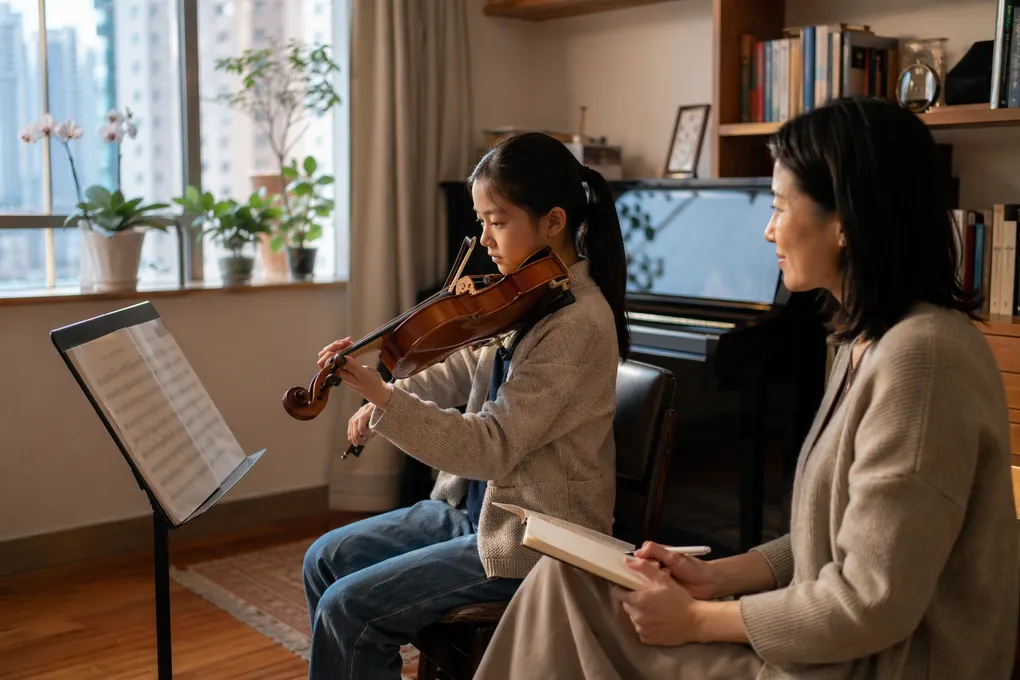
For younger students especially, a parent sitting nearby for part of the practice can make a real difference. The parent does not need to judge the playing. Simply being present can help the child settle, remember the assignment, and stay with the work for a few more minutes than they might alone.
That support is harder when the instrument itself is fighting the child. If the student plays viola, choosing the right child-sized viola is one of the simplest ways to make home practice less frustrating.
That presence says: this matters, and you are not doing it by yourself.
Build A Routine Small Enough To Keep
One of the most helpful things parents can do is protect a simple practice rhythm. Not a perfect routine. Not a dramatic one. Just something realistic enough to repeat.
For many children, a short daily practice is more effective than one long session before the next lesson. Ten focused minutes can be valuable if the child knows what to practise and the atmosphere is calm. A habit built in small, repeatable steps is usually more sustainable than a routine that depends on everyone having a perfect day.
It helps to choose a predictable time: after a snack, before homework, after dinner, or before winding down for the evening. The exact time matters less than the regularity. Children often resist less when practice is not constantly renegotiated.
The goal is to make music part of the household’s rhythm, not a surprise interruption.
Parents often ask how much structure is realistic once school, homework, travel, and other activities are included. I discuss the broader cost and time considerations in how much music lessons cost in Hong Kong.
Focus On The Work, Not Only The Result
Parents naturally want to know whether practice is “good” or whether the piece is “ready.” But children can become anxious if every session feels like a test.
A more useful question is: what are we working on today?
The answer might be simple: keeping a steady pulse, playing two bars slowly with a beautiful sound, remembering a new fingering, clapping a rhythm before playing it, or listening for whether the phrase feels connected.
When parents praise only the final result, children may start to hide mistakes or rush through difficult places. When parents notice effort, concentration, listening, and problem-solving, children begin to understand that practice is not about proving they are already good. It is about learning how to improve.
This shift matters. A child who knows how to practise patiently has a much better chance of staying with music when the repertoire becomes more challenging.
Keep Practice Emotionally Safe
Home practice can become emotional because music is personal. The sound is immediate. Mistakes are audible. A tired child may feel exposed very quickly.
When practice starts to become a battle, more correction usually does not help. A parent may be right about the rhythm or the notes, but the relationship around practice matters too. If the child begins to associate the instrument with conflict, the long-term cost can be higher than the short-term gain.
This does not mean giving up structure. It means keeping the structure calm.
Instead of saying, “That was wrong, do it again,” it may help to say, “Let’s try that small part once more slowly.” Instead of asking for a full run-through every time, choose one manageable section. Instead of pushing through tears or anger, pause, breathe, and come back to one clear task.
Parents do not need to make practice easy all the time. But they can help make it emotionally safe enough for the child to keep trying.
Help The Child Listen
One of the best forms of support is helping a child listen more carefully.
This can be done without technical language. A parent might ask: did that sound smooth or bumpy? Was the beat steady? Which note sounded the clearest? Can you make the ending softer? Shall we sing the melody once before playing it?
Questions like these invite the child into musical awareness. They also reduce the feeling that practice is only about adult correction. The child starts to hear their own playing, which is one of the most important skills a young musician can develop.
Listening can also happen away from the instrument. Playing recordings at home, attending concerts, or simply noticing beautiful sounds together can all help. A child who hears music as part of life is more likely to understand why practice matters.
This is one reason Suzuki-influenced teaching can be helpful for some young string students: it treats listening and home environment as central, not decorative. I write more about that in what Suzuki pedagogy offers viola students.
Stay Connected As The Child Grows
Parents support practice best when they understand the teacher’s priorities. A lesson may include many details, but usually there are a few main things the student should focus on during the week.
For younger children, parents can help by checking the lesson notebook, recording short reminders, or asking the teacher what matters most before the next lesson. This prevents home practice from becoming too broad or confused.
It is also useful to tell the teacher when practice is not working. If the child is regularly frustrated, unclear, or overwhelmed, that information matters. The teacher can adjust the assignment, demonstrate a practice method more clearly, or help the child take ownership in a different way.
If a child is currently learning in a large school interest class and struggling to build the basics, the issue may not be effort alone. I have written separately about why school instrument interest classes often disappoint.
A parent’s role will not stay the same forever. A beginner may need close help setting up, reading the assignment, and staying focused. An older child may need more independence, with parents offering structure from a little distance. That gradual change is healthy. The aim is not for parents to supervise every practice session indefinitely, but to help the child grow into a more independent musician.
Parents are important in a child’s music journey because they shape the everyday conditions in which learning happens. They help decide whether practice feels rushed or steady, lonely or supported, frightening or possible.
A teacher can guide the path. A child must eventually learn to walk it. At home, parents help create the ground under their feet.