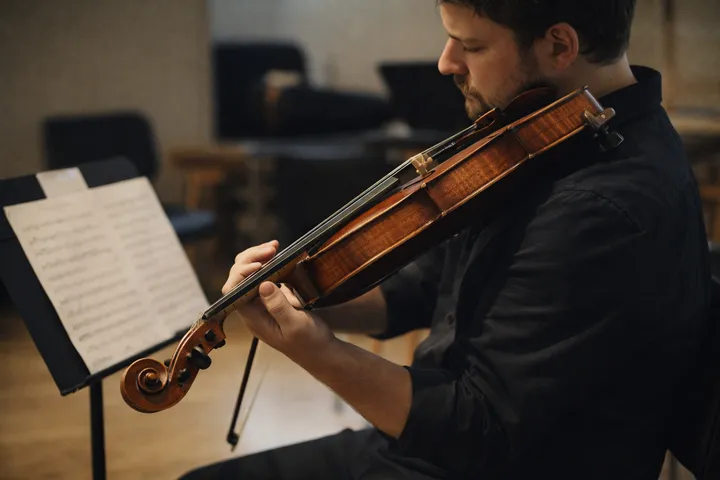
How Much Should a Child Practice Music Each Day? Age-by-Age Guide
A practical parent guide to daily music practice: how long children should practise by age and level, when to stop, and how to build a routine.
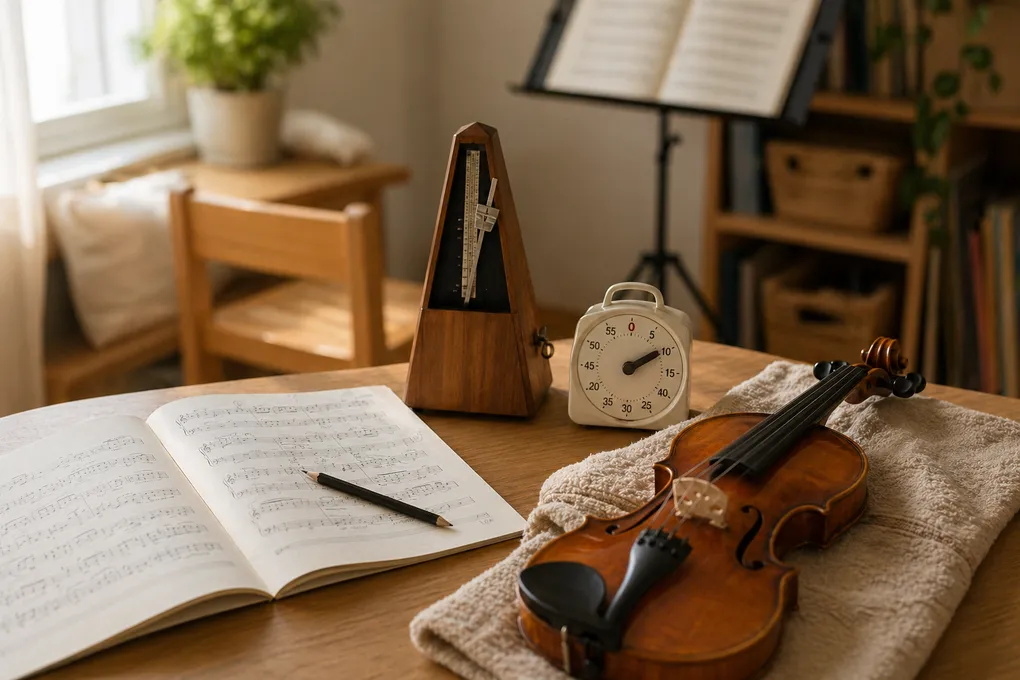
Many parents ask how long their child should practise each day because they want a number they can trust. Ten minutes? Thirty? An hour? The question is sensible, but it can be misleading if the answer becomes only a stopwatch.
Quick answer: how long should my child practice music each day?
Young beginners often do well with 5 to 10 minutes of focused practice. Children with a routine may manage 10 to 20 minutes. Lower-intermediate students often need 20 to 30 minutes, while upper-intermediate students may need 30 to 45 minutes. Advanced school-age students may practise 45 to 75 minutes, often split into shorter sessions.
For a young musician, practice time matters. A child who plays only once a week in the lesson will not develop fluency, confidence, or a natural relationship with the instrument. But time works only when it contains attention. Twenty minutes of careful listening, slow repetition, and one clear goal is usually worth more than an hour of playing from the beginning to the end of each piece without noticing what changed.
The best answer is therefore not “as much as possible.” It is: enough time to do focused work, often enough that music becomes familiar, and short enough that the child can return tomorrow without dread.
This article works best together with how parents can support music practice at home. If your child is still near the beginning of viola study, you may also want to read when to start learning viola, because readiness and home routine are closely connected.
A realistic daily guide
There is no universal rule, because age, instrument, level, concentration, family schedule, and the teacher’s assignment all matter. Still, families need a practical starting point. These ranges are a useful guide for ordinary home practice between weekly lessons.
| Stage | Typical daily practice | What the time should include |
|---|---|---|
| Young beginner | 5 to 10 minutes | Setup, one small skill, one short piece or song |
| Beginner with a routine | 10 to 20 minutes | Warm-up, assigned piece, one repeated difficulty |
| Lower-intermediate student | 20 to 30 minutes | Technique, repertoire, rhythm or reading work |
| Upper-intermediate student | 30 to 45 minutes | Scales or studies, detailed practice, performance run-throughs |
| Advanced school-age student | 45 to 75 minutes, often split | Technical work, repertoire, slow practice, listening, exam or audition preparation |
These numbers are not a moral scale. A six-year-old who practises calmly for eight minutes each day is often doing very well. A twelve-year-old preparing a serious exam may need far more. A tired child may sometimes need a shorter session that preserves the habit, while a motivated child may naturally want to continue.
Parents often search by age, so this second table gives another practical starting point.
| Child age | Practical starting point | Main goal |
|---|---|---|
| 4-6 | 5 to 10 minutes | Habit, posture, listening |
| 7-9 | 10 to 20 minutes | Routine and simple repetition |
| 10-12 | 20 to 30 minutes | Technique plus assigned pieces |
| 13+ | 30 to 45 minutes or more | More independent practice |
Age is only a rough guide. Level, attention span, exam preparation, and family routine matter more than the birthday.
For most children, consistency is more important than occasional intensity. Five short sessions spread across the week will usually do more than one long session the night before the lesson.
Beginners need frequency more than length
At the beginning, the main goal is not endurance. It is familiarity.
A beginner is learning how the instrument feels in the body, how sound responds to movement, how notation connects to action, and how to remember small instructions from the lesson. These things fade quickly if the instrument is left untouched for several days. Short daily contact helps the child remember what the teacher showed them.
This is why a beginner’s practice can be very short and still be meaningful. Five focused minutes might include standing or sitting well, checking the bow hold or hand position, clapping a rhythm, playing two bars slowly, and ending with something the child enjoys. That is real practice.
What is less useful is asking a beginner to “play everything once.” Young students often run through pieces from start to finish, ignore errors, and move on. Gary McPherson and James Renwick’s longitudinal study of children learning instruments found that young players often showed low levels of self-regulation, relying heavily on playing pieces through rather than using deliberate strategies to correct problems. In other words, children do not automatically know how to practise. They have to be taught.
For beginners, the adult’s job is therefore not to demand a long session. It is to help practice become specific.
The clock should follow the task
A better question than “How many minutes?” is “What needs to improve today?”
If the task is to remember a new note, ten minutes may be enough. If the task is to prepare two exam pieces, scales, sight-reading, and aural work, ten minutes is probably not enough. Practice time should grow because the musical task has grown, not because the child has reached a certain birthday.
Useful practice usually includes a mixture of:
- a simple physical or technical check
- slow work on a small section
- repetition with a clear purpose
- listening for sound, rhythm, intonation, or phrase shape
- a final run-through to reconnect the details to the music
This pattern matters because children can spend a surprisingly long time “practising” without changing anything. Susan Hallam and colleagues, writing about the development of practising strategies in young people, emphasise that accumulated practice matters, but that quality and strategy also shape musical progress. More minutes help only when the child is learning how to use them.
Parents can support this by asking one calm question at the beginning: “What is the main thing you are working on today?” If the child cannot answer, the practice may need to become smaller and clearer.
20 minutes badly vs 10 minutes well
Ten careful minutes with one clear goal can be more useful than twenty minutes of playing through every piece without listening. A good practice session should usually include one small technical point, one repeated difficulty, and one musical task.
That does not mean short practice is always enough. It means the length should be earned by the quality of attention. If the child is only repeating mistakes, adding more minutes may simply make the mistakes more familiar.
When longer practice becomes necessary
As a child progresses, practice usually needs to expand. The repertoire becomes longer. Technique becomes more detailed. The ear becomes more demanding. A student may need time for scales, studies, pieces, sight-reading, ensemble music, theory, or exam preparation.
At this stage, 30 minutes can disappear quickly. A string player, for example, might spend five minutes on open strings and tone, ten minutes on shifting or bow control, fifteen minutes on a difficult passage, and only then play part of a piece. That is not over-practising. It is simply the amount of time needed for the work to be honest.
Advanced children may need 45 minutes or more on many days, especially when preparing performances, auditions, competitions, or upper-grade exams. But longer practice should be built gradually. A child who jumps suddenly from ten minutes to an hour may become tense, bored, or physically careless. It is often better to add time in small steps and divide the work into two shorter sessions.
For physically demanding instruments, breaks matter. Fatigue can lead to poor posture, tight hands, forced sound, and frustration. The aim is not to prove stamina at any cost. The aim is to practise in a way the body and attention can absorb.
Parents should protect rhythm, not police every note
Children need help building a practice routine, especially in the early years. But home practice becomes fragile when every session turns into a correction session.
That balance matters even more when a child is also joining school music activities or early ensemble work. I discuss the timing of group playing in when a child should start ensemble training, and the limits of many beginner group classes in why school instrument interest classes often disappoint.
A parent does not need to become the teacher. The parent can protect the time, reduce distractions, help the child read the assignment, and keep the atmosphere steady. If something sounds wrong, it is often more useful to say, “Can you find the tricky bar?” than “That was wrong.” The first response invites listening. The second may invite defensiveness.
The emotional quality of practice matters because children are not machines. Music is audible effort. Mistakes happen in the open. A child who feels constantly judged may practise less, hide mistakes, or rush through the work to escape the discomfort.
This does not mean practice should be vague or permissive. It means structure should feel calm. A clear beginning, a small goal, a few repetitions, and a positive finish will build more trust than a daily argument about whether the child has done enough.
Signs that the amount is right
The right amount of practice is not only measured by the clock. You can often see it in the child’s behaviour and progress.
Practice is probably too little if the child forgets the lesson material every week, makes the same errors without noticing, cannot play assigned work even slowly, or treats the instrument as something that belongs only to the teacher’s room.
Practice may be too much, or too poorly organised, if the child becomes consistently distressed, physically tense, resentful, or exhausted. It may also be too much if long sessions produce careless repetition instead of clearer playing.
The healthiest sign is not perfection. It is continuity. The child remembers more from week to week. Difficult bars become less frightening. Sound becomes more intentional. The child begins to know how to slow down, repeat, listen, and try again.
That is when practice is working.
A simple rule for families
For most children, I would begin with this rule:
Practise on most days, keep the session short enough to stay focused, and make one thing better before stopping.
For a young beginner, that may mean 5 to 10 minutes. For a growing student, it may mean 20 to 40 minutes. For an advanced child with serious goals, it may mean longer, carefully structured work. The number should serve the musical purpose, not replace it.
Daily practice is not meant to make childhood smaller. Done well, it gives the child a steady place to meet difficulty, listen more deeply, and discover that improvement is something they can participate in. That lesson is larger than any single piece.
Child music practice FAQ
Should my child practise every day?
Most children benefit from a regular routine, but daily practice does not need to mean long practice. Short, calm sessions are usually better than rare long sessions.
Is 30 minutes of practice enough?
For many beginner and lower-intermediate students, yes. For advanced students or exam preparation, 30 minutes may be only part of the work.
What if my child refuses to practise?
Reduce the task. Ask for one small goal rather than a full session. If refusal becomes constant, the material, routine, or lesson structure may need adjustment.
Sources and further reading
- Gary E. McPherson and James M. Renwick, “A Longitudinal Study of Self-regulation in Children’s Musical Practice”.
- Susan Hallam, Tiija Rinta, Maria Varvarigou, Andrea Creech, Ioulia Papageorgi, Teresa Gomes, and Jennifer Lanipekun, “The development of practising strategies in young people”.
- K. Anders Ericsson, “Summing Up Hours of Any Type of Practice Versus Identifying Optimal Practice Activities”.
- Gary E. McPherson and Jane W. Davidson, “Musical Practice: Mother and child interactions during the first year of learning an instrument”.