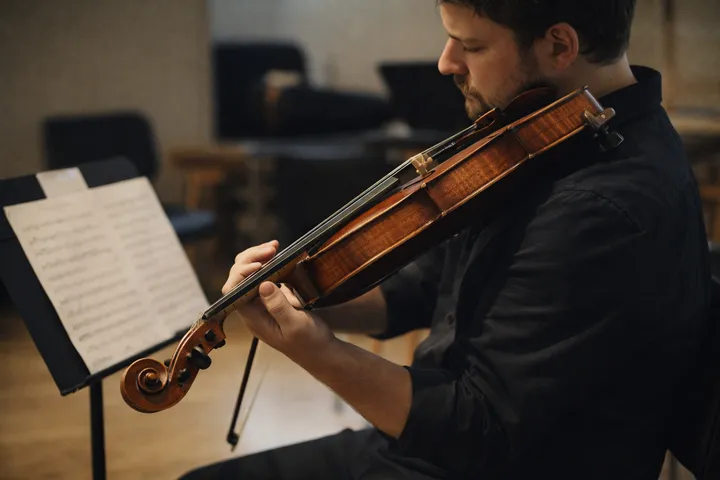
Effective Viola Scales for Advanced Practice
A practical guide for serious viola students on scale systems, including Galamian, Dounis, Carl Flesch, double stops, modes, chromatic work, and musical application.
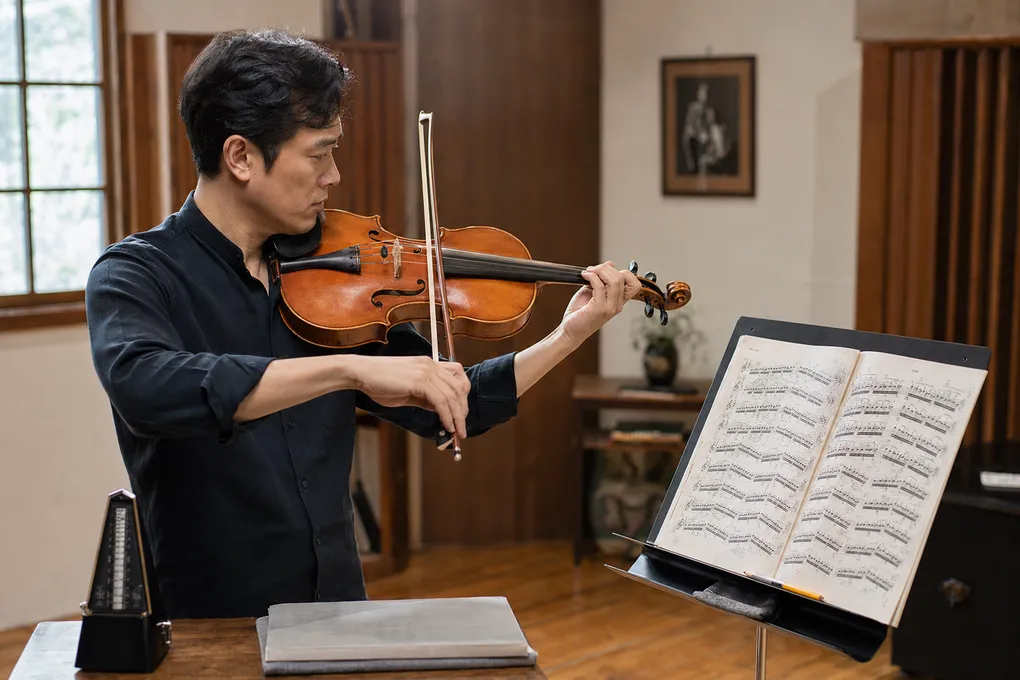
For an advanced violist, scale practice is no longer about proving that the fingers know the notes. That stage has already passed. The real question is whether scales can organise the whole playing mechanism: left-hand frame, shifting, bow distribution, intonation, sound, rhythm, memory, and musical direction.
This is why the serious study of scales should not be limited to one book or one routine. A Carl Flesch scale, a Galamian acceleration pattern, a Dounis-style finger exercise, a slow double-stop scale, and a single singing scale in one octave do not train the same thing. They may share the word “scale”, but they ask different questions of the player.
For viola students preparing auditions, conservatory study, competitions, or demanding repertoire, the value of scale practice lies in choosing the right kind of scale for the right technical and musical purpose.
This is the advanced companion to effective viola scales for better practice. Students preparing graded exams may also want the more exam-focused guide to ABRSM viola scales.
Advanced scale work is most useful when it feeds directly into repertoire, auditions, and sound control. For that wider context, see practising slowly without losing the musical line and the music school audition checklist.
The Basic Scale Is Still Not Basic
Even at a high level, the plain three-octave scale remains central. It is the simplest diagnostic tool we have. If the tone narrows in the upper register, if the left hand tightens during shifts, if the bow loses contact on string crossings, or if the return down the scale feels less organised than the ascent, the scale has exposed something useful.
The point is not to play it faster every week. Speed has value only when the structure underneath it is stable. A serious three-octave scale should show:
- a clear tonal centre before the first note
- a consistent hand frame through positions
- prepared shifts that are heard before they are played
- an even sound across all four strings
- bow changes that belong to the phrase
- a controlled return to the tonic, not a collapse after the top note
On viola, the descent deserves special attention. Many players practise ascent as achievement and descent as exit. But the way down often reveals whether the ear is still active and whether the left hand can release without becoming loose. A beautiful descending scale is a mark of real control.
Carl Flesch: The Complete Technical Map
The Carl Flesch scale system is one of the great comprehensive scale methods for bowed strings. It is not simply a collection of scales in different keys. It is a way of mapping the fingerboard through major and minor scales, arpeggios, dominant sevenths, diminished sevenths, chromatic scales, thirds, sixths, octaves, tenths, and related patterns.
For advanced violists, Flesch is valuable because it refuses to separate technique into small isolated tricks. A key is explored from several angles: stepwise motion, broken harmony, extension, contraction, shifting, and double-stop intonation. This is close to how repertoire actually behaves. A Brahms sonata, a Bach suite, a Walton passage, or an orchestral excerpt will rarely ask only for a neat scale. It asks for harmonic awareness, fast adjustment, and a hand that understands the geography of the instrument.
The danger with Flesch is completeness without listening. It is easy to turn the system into a daily endurance test. That is not the most intelligent use. A better approach is to choose one key and work deeply: one day for sound and intonation, another for shifting, another for double stops, another for tempo and articulation. The method is large enough to punish mindless repetition, but it rewards clear intention.
Use Flesch when you need a full technical audit of a key.
Galamian: Rhythm, Acceleration, and Freedom
Ivan Galamian’s scale approach is often associated with rhythmic groupings and acceleration patterns. The core idea is extremely useful: instead of jumping from slow practice to fast playing, the player trains controlled speed through varied rhythms, note groupings, bowings, and gradual compression of time.
For viola, this is especially important because the instrument can tempt players into heavy preparation. We want depth of sound, but not sluggishness. Galamian-style work helps the left hand learn speed without panic and helps the bow stay rhythmically alive while the fingers move faster.
A simple Galamian-inspired routine might take one scale and practise it in groups of two, three, four, six, eight, and twelve notes per bow or pulse. The notes are the same, but the relationship between mind, hand, and bow changes each time. Accents can be moved through the group so the player does not depend on the first note for orientation.
This matters because repertoire often hides difficulty inside uneven rhythmic stress. A passage may be technically manageable when the hand is allowed to feel downbeats, but unstable when accents fall in unexpected places. Galamian-style scale practice teaches the player to remain organised when the rhythmic surface changes.
Use Galamian when you need speed that stays coordinated, rhythmic, and free.
Dounis: Independence and Neuromuscular Precision
Dounis exercises are not scale practice in the ordinary sense, but they belong in this discussion because they address one of the deeper problems behind advanced scale playing: independence. Demetrius Constantine Dounis was concerned with the player’s physical organisation, especially the independence and responsiveness of the fingers, the release of unnecessary tension, and the connection between mental command and physical action.
Applied to viola scales, a Dounis-informed approach asks whether each finger can act clearly without dragging the rest of the hand with it. Can the fourth finger remain alive without stiffness? Can one finger drop while another releases? Can the hand frame stay balanced during extensions? Can speed come from readiness rather than force?
This kind of work is often slow, exacting, and mentally tiring. It is not glamorous. But it is powerful for advanced players who feel that their scales are correct but not clean, fast but not relaxed, or secure in one key but unreliable in another.
One practical application is to isolate small fragments of a scale and practise finger preparation and release without squeezing. Another is to use rhythms that expose weak fingers or delayed coordination. The goal is not to make the exercise sound impressive. The goal is to make the hand more intelligent.
Use Dounis-style work when the issue is not knowledge of notes, but the physical quality of response.
Double-Stop Scales: Intonation You Cannot Fake
Double-stop scales are among the most honest forms of scale practice. Thirds, sixths, octaves, fingered octaves, and tenths each reveal a different part of the hand. They also reveal whether intonation is being understood harmonically or merely corrected note by note.
For violists, thirds and sixths are especially useful because they train the hand to hear vertical relationships while still moving horizontally. Octaves demand clarity of frame and a calm shifting mechanism. Tenths require care; they are valuable for some advanced hands but should never be forced. The viola is not built in one standard size, and hand size, instrument length, and setup all matter.
The most important rule is that double stops must be practised as sound, not as pressure. If the player squeezes to hold both notes, the exercise teaches tension. The bow should draw the interval into resonance, and the left hand should search for balance rather than grip.
Do not rush double-stop scales. Their purpose is not velocity first. Their purpose is to refine the ear, clarify the frame, and teach the player to hear harmony under the fingers.
Use double-stop scales when you need intonation to become structural rather than approximate.
Chromatic, Whole-Tone, and Modal Scales
Advanced scale practice should also move beyond major and minor. Chromatic scales train compactness, finger substitution, shifting economy, and the ability to keep pitch relationships small without becoming tense. They are essential for modern repertoire, orchestral writing, and passages where the hand must move by half step without losing tonal clarity.
Whole-tone scales train a different ear. Because there is no conventional leading tone, the player cannot rely on normal tonal gravity. This is useful for music with floating harmony or impressionistic colour, and it forces the bow to shape the line when the harmony does not provide obvious arrival points.
Modes are equally valuable. Dorian, Phrygian, Lydian, and Mixolydian patterns change the character of familiar finger relationships. For a violist, this is not theoretical decoration. Modal awareness helps with early music, folk-influenced writing, contemporary repertoire, and passages where major-minor thinking is too narrow.
Use these scales when you want the ear to become more flexible and less dependent on standard tonal habits.
Scales in Repertoire Keys
One of the most efficient advanced habits is to practise scales in the keys of current repertoire. If the student is working on Hindemith, Bach, Clarke, Brahms, Walton, or orchestral excerpts, the daily scale work should speak directly to that musical world.
This does not mean only playing the tonic scale of the piece. It means identifying the keys and harmonic regions that cause difficulty. A passage may need E-flat minor comfort, dominant seventh clarity, chromatic shifting, or thirds in a particular position. Once identified, the scale work becomes targeted rather than general.
This is where advanced practice becomes genuinely professional. The scale is no longer a separate technical ritual. It becomes preparation for the exact musical demands of the repertoire.
Use repertoire-key scales when you need technique to transfer immediately into music.
How to Build an Advanced Scale Routine
A serious violist does not need to practise every scale type every day. That usually leads to fatigue and shallow concentration. A more effective routine rotates purposes.
For example:
- one key as a full Flesch-style technical map
- one Galamian-style acceleration pattern for speed and coordination
- one slow double-stop scale for intonation
- one chromatic or modal scale for ear flexibility
- one scale connected directly to current repertoire
The routine should be demanding but not bloated. Fifteen minutes of exact, listening scale practice can be more valuable than forty minutes of unfocused technical labour. The test is simple: after scales, does the player sound freer, more centred, and more ready to play music? If not, the routine may be too mechanical.
The Professional Purpose of Scales
Professional scale practice is not about covering material. It is about removing avoidable uncertainty from the instrument.
Flesch gives the player a map. Galamian gives rhythmic command and controlled speed. Dounis gives physical precision and independence. Double stops give harmonic truth. Chromatic, whole-tone, and modal scales widen the ear. Repertoire-key scales make the work practical and immediate.
For an advanced violist, the question is not whether scales are necessary. They are. The better question is: what kind of scale does my playing need today?
When that question is asked honestly, scales stop being a duty inherited from teachers and exam syllabuses. They become one of the most direct ways to build authority on the instrument: a clearer ear, a freer hand, a more responsive bow, and a sound that can carry musical thought without hesitation.