What Suzuki Pedagogy Offers Viola Students
What Suzuki pedagogy offers viola students in Hong Kong: listening, steadiness and musical growth from the beginning.
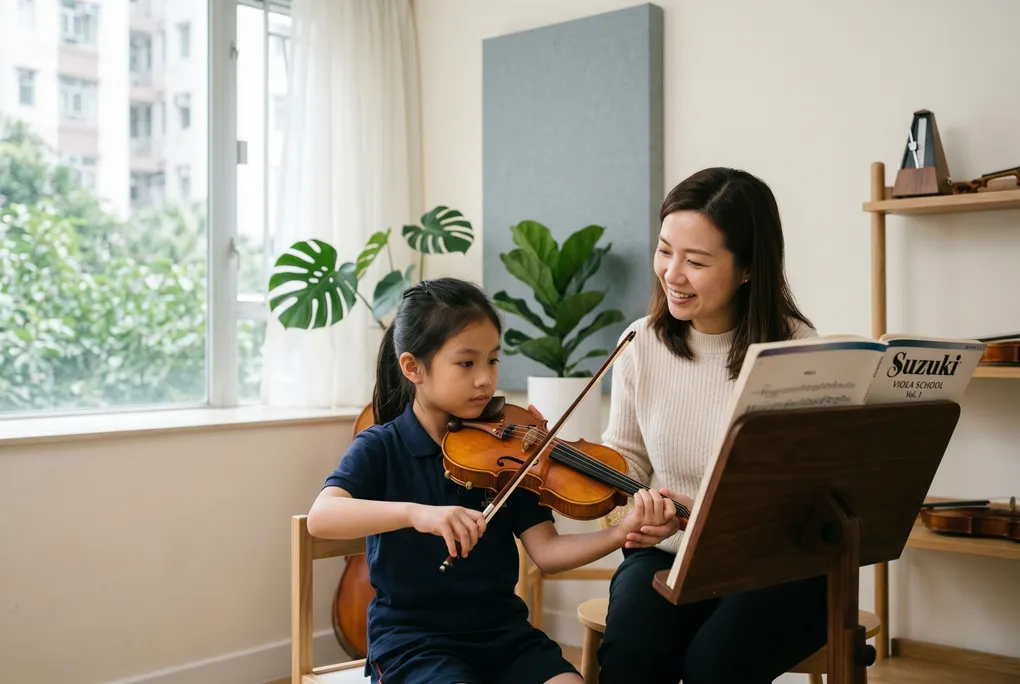
Because Suzuki-influenced teaching depends so much on listening and repetition at home, this article connects closely with how parents can support music practice at home and how much a child should practise music each day.
In Hong Kong, music lessons are often discussed in practical terms very quickly. Parents ask about reading, exams, weekly progress, and whether a child is moving fast enough. Those are understandable questions. But they can also make it easy to overlook a deeper one: what kind of musical foundation is actually being built?
That is one reason Suzuki pedagogy remains so valuable, especially for young string players. It is sometimes misunderstood as a soft method, or as something that is only about imitation. In fact, what makes it distinctive is not that it lowers standards, but that it organizes learning around listening, repetition, careful sequencing, and a strong sense of environment. For viola students in particular, that matters a great deal.
What is special about Suzuki pedagogy
The central idea behind Suzuki teaching is often described through the “mother tongue” approach. A child learns language first by hearing it constantly, living inside it, repeating it, and gradually making sense of it through use. Reading and writing come later. Suzuki applies a similar principle to music: the ear is trained early, the body learns through guided repetition, and musical understanding is built from lived sound rather than from symbols alone.
That does not mean notation is unimportant. It means notation is not the first doorway.
This difference is more important than it may first appear. In many systems, students are quickly asked to decode information: note names, finger numbers, rhythms on the page. Suzuki, by contrast, asks whether the student is first learning to hear, to remember, to imitate a healthy sound, and to experience music as something alive. The emphasis on listening before reading often allows students to play with more natural phrasing and steadier tone at an earlier stage than one might expect.
Another special feature is the careful use of small steps. Repertoire is sequenced so that each piece introduces one or two new demands while reinforcing previous habits. Review is not treated as remedial. It is part of the method itself. Students return to earlier pieces so that posture, tone, rhythm, memory, and confidence are strengthened over time instead of being discarded as soon as the next assignment appears.
There is also a strong emphasis on the learning environment. Teacher, parent, and student are not treated as separate worlds. Especially in the earlier years, home listening and thoughtful parental support help shape the student’s consistency. In a city like Hong Kong, where schedules are often crowded and children move quickly from one demand to the next, that kind of stable musical environment can be unusually valuable.
Why Suzuki works especially well for viola learning
The viola asks for patience from the beginning. Its size, weight, and response are different from the violin. A student cannot rely on superficial brightness. They have to learn how to draw sound more fully, how to balance the instrument comfortably, and how to listen for resonance rather than merely for whether the note has spoken.
Suzuki pedagogy supports this well because it gives so much importance to the quality of sound from the earliest stages. A violist benefits from being taught that tone is not an optional extra to think about later. It is part of the basic language of the instrument. Through repeated listening, imitation, and guided tonal work, students begin to recognize what a centered, ringing viola sound feels and sounds like.
The method also helps with intonation in a particularly musical way. On viola, pitch security depends not only on left-hand accuracy, but also on a settled inner ear. Because Suzuki students spend so much time listening and memorizing, they often build a stronger relationship between what they hear internally and what they produce physically. That connection matters on every string instrument, but on viola, where the ear has to guide a warmer and often less immediately brilliant register, it is especially useful.
Memorized repertoire can also be freeing. When a student’s attention is not consumed too early by the page, they often have more space to notice balance, bow distribution, contact point, and phrase shape. This does not replace reading. It simply allows some important physical and musical habits to settle before too many demands compete at once.
Suzuki group learning is another strength. Viola students can sometimes feel isolated because there are fewer of them than violinists in many schools and studios. Group classes create a sense of shared work. Students hear others playing the same pieces, learn by observing, and gradually become more comfortable making music with others. For violists, who will often spend much of their musical life inside ensemble textures, that communal side of learning is not incidental. It is excellent training.
Why it is beneficial in Hong Kong
The benefit of Suzuki pedagogy in Hong Kong is not simply that it helps children start young. Its deeper value is that it can protect the early years of learning from becoming too narrow.
Local music culture often rewards visible progress. A child who can show the next page, the next grade, or the next certificate is easy to understand. Suzuki asks us to value another kind of progress too: whether the ear is becoming sensitive, whether practice is becoming steady, whether posture is being built without panic, and whether music is already being experienced as expression rather than only as assessment.
That is a meaningful counterweight in an exam-conscious environment. Suzuki teaching is not anti-exam, but it does remind us that a student who listens well, repeats carefully, reviews intelligently, and develops a warm relationship with sound is building something more durable than short-term preparedness.
It can also be beneficial for family life. Many Hong Kong households are busy, and practice can easily become a site of tension. Suzuki’s emphasis on routine listening, small goals, and patient repetition can make home practice more workable. The point is not to make parents into full-time teachers, but to help them support a healthy atmosphere around learning.
That makes Suzuki pedagogy closely related to the wider question of how parents can support music practice at home and how much a child should practise music each day.
For viola students specifically, Suzuki offers a way of growing into the instrument without apology. The viola is sometimes introduced as a secondary option or as a later transition. But when the learning process begins with listening, tone, and ensemble awareness, the instrument’s real strengths become easier to recognize early on. Students begin not only to play the viola, but to understand how the viola thinks.
What Suzuki does not mean
It is worth saying clearly that Suzuki pedagogy is not a shortcut, and it is not an excuse to neglect reading, discipline, or thoughtful technical work. Good Suzuki teaching still requires careful posture, rhythm, intonation, and long-term planning. Reading should eventually be taught well. Technical problems still need direct attention. Not every student will move at the same pace, and the method only works properly when it is taught with seriousness and flexibility.
But these are not weaknesses in the approach. They are reminders that Suzuki is most effective when understood as a complete educational philosophy rather than a bag of teaching tricks.
A quieter kind of strength
What Suzuki pedagogy offers viola students is, above all, a strong beginning. It builds the ear before it floods the eye. It treats review as growth rather than repetition for its own sake. It values tone, memory, attentiveness, and environment. And in a place like Hong Kong, where music study can become hurried or overly measured, that is not a small thing.
For the right student, Suzuki does more than help them start the viola. It helps them start music in a way that is patient, musical, and sustainable.