ABRSM Online Exam Recording: Technique and Stress
ABRSM online exam recording advice for Hong Kong students: prepare musically, manage recording stress and stay focused when the camera is on.
Many students assume that an ABRSM online exam is easier than walking into a live exam room. In practice, it is not easier. It is simply a different kind of pressure.
For students in Hong Kong, that difference matters. A live exam disappears the moment it ends. A recording does not. It can be repeated, reviewed, doubted, and over-analysed. That changes the psychology of preparation, and it also changes the kind of technique that matters most.
As of 14 April 2026, the HKEAA ABRSM page still describes Performance Grades as digital exams available on demand, with the video submitted at booking or within the following 28 days. In the current ABRSM bowed strings Performance Grades specification, candidates present four pieces in one continuous performance, with no break in the programme. That point alone explains a lot: the exam is not just testing whether each piece is prepared. It is testing whether the player can build and sustain a performance.
For the administrative side of booking, uploading, and results, see the step-by-step ABRSM exam procedure guide for Hong Kong. When you are ready to enter the exam online, use the screen-by-screen ABRSM recorded practical exam enrolment and file submission guide. If you are still comparing digital and live routes, begin with ABRSM viola exams in Hong Kong: online or live.
Technique for an online exam is not only instrumental technique
When people hear the word technique, they often think immediately of intonation, rhythm, articulation, shifting, bow control, and coordination. Of course these still matter. But for an online exam, technique also includes how you start, how you recover, how you move from one piece to the next, and how steadily your musical intention survives the presence of a camera.
This is why recording preparation should not be left until the end. A student should not spend weeks practising four separate pieces and then suddenly discover, two days before submission, that the real difficulty is stamina, pacing, page-turning, tuning, or keeping concentration through transitions.
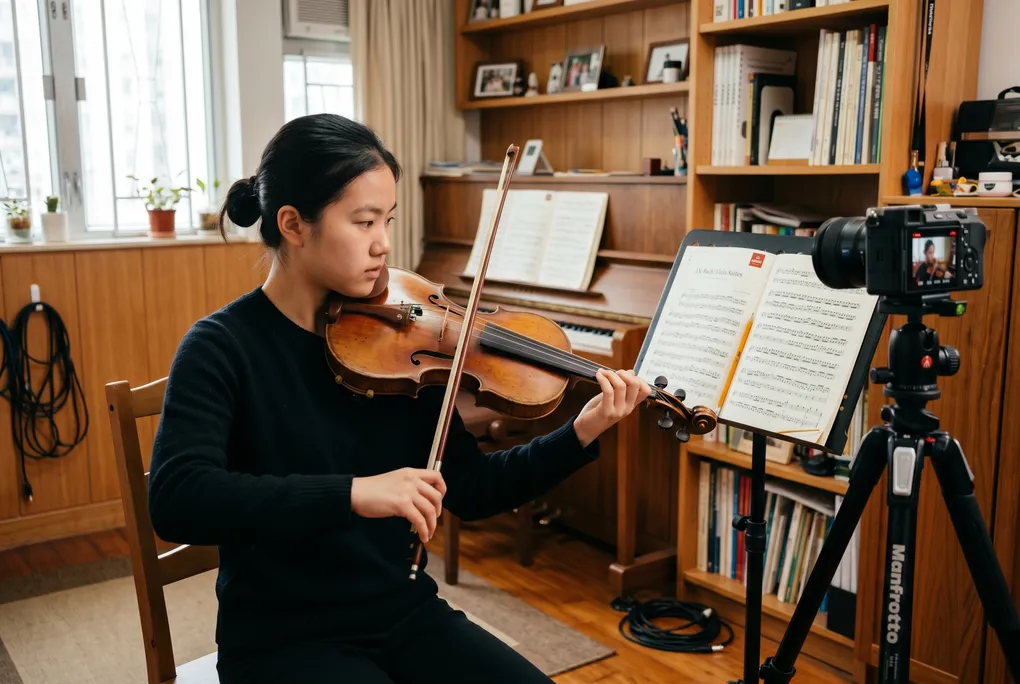
In Hong Kong, there are also very ordinary local realities that affect results more than people expect. Many homes are small. Floors and walls can make the sound feel hard or boxed in. Street noise may arrive exactly when the best take begins. The piano may be too close. The camera may be placed where the instrument is visible but the sound becomes thin. None of this is dramatic, but all of it affects confidence.
For that reason, good online-exam technique starts with three practical habits.
First, rehearse the full programme regularly, not only the individual pieces. Do not wait until every detail feels perfect. Run the whole sequence early enough that transitions become normal rather than frightening.
Second, practise under recording conditions before the real recording day. Use the actual room if possible. Check whether the opening note speaks easily, whether softer dynamics still carry, and whether the performance still feels musically alive when you cannot stop after a small lapse.
Third, simplify the setup. A clean frame, stable device position, readable music, and a calm room do more for a student than complicated equipment. The goal is not cinematic polish. The goal is to remove avoidable distractions so the playing can speak.
The real stress of recording is usually mental, not technical
Recording creates a particular kind of anxiety because it tempts students into false perfectionism. A live performance asks, “Can you keep going?” A recording often whispers, “Can you do it without any flaw at all?” That is a dangerous question, because it leads students away from communication and toward self-surveillance.
The result is familiar. By the sixth or seventh take, the student is no longer hearing phrasing, harmony, pulse, or character. They are listening only for danger. The bow arm tightens. Breathing becomes shallow. Beginnings become cautious. Endings lose shape. What was musical in the practice room becomes guarded in front of the camera.
The answer is not simply “relax”. Students need a structure that makes relaxation more likely.
One helpful approach is to separate preparation days from submission days. On one day, you record working takes and learn from them. On another day, after rest, you make the takes that could actually be submitted. This protects the student from feeling that every run-through must immediately become a final verdict.
Another helpful approach is to limit the number of serious takes. Endless repetition usually lowers quality rather than raising it. A student who knows there are, for example, three proper takes available will often play with more direction than a student who assumes they can record twenty times.
It also helps to decide in advance what counts as acceptable. A convincing take is not the same thing as a flawless take. If tone, pulse, shape, and character are present, a small imperfection inside an otherwise musical performance may be less serious than a technically neat take that sounds afraid.
For younger students, the emotional temperature of the room matters too. Parents and teachers do not need to become additional examiners. Calm practical support is better than constant commentary after every attempt.
What to focus on while the recording is happening
The most useful mental focus during recording is usually narrower and more musical than students expect.
Do not think about the final result while playing. Do not think about the mark. Do not think about whether this take is “the one”. Those thoughts arrive too early and make the body behave defensively.
Instead, focus on the next musical responsibility.
At the beginning of a piece, think about pulse and character. Not “I must not make a mistake”, but “What kind of first bar is this?” Is it singing, dancing, grounded, bright, inward, poised? If the first gesture has a clear identity, the body often organises itself more naturally.
Inside the piece, focus on line rather than individual notes. A player who thinks only from note to note usually sounds smaller on a recording. A player who thinks from phrase to phrase sounds more settled, even when the technique is not perfect.
That is why slow practice before recording should still preserve pulse and direction. I go into that process more fully in practising slowly without losing the musical line.
In passages that feel exposed, focus on the quality of the beginning of each note. Online recordings often magnify uncertainty at the front of the sound: hesitant attacks, unclear string crossings, late finger preparation, and beginnings that do not quite speak. Very often, improving the start of the note improves the whole phrase.
After a minor slip, focus on continuity. In a digital Performance Grade, the examiner is still listening for a sustained performance, not for panic after an error. The student who keeps the tempo alive and the musical line intact usually sounds more mature than the student who reacts visibly to every imperfection.
Between pieces, focus on resetting the atmosphere rather than recovering from the previous one. One of the subtle skills in an online exam is emotional transition. The silence before the next piece is part of the performance. Use it to hear the new tempo inwardly, release the shoulders, and enter the new character with intention.
A recording should sound alive, not merely safe
This may be the most important point of all. Online exams encourage control, but control is not the same thing as musical life.
Students sometimes submit the take in which the fewest things went wrong. That is understandable, but it is not always the strongest choice. The better question is whether the performance has energy, shape, and a believable sense of direction. Is there breathing in the phrasing? Is there courage in the sound? Does each piece sound as if the player understands why it exists?
In Hong Kong, where students are often balancing school pressure, tight schedules, limited space, and the practical convenience of on-demand submission, it is easy to let the recording process become administrative. But an ABRSM online exam is still a musical performance. The camera changes the conditions, not the purpose.
So the aim should not be to think less, but to think better. Not “How do I avoid every mistake?” but “What does this music need from me, now, from the first note to the last?”
That shift of attention is often what turns a tense recording into a persuasive one.