ABRSM Exam Procedure in Hong Kong: Booking to Results
Hong Kong ABRSM exam procedure guide: Practical and Performance Grade booking, documents, exam-day rules, recording requirements and results.
ABRSM procedure can feel simple from a distance: choose a grade, book the exam, prepare the music, take the exam, wait for the result. In real life, most problems happen in the small spaces between those steps.
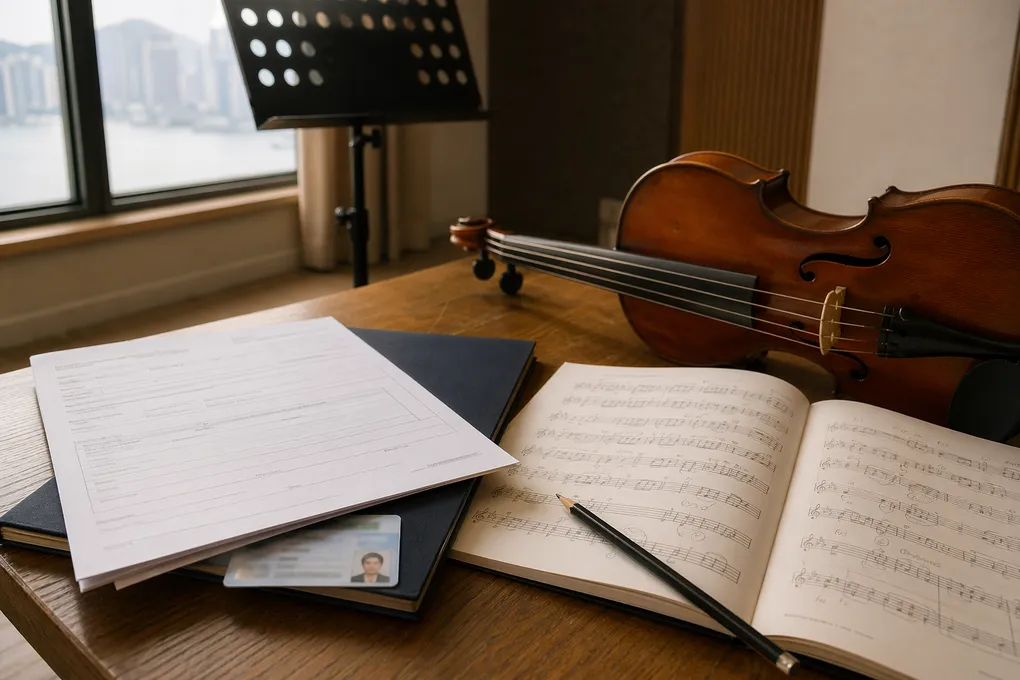
A name on an ID document does not match the booking. A Grade 6 prerequisite is assumed rather than checked. A digital exam video is recorded beautifully but not in one continuous take. A candidate arrives without the correct programme form. A parent thinks a school closure automatically means the exam is cancelled. None of these problems is musical, yet any one of them can make an exam day unnecessarily stressful.
This guide is written for Hong Kong students, parents, and teachers who want the whole ABRSM process in one clear place. It focuses on Practical Grades and Performance Grades, because those are the routes most instrumental and singing candidates are comparing. It is based on the current HKEAA ABRSM Practical Grade and Performance Grade page, the ABRSM Performance Grades guide, and ABRSM syllabus and regulation materials available as of 23 April 2026. Always check the official pages again before booking, because dates, fees, and administrative arrangements can change.
If you are still deciding whether to take the live or digital route, start with my broader guide to ABRSM viola exams in Hong Kong. Students who already know they want a face-to-face exam may find the ABRSM live viola exam guide more directly useful, while candidates choosing the digital route should also read about ABRSM online exam recording technique and the step-by-step ABRSM recorded practical exam enrolment and file submission guide. For a parent-focused summary of the current fee table and booking windows, see ABRSM viola exam fees, dates and booking in Hong Kong.
Step 1: Choose the right ABRSM route
The first procedural decision is not the grade. It is the route.
In Hong Kong, HKEAA describes ABRSM Practical Grades as face-to-face examinations and Performance Grades as digital examinations. They are both recognised ABRSM graded exams, but they are not the same musical task.
| Route | Format | What the candidate prepares | Best suited to |
|---|---|---|---|
| Practical Grade | Face-to-face exam | Pieces, technical work, sight-reading, aural tests | Students who need a rounded test of musicianship, response, reading, listening, and technique |
| Performance Grade | Digital video submission | Four pieces or songs as a continuous programme | Students ready to present a sustained performance with strong pacing, character, and musical communication |
For a Practical Grade, the examiner leads the exam in the room. In many instruments, including bowed strings, the exam includes three pieces, technical work such as scales and arpeggios, sight-reading, and aural tests. The marks total 150, with 100 for a pass, 120 for merit, and 130 for distinction.
For a Performance Grade, ABRSM assesses a submitted video recording. The candidate performs four pieces or songs as a continuous programme. For most non-jazz subjects, three pieces are chosen from the syllabus, one from each list, and the fourth is an own-choice piece. Each piece is marked out of 30, and the performance as a whole receives another 30 marks, again making 150 in total.
The common mistake is to treat Performance Grade as the easier Practical Grade. It is not. It removes scales, sight-reading, and aural tests from the exam format, but it asks for a longer musical arc. It also asks the candidate to manage recording pressure, room setup, programme order, and the discipline of one continuous take.
Step 2: Check the grade, syllabus, and prerequisites
Once the route is clear, check the actual syllabus for the instrument and grade. Do this before buying music, booking the exam, or promising a timeline.
For Initial Grade to Grade 5, HKEAA states that there are no specific entry requirements for Practical and Performance Grades. Candidates do not have to take every grade in order. A student may skip grades if the level is musically appropriate.
Grades 6, 7, and 8 are different. Candidates entering these grades must already have passed Grade 5 or above in Music Theory, Practical Musicianship, or an accepted solo Jazz subject. ABRSM also accepts certain alternative qualifications, but those should be checked directly with ABRSM before booking if there is any doubt.
This prerequisite catches families surprisingly often. A student may be technically ready for Grade 6 repertoire, but if the theory or accepted alternative is not in place, the booking becomes risky. For Hong Kong candidates, HKEAA notes that if ABRSM asks for prerequisite submission, candidates should email a digital colour copy of the Grade 5 or above certificate or mark form to HKEAA using the requested format.
The practical advice is simple: for Grade 6 to 8, check the prerequisite before choosing the exam date. Do not leave it until the booking week.
Step 3: Know when and how booking works
For most Practical Grade instrumental and singing exams in Hong Kong, applicants register and pay through the ABRSM online booking service. Choral Singing and Ensembles are exceptions handled through HKEAA’s own online booking route during the relevant period.
Practical Grade bookings depend on examination sessions. HKEAA publishes the local timetable, including the examination dates and registration dates. As of the current 2026 HKEAA page, Hong Kong Practical Grade sessions include March to April, August to September, and October to November 2026, each with its own booking window. Those windows are short. Missing the booking period usually means waiting for the next session.
Performance Grades are different. Since August 2022, HKEAA states that digital Performance Grade and ARSM Music Performance exams are available on demand. There are no booking periods or examination sessions. Applicants can book at any time and submit the video when making the booking or within the following 28 days.
For Online Music Theory Grades 1-5, the booking screens are slightly different from instrumental Performance Grades. Use the separate ABRSM Online Music Theory enrolment guide if you are booking the theory prerequisite rather than an instrumental exam.
Before booking, have these details ready:
- candidate’s full English name as it appears on the identity document
- candidate’s date of birth
- subject, grade, and route
- candidate or parent/carer email address
- any access arrangement or reasonable adjustment request
- prerequisite evidence for Grade 6 to 8, if needed
- payment method, remembering that ABRSM online payments may be treated as international transactions by banks or card issuers
The name and ID details matter. They are not decoration. They are used for identity checking, and mismatches can become serious on exam day.
Step 4: After booking, watch the account and emails
After a Practical Grade booking, the applicant should check the assigned examination date, time, and venue in the ABRSM account and inform the candidate clearly. Do not rely on memory, screenshots sent weeks ago, or a half-remembered lesson conversation.
HKEAA says that no admission forms are required for Practical Grade and Performance Grade exams. For face-to-face Practical Grade sessions, the “Notes to Applicants and Candidates” are emailed to applicants about two weeks before the first date of the Practical Grade exam session and are also made available for download when relevant.
Read those notes. They are not just formal language. They tell you arrival time, ID requirements, programme form requirements, waiting-room arrangements, electronic-device rules, bad-weather procedures, and result information for that particular session.
For Performance Grades, the important deadline is the upload deadline. Once booked, the video must be submitted within the given 28-day period. Treat the deadline as a hard wall, not a target to approach at midnight with a large file and an unstable internet connection.
Step 5: Prepare the Practical Grade paperwork and exam-day items
For a face-to-face Practical Grade in Hong Kong, the candidate should arrive 15 minutes before the assigned examination start time and report to the steward. Candidates arriving after the assigned start time may not be examined and may be marked absent if refused admission because of lateness.
The candidate must bring an original official valid identification document with a photograph and English name. HKEAA states that the English name and ID number must match the information submitted during booking. Student handbooks, student cards, and photocopies are not accepted. If the candidate’s ID document has no photograph, the completed ABRSM Candidate Identification Form with photo is also required.
There are Hong Kong-specific identity caveats. HKEAA notes that British National (Overseas) passports cannot be used as proof of identity in Hong Kong, and old forms of smart Hong Kong Identity Cards issued before 26 November 2018 have been invalidated according to the relevant HKSAR government order. If a candidate still has an old HKID card, fix that before the exam period.
Candidates taking Prep Test, Initial Grade, or Grades 1 to 8 must submit the completed ABRSM Exam Programme & Running Order Form to the examiner. ARSM candidates use the ARSM Programme Form instead. The form should match the music actually performed.
Bring only what belongs in the exam room: the instrument, the programme form, music books, and syllabuses where relevant. HKEAA specifically warns that unauthorised items such as specimen sight-reading, aural test materials, scales books, or aural books are not allowed in the exam room. Electronic devices must be switched off before entering; alarms should be disabled as well. No photos, audio recordings, or video recordings are allowed inside the examination centre.
For instruments other than piano, candidates bring their own instruments unless specific arrangements apply. Large-instrument candidates should contact the examination centre at least one week before the exam day to make sure there is enough space and to make any necessary arrangements.
For string and wind candidates, the instrument must be tuned to the piano in the examination room immediately before the exam. In Initial Grade to Grade 5, the teacher or accompanist may tune or advise before the exam begins. In Grades 6 to 8 and ARSM, candidates must tune their own instruments. This is a small procedural rule with a large psychological effect: higher-grade candidates should practise tuning calmly under exam conditions.
Step 6: Understand what happens inside a Practical Grade
In a Practical Grade, the examiner is not trying to trick the candidate. The exam has a structure, and the structure is predictable even though some materials, such as sight-reading and aural tests, are unseen or unheard in advance.
The exact order may vary, but candidates should be ready for these areas:
- prepared pieces or songs
- technical work, such as scales and arpeggios where required
- sight-reading or the relevant equivalent task
- aural tests
For many instruments, at least one piece may require accompaniment. Candidates must provide their own accompanist where accompaniment is required. The examiner will not accompany. The teacher may act as accompanist if appropriate, but the accompanist must be punctual and musically prepared. A weak accompaniment can unsettle a strong candidate, especially in higher grades.
Playing from memory is optional for face-to-face Practical Grades, but if a candidate plays prepared pieces from memory, copies of the music must still be brought for the examiner’s use. If photocopies are used for that purpose, permission must be obtained where required.
If the candidate needs assistance during the exam, such as adjusting a piano stool, HKEAA advises asking the examiner at once. Waiting until after the exam to raise a problem may make a special consideration request difficult or impossible.
Step 7: Prepare the Performance Grade recording properly
For a Performance Grade, the exam venue is chosen by the candidate or applicant. It can be a home, school, teacher’s studio, or another suitable space with appropriate instruments, equipment, and accompaniment arrangements. The room does not have to look impressive. It has to allow the examiner to hear and see the performance clearly.
The recording must be one continuous audio-visual file. Once recording begins, the candidate makes the required announcement, shows any required materials, and performs all repertoire in one take. The recording must not be paused, stopped, stitched together, or edited.
This is the point where many candidates misunderstand the digital route. You may record more than one complete take before choosing the submission, but the submitted file itself must be continuous and unedited.
For Performance Grades, the candidate should announce the candidate name, subject, grade, and pieces in performance order. ABRSM’s current Performance Grades page states that for most non-jazz subjects, the programme includes three syllabus pieces, one from each list, plus one own-choice piece. If using an own-choice piece, the opening of that music must be shown to the camera before the performance begins so the examiner can see the title and opening musical information. For Grades 6, 7, and 8, candidates should also be ready to show photo identification to the camera according to ABRSM’s candidate identification requirements.
If the candidate is under 18, the recording process must be overseen by a responsible adult aged 18 or over. That adult may be a parent, teacher, or applicant. Their role is not to coach during the take. Their role is to make sure the process follows the rules, and to complete the required declaration during submission where applicable.
Use a static camera. The candidate’s face, instrument, and music stand should be clearly visible throughout, with accompanists in view where possible. The candidate should remain the main focus if the frame cannot include everyone equally. Test the balance before the real take. A beautiful performance that is distorted, covered by piano, or too quiet has made the examiner’s job harder.
ABRSM guidance has commonly advised setting the recording to 720p to keep quality clear while avoiding an oversized file. The file should be in an accepted video format such as MP4, WMV, MOV, or MPG, with a maximum size of 2GB. Use a filename with only letters, numbers, underscores, or dashes. Spaces and unusual characters can cause upload problems.
Before uploading, watch the whole file. Check that the beginning procedures are present, the audio is not distorted, the video is not mirrored in a confusing way, the file is the correct take, and the programme order matches the online programme form. You normally get one submission. Do not treat upload as rehearsal.
Step 8: Submit the digital exam without drama
When submitting a Performance Grade, the applicant or candidate completes the online programme information and declaration in the ABRSM account. If the candidate is under 18, the responsible adult who oversaw the recording should be present for the upload because they may need to complete the declaration.
Do not upload from a weak connection if you can avoid it. A large video file can take time. If the connection drops briefly, uploads may resume, but a longer disconnection can stop the upload and force you to try again. Leave time for this.
There are also integrity rules. The recording is for ABRSM assessment and should not be posted publicly or shared as social media content. A recording submitted for one qualification should not be reused for another. These rules protect both exam integrity and copyright interests in the music.
Step 9: Results, certificates, reviews, and concerns
For Practical Grades and Performance Grades from Initial Grade to Grade 8, HKEAA states that results and digital mark forms are released to the applicant’s ABRSM account within one week of the examination date or video submission. Candidates with ABRSM accounts gain access seven days later.
Digital certificates are available for successful candidates in the applicant’s ABRSM account when results are released, except for certain assessment types such as Prep Test and Open Music Assessment. If a paper certificate is wanted in addition to the digital certificate, it can be ordered through the ABRSM account with the relevant payment. As of the current HKEAA page, the Hong Kong paper certificate fee is HK$36 and dispatch can take up to four months after the order date.
For face-to-face examination delivery concerns and result review requests, HKEAA says these must be submitted to ABRSM within three weeks of the online result release. If something genuinely happened during the exam that may need consideration, act promptly and keep the account holder involved.
Prep Test and Open Music Assessment are different: candidates receive a paper certificate with examiner comments at the end of the assessment, and no marks are awarded.
Common caveats families miss
The first caveat is route confusion. “Online ABRSM” usually means Performance Grade, not the same Practical Grade delivered over video call. The content and preparation are different.
Some families are not only choosing between ABRSM routes, but between exam boards. If that is the real decision, compare the musical trade-offs in ABRSM vs Trinity exams before booking.
The second is the Grade 6 to 8 prerequisite. Do not book a higher-grade Practical or Performance exam assuming the Grade 5 theory requirement can be tidied up later.
The third is identity. The candidate’s English name and ID number should match the booking. Bring the original accepted ID. A student card is not enough.
The fourth is the Practical Grade programme form. It feels like a minor piece of paper until the candidate is standing outside the room without it.
The fifth is the Performance Grade continuous take. A clean edit is still an edit. If the take is interrupted, record a new complete take.
The sixth is accompaniment. For Practical Grades, the accompanist must be arranged and prepared. For Performance Grades, the accompaniment setup must also record clearly and balance with the candidate.
The seventh is bad weather. In Hong Kong, a school closure announcement does not automatically mean an HKEAA-administered ABRSM exam is postponed or cancelled. HKEAA says candidates should watch for official HKEAA announcements, normally made about two hours before the exam where postponement or cancellation is necessary.
The eighth is timing. Practical booking windows are short. Performance uploads have a 28-day window. Neither rewards last-minute administration.
A calm timeline to follow
Three to six months before the target exam, choose the route and grade with the teacher. Check the syllabus, repertoire lists, technical requirements, and any prerequisite. If the student is heading for Grade 6 to 8, confirm the prerequisite evidence early.
Two to three months before, settle the programme. For Practical Grades, check accompaniment needs, scales, sight-reading, and aural preparation. For Performance Grades, choose the fourth piece carefully and practise the full four-piece order as a performance, not only as separate pieces.
During booking, enter the candidate details exactly. Check spelling, ID number, email, subject, grade, route, and access arrangements before payment. Save the confirmation and keep watching the ABRSM account.
Two to four weeks before a Practical Grade, read the HKEAA notes for that session. Prepare the ID document, programme form, music, instrument, accompanist plan, route to the venue, and arrival time. For a Performance Grade, run complete practice takes in the actual room and test camera position, sound balance, lighting, storage space, and upload time.
On Practical exam day, arrive early, check in calmly, keep devices off, and ask the examiner immediately if practical help is needed. On Performance recording day, make the room quiet, remove avoidable interruptions, record complete takes only, and stop before fatigue starts making every take worse.
After the exam, check the ABRSM account for results. Read the mark form as feedback, not only as a number. If ordering a paper certificate, note the expected dispatch timeframe. If a review or concern is genuinely needed, act within the official deadline.
FAQ
Is a Performance Grade easier than a Practical Grade?
Not necessarily. It is different. Performance Grade removes scales, sight-reading, and aural tests from the exam format, but it requires a continuous four-piece programme and strong musical presentation. Some students find that freer. Others find recording pressure harder than a live room.
Can a candidate skip grades?
Yes, for Initial Grade to Grade 5 there are no specific entry requirements. For Grades 6 to 8, the Grade 5 theory, Practical Musicianship, accepted solo Jazz subject, or accepted alternative prerequisite must be satisfied.
Can the teacher book the exam?
An applicant may be a teacher, school, parent, or adult candidate, provided they use the appropriate ABRSM account and are eligible to make the booking. For candidates under 18, make sure parents understand deadlines, ID requirements, and who will receive results first.
Do Practical Grade candidates need an admission form?
HKEAA states that no admission forms are required for Practical Grade and Performance Grade exams. However, Practical Grade candidates still need the correct programme form and valid ID, and they should read the session notes carefully.
What if the candidate is late?
For Hong Kong face-to-face exams, candidates are told to arrive 15 minutes before the assigned start time. A candidate arriving after the assigned start time may be refused admission and marked absent.
Can a Practical Grade candidate play from memory?
Yes, playing prepared pieces from memory is optional, but the candidate must still bring copies of the music for the examiner. Copyright permission may be needed if photocopies are used.
Can a Performance Grade video have a break between pieces?
The programme is recorded as one continuous take. Any permitted pause or reset must remain inside the same continuous recording. Do not stop the camera.
Can parents or teachers speak during the Performance Grade recording?
The required announcement may be made as allowed by ABRSM guidance, and a responsible adult may help with process requirements. During the performance itself, people in the room should not coach, direct, or distract the candidate.
What happens if the upload fails?
Try again within the submission window. Leave enough time before the deadline for upload problems, file-size issues, or internet interruptions. Do not record on the final day and assume the upload will be painless.
When do results arrive?
For Practical and Performance Grades from Initial Grade to Grade 8, HKEAA currently states that results and digital mark forms are released to the applicant’s ABRSM account within one week of the exam date or video submission. Candidates with accounts gain access seven days later.
The point of getting procedure right
Good procedure is not the same as good music, but it protects the conditions in which good music can happen.
When the booking is accurate, the documents are ready, the route is understood, the recording rules are respected, and the candidate knows what will happen next, the exam becomes less mysterious. That does not remove nerves. It removes avoidable confusion.
And that matters. A student should be spending the final days before an ABRSM exam listening, shaping, practising intelligently, and building trust in their preparation. They should not be discovering, at the last moment, that the real test is a missing form.