ABRSM Live Viola Exam Hong Kong: Practical Grade Guide
A Hong Kong guide to the ABRSM live Practical Grade for viola: who it suits, what it tests, accompanist planning, scales, sight-reading, and aural preparation.
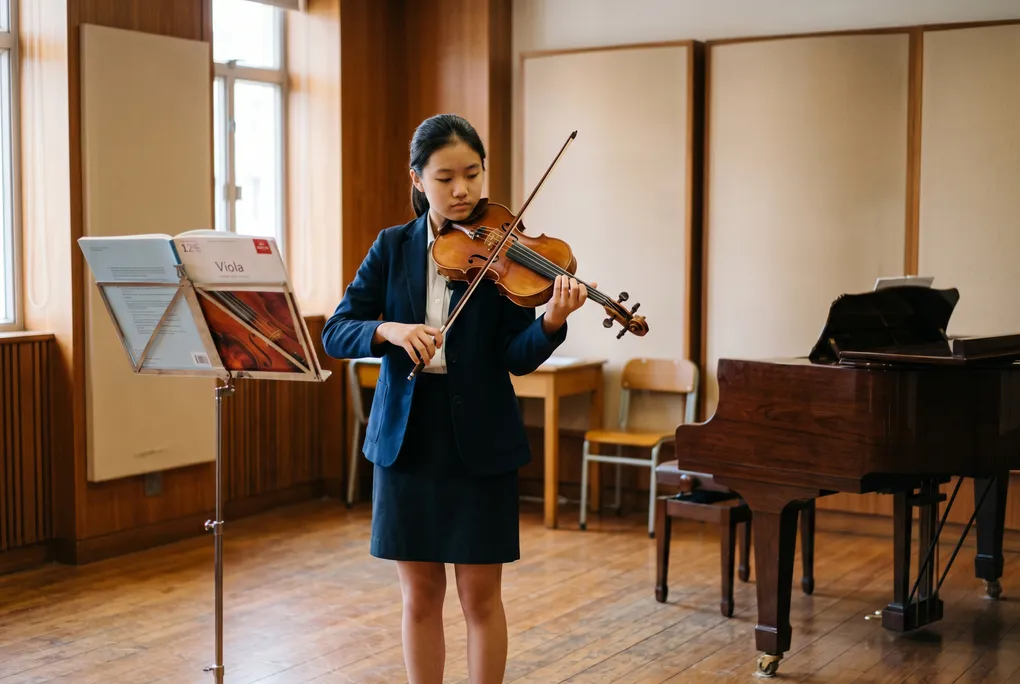
The live Practical Grade route makes scales, sight-reading, and aural work visible in a way the digital Performance Grade does not. For scales specifically, see ABRSM viola scales: how to practise them musically.
If you are still deciding between the live and digital formats, start with ABRSM viola exams in Hong Kong: online or live.
Families who need the administrative steps can also use the ABRSM exam procedure guide for Hong Kong.
For booking windows, current 2026 fee levels, and parent planning, see ABRSM viola exam fees, dates and booking in Hong Kong.
In Hong Kong, once a viola student reaches a serious stage of study, the same question appears sooner or later: if ABRSM now offers digital Performance Grades, is there still any reason to do the live exam?
I think there is, but not for everybody, and not for sentimental reasons. The live route still matters because it tests a fuller kind of musicianship. It asks not only whether a student can prepare repertoire, but whether they can arrive in a room, settle themselves, respond in real time, listen under pressure, and keep musical continuity when the next task is unknown. For many violists, that is not an outdated skill. It is the skill.
In Hong Kong, this matters especially because so many students are growing inside school orchestras, youth ensembles, chamber groups, and tightly scheduled school life. A musician who can only function in carefully controlled conditions will eventually feel that limit. The live exam does not solve everything, but it can reveal and strengthen things that a recorded submission does not touch.
What the live viola exam actually includes
In ABRSM’s current bowed strings syllabus, valid from 1 January 2024 until further notice, the face-to-face Practical Grade for viola includes three pieces, scales and arpeggios, sight-reading, and aural tests. The three pieces are chosen one from each of Lists A, B, and C. At least one piece must be accompanied. Scales and arpeggios are played from memory. In sight-reading, the candidate is given half a minute to look through the test and may try out part or all of it before playing. Aural tests are given by the examiner from the piano. The mark allocation is also worth knowing: 30 marks for each piece, 21 for scales and arpeggios, 21 for sight-reading, and 18 for aural tests, making 150 in total, with 100 needed for a pass.
For Hong Kong candidates, the local administrative picture is also clear on the HKEAA ABRSM page: Practical Grades are face-to-face examinations, while Performance Grades are digital. That distinction sounds obvious, but it helps to say it plainly because families sometimes use the word “online” as if it were simply another delivery mode for the same test. It is not. The live exam is a different musical task.
Who should still choose the live route
The live viola exam is not automatically the better route, and I would not push every student towards it. If a player is genuinely more ready to build a convincing four-piece programme than to respond on the spot, the digital route may give a fairer picture of their current musicianship.
But I do think the live route suits certain students especially well.
It suits the student whose playing is musical but whose technical housekeeping is still uneven. On viola, that often means intonation that works until the room becomes tense, bow distribution that sounds generous at home but becomes tight in public, or a left hand that manages repertoire but is not fully organised in keys and patterns. A live Practical Grade exposes these things early, which is often helpful rather than cruel.
It also suits the student who spends a lot of time making music with others. In ensemble life, you do not get to choose only the conditions that flatter you. You have to react, recover, tune, listen, and continue. Scales, sight-reading, and aural tests all support that larger kind of readiness.
And it suits the student who needs a more rounded discipline. Some players will prepare pieces faithfully but avoid scales, postpone sight-reading, and treat listening work as optional. The live exam is useful because it refuses that split. It reminds the student that being a violist is not only about presenting finished pieces. It is about being musically awake in more than one way.
Preparing the pieces
The first mistake many candidates make is to prepare three pieces as if they were three separate problems. In a live exam, they are heard as three windows into the same player. If one piece is rhythmically alive, another is technically fragile, and the third has no clear sense of line, the examiner does not hear three unrelated accidents. They hear a pattern.
So piece preparation should begin with choosing a balanced programme honestly. List A often asks for more movement and technical agility. List B asks more from line, sound, and expressive control. List C often tests character, style, or flexibility of language. A sensible selection does not merely cover the syllabus requirement. It helps the student show different strengths without exposing a weakness they have not yet learned to manage.
For level-by-level programme thinking, see ABRSM viola repertoire by grade.
Once the pieces are chosen, preparation should focus less on “getting through” and more on stability. On viola, that means securing starts, shifts into exposed notes, crossings that change colour, pulse through longer note values, and the quality of sound at softer dynamics. Many students practise the middle of a piece most and the beginnings least, when in fact the opening few seconds often decide how settled the whole performance will feel.
In Hong Kong, where lesson and school schedules are often crowded, it is tempting to leave accompanist work late. That is usually a mistake. At least one piece must be accompanied, recorded accompaniments are not allowed, and the accompanist matters musically, not just administratively. Rehearse entries, tempo relationships, and where the viola needs space to speak. A weak balance with piano can make a viola sound smaller than it really is.
It also helps to practise the exam version of performing. That means walking in, tuning, announcing the piece if needed, starting without apology, and continuing after a slip. Not every run-through needs to feel intense, but some of them should feel formal enough that the student learns how to settle the body before the first note.
Preparing scales and arpeggios
Scales and arpeggios are often the part students fear most, mostly because they are left until too late. Yet for viola, they are one of the most honest forms of preparation. They show whether the hand frame is clear, whether the ear leads the fingers, and whether the bow can stay calm while the left hand changes shape.
The best way to prepare them is not to “revise the list” nervously, but to build a daily routine that makes the patterns feel normal. Group keys intelligently. Practise hearing the tonic before starting. Answer the imagined examiner’s instruction immediately instead of warming up into it. At Grades 1 to 8, the examiner usually asks for a range of types, so students should become used to switching quickly between scale, arpeggio, chromatic, and other patterns rather than drilling one category for too long.
For violists, tone matters here more than many students realise. ABRSM’s criteria are not only about correct notes. They also hear continuity and tonal control. That means avoiding the habit of pushing for security with a heavy bow. Use enough bow to keep the sound alive, but not so much pressure that the left hand tightens. Practising with a drone, checking frame notes, and varying rhythm patterns can help intonation settle more deeply than simple repetition.
Most importantly, practise starting cleanly. A great many scale marks are lost not in the middle but in the first second, when the student hesitates, guesses, or searches physically for the shape.
Preparing sight-reading
Sight-reading is where many students reveal what their everyday reading habits really are. It is not mainly a test of courage. It is a test of how calmly the eye, ear, pulse, and hand can work together.
Because ABRSM gives half a minute of preparation, students should train a simple routine for that half minute. First take in the key and time signature. Then notice the starting note and basic hand position. Then scan for the place most likely to cause a derailment: a shift, an accidental, a rhythmic figure, a repeated pattern that changes on the second time. Only after that should the student imagine pulse and character.
The goal is not to eliminate mistakes. The goal is to preserve continuity. Examiners are listening for overall security of notes, rhythm, and flow, not perfection bar by bar. So the right habit is to keep going musically, not to stop and repair every error. On viola especially, students sometimes slow down too much out of caution and lose the line. A modest but believable tempo is usually better than a frightened one.
The most effective preparation is little and often. Read something new every week, preferably every lesson and several times between lessons. Duets, unfamiliar studies, hymn tunes, orchestral extracts, and simple piano melodies adapted into alto clef can all help. The student who reads only exam specimens often becomes good at recognising a format rather than genuinely reading.
Preparing aural tests
Aural work is often misunderstood in Hong Kong because students can be quite notation-strong while still feeling shy about singing, echoing, or answering aloud. But ABRSM is not judging vocal beauty here. It is judging whether the ear is awake.
For that reason, aural preparation should become part of ordinary lesson life rather than a separate theory corner near the exam. Clap back rhythms. Sing back short patterns. Identify whether a phrase feels complete or unfinished. Notice changes in tonality, articulation, or character. If a student always waits to be told the answer, they are not really preparing for aural tests. They are preparing to recognise correction.
For viola students, singing is especially useful. It connects pitch imagination with phrasing and intonation in a way that the instrument alone sometimes hides. A student who can sing a line with shape will usually play it with more direction. At higher grades, where the aural tasks become more detailed, this inner hearing matters even more.
What helps most is regularity. Five minutes every lesson, and a little at home, is worth more than a long anxious session the week before the exam.
A few practical points before the day
There are a few administrative details worth treating seriously. In face-to-face Practical Grades, playing from memory is optional, but if a student does play from memory they must bring the music for the examiner’s use. Candidates must provide their own accompanist where accompaniment is required. For bowed strings, candidates in Initial Grade to Grade 5 may be tuned by the teacher or accompanist before the exam begins, but from Grade 6 to Grade 8 candidates must tune their own instruments. For Grades 6, 7, and 8, ABRSM also requires the usual Grade 5 prerequisite or an accepted alternative.
None of these details are musically deep, but they affect how calm the day feels. Calm is not a small thing in a live exam.
The deeper reason to do it
The best reason to choose the live viola exam is not that it is more traditional, nor that it looks more serious. It is that, for some students, it develops exactly the kind of responsiveness they need next.
If a violist already plays with sensitivity but still needs stronger reflexes, steadier reading, clearer technical organisation, and more trust in their ear under pressure, the live route can be very healthy training. If those are not the present needs, another route may be wiser.
So the real question is not whether everyone should do the live exam. They should not. The real question is whether this student, at this stage, would benefit from becoming a more complete musician in real time. When the answer is yes, the ABRSM live Practical Grade still has real value.