Why Does My Child Sound Out of Tune?
Why young string players sound out of tune: equal temperament, just intonation, harmonic tuning and violin or viola context.
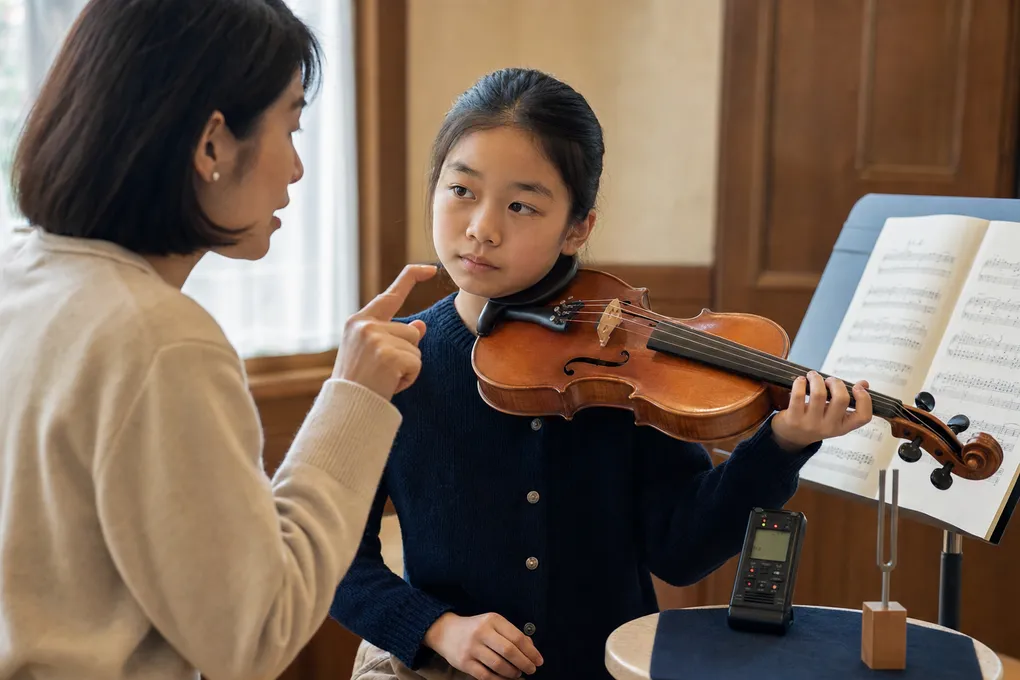
Parents often ask a very reasonable question: why does my child still sound out of tune if they have practised the notes?
With violin and viola, the answer is sometimes simple. The finger may be too high or too low. The instrument may not be tuned carefully. The student may be squeezing, rushing, or not listening before playing. But there is also a deeper reason: string players do not live inside only one tuning system.
A piano has fixed keys. Once it is tuned, each note is already decided. A violin or viola is different. The player creates the pitch every time the finger touches the string, and the “right” place can shift slightly depending on whether the student is playing with piano, tuning open strings, practising double stops, or fitting into a group.
That is why intonation can feel confusing. A note can be correct in one context and need adjustment in another. This does not mean tuning is random. It means the ear has to learn what kind of correctness the music is asking for.
This connects closely with perfect pitch and relative pitch in violin and viola learning. Good intonation is not only knowing the note name. It is hearing how the note belongs.
Equal Temperament: The Piano Compromise
Equal temperament is the tuning system most people meet through the piano. The octave is divided into twelve equal semitones, so every key can be used and the instrument can move from one key to another without being retuned.
This is a brilliant compromise. It allows the piano to play in C major, F sharp major, E flat minor, or any other key with the same keyboard. It also makes fixed-pitch instruments practical in modern musical life. A child accompanying a piano, playing with a digital keyboard, using a tuner, or preparing for many exam situations will often be pulled toward equal temperament.
But equal temperament is a compromise, not nature itself. Some intervals are slightly adjusted so that all keys can work. Major thirds on the piano, for example, are wider than the pure major thirds that string players often want inside a resonant chord. Perfect fifths are also very slightly narrowed compared with pure fifths.
For a beginner, equal temperament is useful because it gives a stable reference. The student can learn note names, finger patterns, scales, and basic pitch placement. A tuner app can also help show whether a note is generally high or low.
The danger comes when students think the tuner is the final judge of every note. On violin and viola, a green light is only one kind of answer. In real music, the ear still has to ask: am I playing with piano? Am I tuning a chord? Am I leading to the next note? Am I blending with another instrument?
Just Intonation: Tuning To The Harmony
Just intonation means tuning intervals according to simple, pure relationships in the harmony. In practical string playing, this often means adjusting notes so that chords sound settled, resonant, and free from unnecessary beating.
If a viola plays the third of a major chord, that note may need to sit slightly lower than the equal-tempered version. If a violin or viola plays the third of a minor chord, it may need a different placement again. These small changes make the harmony feel calmer and more beautiful. The notes seem to lock into each other.
This is one reason students sometimes sound “correct but not blended” in ensemble playing. They may be putting every note where a tuner would approve, but the chord still feels tense because the notes are not listening to one another.
Just intonation is especially important in:
- double stops
- string quartets and chamber music
- slow chords in orchestra
- unaccompanied Bach and other solo writing
- scales and arpeggios practised for harmonic awareness
It is also why ABRSM viola scales should not be practised only as finger drills. A scale teaches key feeling. An arpeggio teaches harmony. If the student hears the tonic, third, fifth, and leading note as musical functions, tuning becomes more intelligent.
The important point is that just intonation is not about being fussy for the sake of it. It is about listening vertically. The player asks, “How does my note fit inside this chord?”
Harmonic Tuning: Open Strings And Natural Resonance
String players also meet tuning through natural harmonics and open-string resonance. This is most obvious when tuning the instrument itself.
Violins and violas are normally tuned in fifths: G-D-A-E for violin, and C-G-D-A for viola. When a teacher tunes the open strings by ear, they are listening for clean fifths. A pure fifth has a particular stillness when the two strings are in the right relationship. If the fifth is too wide or too narrow, the sound beats or feels unsettled.
This kind of tuning is not the same as simply matching each open string to an electronic tuner one at a time. A tuner may help with the A, especially when matching a piano or ensemble pitch. But after that, string players often tune the other strings in relation to it. The instrument has to work as a resonating body, not only as four separate pitch readings.
Harmonics are also useful in playing. They can help students understand resonance, check positions, and feel how the instrument naturally organizes sound. But harmonics can become misleading if treated as a shortcut for all intonation. They are reference points, not a complete musical ear.
For children, this is a helpful lesson: tuning is not only visual. It is not only pegs, fine tuners, and a screen. It is listening for whether the instrument opens up.
Expressive Intonation: Notes That Lean
There is one more layer that parents often hear without knowing its name. In melody, some notes want to lean.
A leading note may want to rise toward the tonic. A dissonance may need tension before it resolves. A note in a scale may feel high or low depending on where the phrase is going. This is sometimes called expressive intonation.
For example, in D major, C sharp often has a strong pull toward D. If a student plays it safely but without direction, it may sound flat emotionally even if it is not badly out of tune by a tuner. In a lyrical phrase, the same pitch may need to belong to the line rather than sit like a fixed object.
This does not give students permission to play inaccurately. Expressive intonation should grow from control, not from guessing. But it explains why advanced players do not sound like they are placing notes on a grid. They are tuning the phrase as well as the pitch.
Young students are not ready to manage all of this at once. Still, they can begin with simple questions:
- Does this note feel settled or does it want to move?
- Am I tuning to the piano, to an open string, or to another player?
- Is this note part of a chord or part of a melody?
- Does the sound become more relaxed when I adjust slightly?
Those questions gradually train the ear to hear meaning, not only height.
So Which Tuning System Should A Child Use?
The most useful answer is: use the tuning that fits the situation.
When playing with piano, the student must respect the piano. A violinist or violist cannot insist on pure thirds if the piano harmony is fixed in equal temperament. In that situation, blending with the piano matters more than proving a theoretical point.
When tuning open strings, listen for clean fifths. Start from the agreed A, then tune the instrument so the strings relate well to each other. A tuner can help, but the ear should still check the fifths.
When practising scales alone, use the scale to build key feeling. The tonic should feel stable. The leading note should have direction. The third should show major or minor character. This is where technical practice and ear training should meet.
When practising double stops, tune the interval itself. Octaves, fifths, thirds, and sixths each have their own sound when they are truly settled. The answer often comes from resonance, not from looking at a screen.
When playing chamber music or orchestra, listen to function. Sometimes the student should tune to the bass. Sometimes to the melody. Sometimes to the chord. Sometimes to the piano or another fixed-pitch instrument. Ensemble intonation is a social skill as much as a technical one.
That is why a good teacher does not only say, “That note is sharp” or “That note is flat.” A good teacher helps the student understand why the note needs to move.
Why Tuners Help And Mislead
Electronic tuners are useful tools. They can help beginners tune the open strings. They can show a student who consistently places a note too high or too low. They can also give parents a simple way to check whether the instrument has drifted badly before practice begins.
But tuners can also train the wrong habit if used too much. A student may stare at the screen instead of listening. They may correct after the note instead of hearing before the note. They may believe intonation means centering every pitch on a visual needle.
For string players, the deeper skill is anticipatory listening. The student hears the note inwardly, plays it, judges it, and adjusts. The tuner can confirm some things, but it cannot replace that loop.
At home, I would use a tuner mainly for open strings and occasional checking. For daily practice, better questions are:
- Can the student sing the note before playing it?
- Can they tell whether a note is high or low without looking?
- Can they tune a simple octave or fifth slowly?
- Can they play a scale with a clear tonic in mind?
Those habits build a real ear.
What Parents Can Listen For At Home
Parents do not need to become tuning theorists. The aim is not to identify every temperament by name during practice. The aim is to support better listening.
If your child sounds out of tune, first check the practical basics. Is the instrument tuned? Are the strings old? Is the bridge leaning? Is the student pressing or collapsing the hand? Some sound problems are equipment or setup problems, which I discuss in why a violin can sound bad in Hong Kong.
Then listen for patterns. Does the child usually play high with the third finger? Do shifts land uncertainly? Do notes sound worse when the bow becomes tense? Does playing with piano feel different from playing alone? These patterns are more useful than a general complaint that the child is “out of tune.”
It also helps to praise the act of correction. If the child notices a pitch problem and adjusts, that is progress. Intonation is not the absence of mistakes. It is the growing ability to hear, diagnose, and refine.
Tuning Is A Form Of Musicianship
The phrase “in tune” sounds simple, but for string players it opens into a whole musical world. Equal temperament helps us play with pianos and fixed-pitch instruments. Just intonation helps chords resonate. Harmonic tuning helps the instrument speak naturally. Expressive intonation helps a phrase move with life.
A child does not need to understand all of this at once. But they do need to learn that tuning is not only finger placement. It is listening in context.
That is why a student may sound out of tune even when they know the notes. They are not only learning where the fingers go. They are learning which musical relationship to trust.
And that takes time.
When it grows well, intonation becomes more than accuracy. It becomes one of the ways a young musician learns to hear harmony, phrase, ensemble, and sound itself.