Last updated on
What I Listen For in a Great Recording
The musical qualities that make a recording feel alive, shaped, and worth returning to over time.
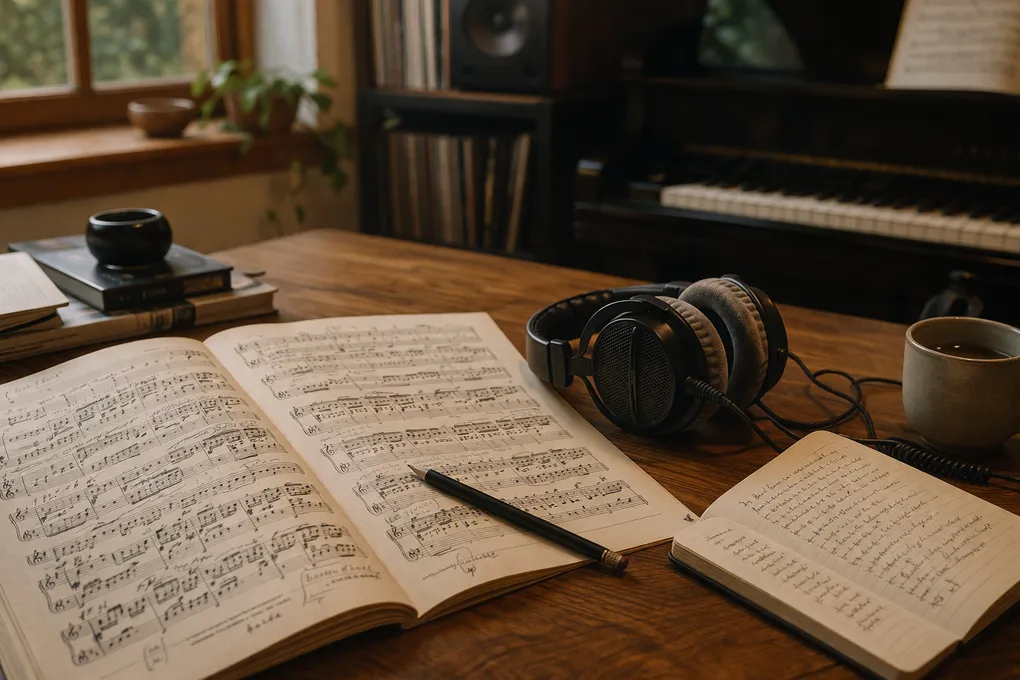
When I return to a recording again and again, it is rarely because it feels flawless in a polished sense. More often, it is because the performance helps me hear the music more truthfully. A great recording does not simply present a piece neatly. It reveals relationships inside the piece: where the line is going, where the tension gathers, where the harmony darkens, where the character changes, where silence matters.
Listening is not separate from practice. The same qualities that make a recording worth returning to also shape how I think about music-first teaching and practising slowly without losing the musical line.
That is why I do not listen first for brilliance alone. Technique matters, of course, and there are recordings whose control or authority is immediately striking. But what makes a recording stay with me is usually something more complete than accomplishment. I want to feel that the performers are hearing deeply enough to shape the music from the inside.
Pacing tells us whether the music is really moving
One of the first things I notice is pacing. Does the performance know how to move through time? Does it feel as though the music is travelling, or merely being counted?
This is not only a question of fast or slow tempi. A recording can be broad and still feel alive, or quick and still feel heavy. What matters is whether the timing has direction. In a convincing performance, phrases do not sit still unless the music truly asks them to. Cadences arrive with a sense of preparation. Climaxes are earned rather than announced too early. Transitions are given enough space to register, but not so much that the line collapses.
Good pacing also creates trust. When the performers understand how a phrase leads into the next one, the listener can relax into the structure of the piece. We no longer feel that moments are being handled one by one. We begin to hear a larger shape holding them together.
Sound is part of interpretation, not decoration
After pacing, I listen for sound. Tone colour is not an ornamental extra added after the real work is done. It is one of the ways interpretation becomes audible.
A performer who can change colour with purpose can make the music easier to understand. A warmer sound can deepen a lyrical passage. A leaner, clearer sound can sharpen rhythm or expose counterpoint. A darker colour can help the harmony feel weighted. A more transparent one can let the music breathe. These choices affect not only beauty, but meaning.
This is especially important in recorded listening because the microphone brings us very close to the quality of attention behind the sound. We can hear whether a player is simply producing a consistent tone, or whether they are shaping the sound according to phrase, register, harmony, and character. The best recordings make tone feel inseparable from thought.
Balance and inner detail reveal how well the performers are listening
Another thing I care about is balance. In chamber music, orchestral playing, and accompaniment especially, balance tells us a great deal about how the musicians are listening to one another.
In weaker recordings, the musical texture can feel hierarchical in an unhelpful way. The obvious line dominates, while inner voices and harmonic movement are left undernourished. The result may still be clean, but the piece sounds flatter than it really is.
In stronger recordings, secondary material is not treated as secondary in importance. Inner lines support the structure. Accompanying figures have character. Harmonic changes are allowed to register. Even when one instrument or voice leads, the others remain musically present. That kind of balance creates the feeling that the ensemble is thinking together rather than merely staying coordinated.
For violists, this kind of listening is especially valuable because the instrument so often lives inside the middle texture. I explore that role in why learn viola in Hong Kong and a history of the viola.
I often find that this is one of the clearest differences between a competent performance and a memorable one. The memorable one lets you hear more of the piece.
Character matters when it grows out of the score
I also listen for character, but I do not mean surface personality alone. A great recording does not impose expression from the outside. It lets character grow naturally from rhythm, articulation, harmony, gesture, and proportion.
Sometimes a performance is full of noticeable ideas, yet the ideas do not belong to the music strongly enough. The phrasing may be highly shaped, the dynamics dramatic, the contrasts vivid, but the whole result still feels slightly external, as if interpretation has been laid on top of the score instead of discovered inside it.
By contrast, the most persuasive recordings often feel inevitable after a few minutes. Their individuality is real, but it is not restless. They sound as though the performers have spent enough time with the work to understand not only what can be done, but what should be done. That kind of judgment gives freedom its proper form.
Honesty is often what remains after everything else
Finally, I listen for honesty. This is the hardest thing to describe and perhaps the most important.
Some recordings impress us immediately through finish, glamour, intensity, or command. There is nothing wrong with that. But not every impressive recording continues to deepen with repeated listening. Some grow smaller once the first effect has passed.
The recordings that stay with me usually have another quality. They sound understood. They sound patient enough not to force meaning, and serious enough not to settle for effect. Even when they are bold, they do not feel eager to prove themselves. They trust the music and allow the listener to meet it.
That kind of honesty is difficult to fake. It can be heard in the way a phrase is allowed to unfold, in the refusal to exaggerate a climax, in the care given to quiet passages, in the sense that every detail belongs to one coherent musical imagination.
A great recording helps us listen better
In the end, what I value most in a recording is not perfection, but illumination. A great performance makes the piece more audible. It sharpens our sense of line, proportion, colour, structure, and character. It reminds us that listening is not passive consumption, but a form of attention.
That is why certain recordings become part of our musical memory. We return to them not only because they are beautiful, but because they continue to teach us how to hear. They leave us with the sense that the music is larger, more alive, and more intelligible than it seemed before.