Trinity Violin Diplomas: ATCL, LTCL and FTCL
ATCL, LTCL and FTCL violin diploma guide: Trinity recital timings, 2026 repertoire, programme approval, written requirements and planning advice.
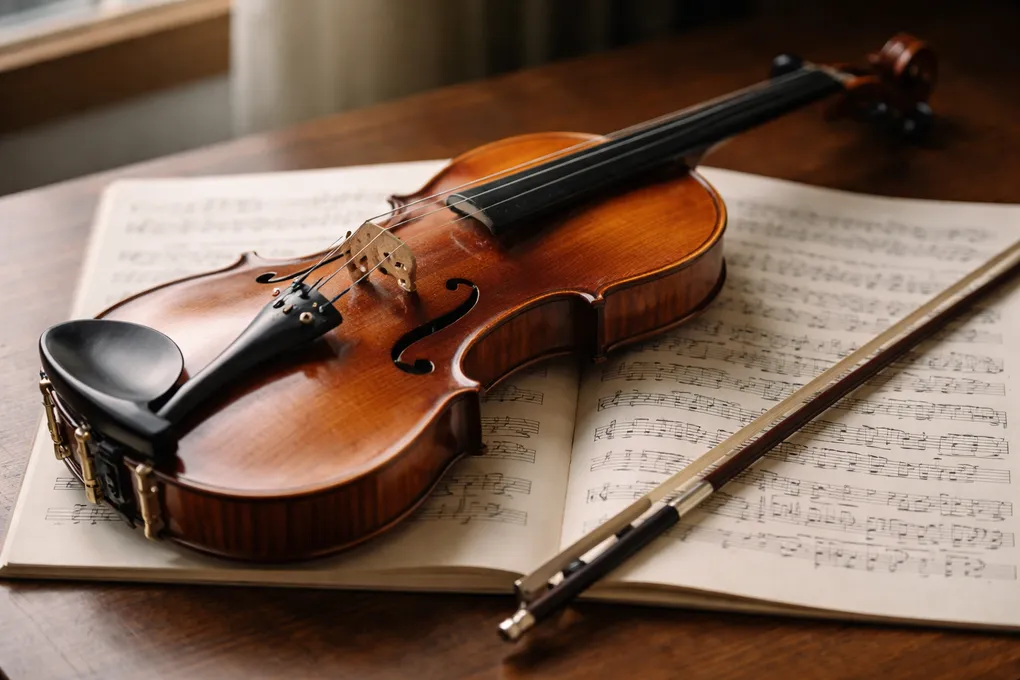
Trinity violin diplomas are recital exams. They are not built around a Viva Voce, Quick Study, scales or supporting tests. The centre of the exam is the performance itself: a planned programme of substantial repertoire, supported by a written programme and judged partly on how well the recital is constructed.
This hub follows Trinity’s Classical Music Performance Diplomas syllabus and the 2026 Trinity violin diploma repertoire list. Always confirm Trinity’s current syllabus, repertoire list, fees, entry process and programme approval rules before entering.
Quick answer
Trinity violin diplomas are best understood as recital qualifications. ATCL is the first diploma after Grade 8 level, LTCL is a more advanced undergraduate-level recital, and FTCL is a fellowship-level performance diploma. The main difference is not only difficulty: each level asks for a longer, more independent and more coherent recital programme.
| Search question | Short answer |
|---|---|
| What is ATCL violin? | A 32-38 minute Level 4 performance diploma, usually the first Trinity diploma after Grade 8 |
| What is LTCL violin? | A 37-43 minute Level 6 performance diploma with stronger recital identity and stamina |
| What is FTCL violin? | A 42-48 minute Level 7 fellowship diploma assessed as Approved or Not Approved |
| Does Trinity require Viva Voce or Quick Study? | No. The exam is centred on the recital and written programme requirements |
| Can I use own-choice repertoire? | Yes, but programmes containing own-choice repertoire need Trinity approval before the exam |
Trinity violin diploma route at a glance
| Level | Standard | Performance duration | Assessment shape |
|---|---|---|---|
| ATCL | Level 4, comparable to a first-year undergraduate recital | 32-38 minutes | Marked out of 100 |
| LTCL | Level 6, comparable to a final-year undergraduate recital | 37-43 minutes | Marked out of 100 |
| FTCL | Level 7, comparable to a postgraduate recital | 42-48 minutes | Approved or Not Approved |
At ATCL and LTCL, Trinity gives 96 marks for the recital and 4 marks for Programme & Planning. At FTCL, the diploma is assessed as Approved or Not Approved, and the written programme includes 1,200-1,600 words of programme notes.
Which Trinity violin diploma should you start with?
For most violinists coming from Grade 8, ATCL is the sensible starting point. It is already a diploma-level recital, but the programme length and level of independence are still realistic for a first serious recital project.
LTCL is a better target when the player can sustain a larger work, make independent interpretive decisions, and manage the emotional pacing of a longer recital. It should not be chosen only because the candidate wants a more impressive title.
FTCL belongs to a different category. The player needs fellowship-level repertoire, a strong recital point of view, and programme notes that explain the musical thinking behind the performance. It is normally wiser to treat FTCL as a long-term artistic project rather than the next administrative step.
What makes Trinity different
Trinity gives candidates considerable programme freedom. A violin recital may be drawn entirely from the published list, combine listed and own-choice repertoire, or consist only of own-choice repertoire. Any programme containing own-choice repertoire must be approved in advance.
This freedom is musically useful, but it is not casual. The programme must still display contrast of mood, style and tempo, meet the exact timing window, and normally use complete works unless the list specifies movements or Trinity approves another plan.
For a player coming from Grade 8, ATCL violin is the first natural step. The 2026 list includes Bach, Beethoven sonatas and Romance, Brahms sonatas, de Falla, Delius, Dvorak, Grieg, Hindemith, Lalo, Mozart, Prokofiev, Schubert, Schumann, Stravinsky, Tchaikovsky, Vitali, Walton and Wieniawski.
LTCL violin is more independent, with repertoire such as Bacewicz, Bartok, Beethoven Kreutzer and Op.96, Brahms Op.108, Britten, Debussy, Elgar, Faure, Franck, Janacek, Mozart concertos, Part, Poulenc, Saint-Saens, Sarasate and Ysaye.
FTCL violin moves into fellowship-level recital work, including Bach solo sonatas or partitas, Barber, Bartok, Beethoven Concerto, Berg, Brahms Concerto, Bruch, Chausson, Dvorak, Elgar, Glazunov, Lutoslawski, Mendelssohn, Paganini and other major repertoire.
Practical planning points
| Requirement | Why it matters |
|---|---|
| Minimum two works | The recital must still feel varied, not like one oversized project |
| Exact timing window | Falling short can lead to referral or penalty |
| Written programme | ATCL/LTCL need accurate programme details; FTCL needs substantial programme notes |
| Programme approval | Own-choice repertoire is judged as a whole programme, not as isolated pieces |
| Digital recording | The performance must be one continuous take with no editing |
Syllabus and approval checklist
Before entering a Trinity violin diploma, check these details against the current syllabus and entry information:
- The exact recital timing window for ATCL, LTCL or FTCL
- Whether every work is from the published list or whether own-choice approval is needed
- Whether complete works or selected movements are required
- Programme order, contrast, total duration and accompanist planning
- Written programme requirements, especially the FTCL programme notes word count
- Digital recording rules if entering by recorded assessment
For violinists in Hong Kong, the Trinity route can suit students who want a performance-focused diploma with programme ownership. It also suits adult learners who can manage a recital project but do not want the ABRSM-style Viva Voce and Quick Study format.
The risk is treating Trinity as easier because it feels freer. A flexible recital exam exposes musical planning very clearly. If the programme is too narrow, too short, badly paced or built around pieces that do not truly belong together, the freedom becomes a problem.
Related violin pages
| Page | Use it when |
|---|---|
| ATCL violin guide | You are planning a first Trinity diploma after Grade 8 |
| LTCL violin guide | You are ready for a more advanced recital project |
| FTCL violin guide | You are considering fellowship-level performance |
The best Trinity violin programmes sound chosen, not merely approved. The player should finish the exam with a stronger recital identity than they had at the start.