ABRSM Grade 5 Musical Terms: English Glossary
A practical ABRSM Grade 5 musical terms glossary, aligned with the Traditional Chinese version for study and exam preparation.
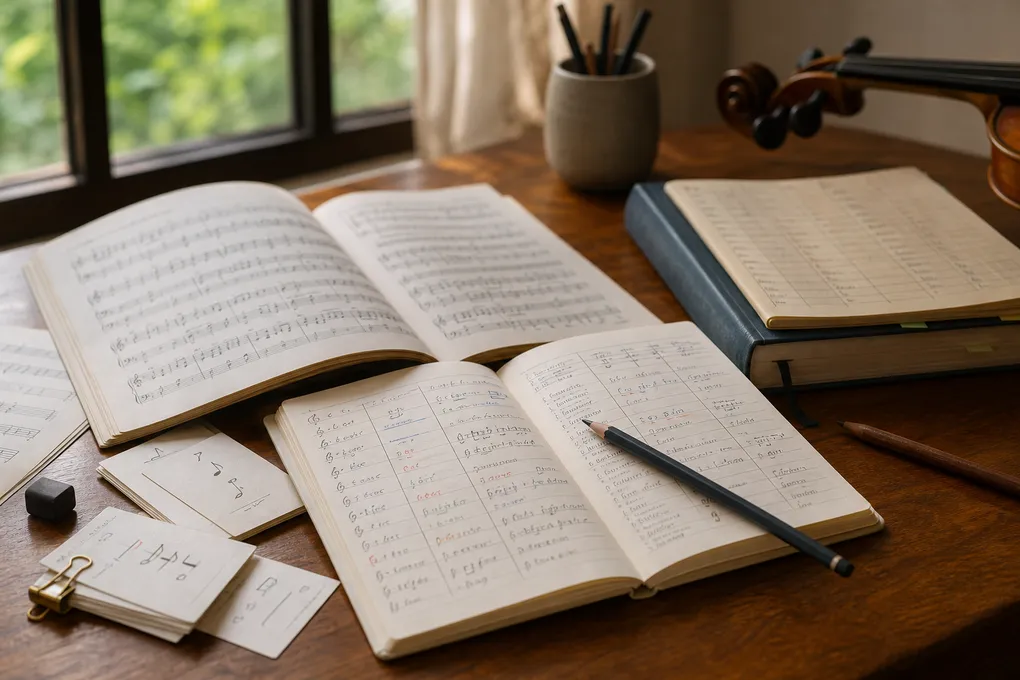
Musical terms are easy to underestimate. Students often treat them as vocabulary to memorise the week before an exam, but in real music they are performance instructions: they tell you about speed, weight, tone, character, direction, and sometimes structure.
This expanded glossary keeps the English and Traditional Chinese versions aligned term by term. The core ABRSM Grade 5 list follows the English meanings compiled by MyMusicTheory; the additional terms are included to match the fuller study list used in the zh-HK version.
For the wider exam context, read this alongside ABRSM Music Theory Grade 5: what students need to learn.
How to Study Terms Properly
Do not learn the words only as dictionary definitions. Learn what each instruction asks a performer to do.
For example, dolce is not just a word to translate. It changes the kind of sound you make. ritardando asks you to shape time towards a musical arrival. sotto voce suggests an undertone, as if the music is speaking privately.
A good study routine is simple:
- say the term aloud
- write the meaning in your own words
- find the marking in a real piece
- decide what changes in tempo, bow, touch, tone, or phrase
- test yourself in both directions: term to meaning, and meaning to term
What Is New in Grade 5
Grade 5 adds a larger group of Italian expressive and structural terms, then broadens the list with common German terms. These are the terms in this glossary that are new after the Grade 4 study list.
| Term | English meaning |
|---|---|
attacca | Go immediately to next section |
dolente | Sorrowful |
dolore | Grief, sorrow |
estinto | Extinguished; as soft as possible |
incalzando | Getting faster and louder |
lacrimoso | Tearful; sorrowful |
loco | At the written pitch; back to normal position |
lunga | Long |
lusingando | Coaxing; caressing |
misura | Measure; bar |
ossia | Or; alternative version |
piacevole | Pleasant |
piangevole | Plaintive; sorrowful |
pochettino | Very little |
rinforzando / rf. / rfz. | Reinforcing |
segue | Continue |
smorzando / smorz. | Dying away in tone and speed |
teneramente / tenerezza | Tenderly; tenderness |
tosto | Quick |
volante | Flying; very fast |
aber | But |
Ausdruck | Expression |
bewegt | Moved; agitated |
breit | Broad |
ein | One; a |
einfach | Simple |
etwas | Somewhat |
fröhlich | Cheerful |
immer | Always |
langsam | Slow |
lebhaft | Lively |
mässig | At a moderate speed |
mit | With |
nicht | Not |
ohne | Without |
ruhig | Peaceful |
schnell | Fast |
sehr | Very |
traurig | Sad |
und | And |
voll | Full |
wenig | Little |
wieder | Again |
zu | To; too |
süss | Sweet |
doppio movimento | Twice as fast |
ABRSM Grade 5 Terms and English Meanings
| Term | English meaning |
|---|---|
accelerando / accel. | Gradually getting faster |
ad libitum / ad lib. | At choice |
adagietto | Rather slow; a little faster than adagio |
adagio | Slow |
affettuoso | Tenderly; affectionately |
affrettando | Hurrying; becoming faster |
agitato | Agitated |
al / alla | In the style of; to the |
alla breve | With a minim beat |
alla marcia | In the style of a march |
allargando | Broadening |
allegretto | Fairly quick |
allegro | Fast |
allegro assai | Very fast |
amabile | Amiable, pleasant |
amore | Love |
andante | At a walking pace |
andantino | Slightly faster than andante |
anima | Soul; spirit |
animato | Animated, lively |
appassionato | With passion |
assai | Very |
ben | Well |
brio | Vigour |
calando | Getting softer and slower; dying away |
cantabile | In a singing style |
cantando | Singing |
come | As, similar to |
comodo | At a comfortable speed |
con / col | With |
crescendo / cresc. | Gradually getting louder |
da capo / D.C. | Repeat from beginning |
dal segno / D.S. | Repeat from the sign |
deciso | With determination |
decrescendo / decresc. | Gradually getting quieter |
delicato | Delicate |
diminuendo / dim. | Gradually getting quieter |
dolce | Sweet, soft |
e / ed | And |
energico | Energetic |
espressione | Expression |
espressivo / espress. / espr. | Expressive |
f / forte | Loud |
facile | Easy; fluent |
ff / fortissimo | Very loud |
fine | The end |
forza | Force |
fp / fortepiano | Loud, then immediately soft |
fuoco | Fire; passion |
giocoso | Playful, merry |
giusto | Proper; strict; suitable |
grave | Very slow, solemn |
grazioso | Graceful |
largamente | Broadly |
larghetto | Rather slow |
largo | Slow and stately |
legato | Smoothly |
leggiero | Light, nimble |
lento | Slow |
l'istesso | The same |
ma | But |
maestoso | Majestic |
marcato / marc. | Emphatic, accented |
marziale | Martial; in march style |
meno | Less |
mesto | Sad |
mezzo | Half |
mf / mezzo forte | Moderately loud |
moderato | Moderate speed |
molto | Very much |
morendo | Dying away |
mosso / moto | Movement |
mp / mezzo piano | Moderately quiet |
niente | Nothing; silence |
nobilmente | Nobly |
non | Not |
p / piano | Quiet |
perdendosi | Dying away |
pesante | Heavy |
più | More |
poco | A little |
possibile | Possible; as much as possible |
pp / pianissimo | Very quiet |
presto | Fast; faster than allegro |
prima / primo | First |
quasi | As if, resembling |
rallentando / rall. | Gradually getting slower |
risoluto | Bold, strong |
ritardando / ritard. / rit. | Gradually getting slower |
ritenuto / riten. / rit. | Held back |
ritmico | Rhythmically |
rubato / tempo rubato | With some freedom of time |
scherzando / scherzoso | Playfully, joking |
seconda / secondo | Second |
semplice | Simple, plain |
sempre | Always |
senza | Without |
sf / sfz / sforzando / sforzato | Forced, accented |
simile / sim. | In the same way |
sonoro | Resonant, with a rich tone |
sopra | Above |
sostenuto | Sustained |
sotto | Under; below |
staccato / stacc. | Detached |
stringendo | Gradually getting faster |
subito / sub. | Suddenly |
tanto | Much; so much |
tempo | Speed, time |
tenuto | Held |
tranquillo | Calm |
triste / tristamente | Sorrowful |
troppo | Too much |
veloce | Fast; rapid |
vivace / vivo | Lively, quick |
voce | Voice |
volta | Time; turn |
animé | Animated, lively |
assez | Enough; rather |
avec | With |
cédez | Slow down; yield |
douce | Sweet, soft |
en dehors | Prominent; standing out |
et | And |
léger | Light |
légèrement | Lightly |
lent | Slow |
mais | But |
moins | Less |
modéré | At a moderate speed |
non | Not |
peu | Little |
plus | More |
presser | Press on; get faster |
ralentir | Slow down |
sans | Without |
très | Very |
un / une | One; a |
vif | Lively |
vite | Quick |
attacca | Go immediately to next section |
dolente | Sorrowful |
dolore | Grief, sorrow |
estinto | Extinguished; as soft as possible |
incalzando | Getting faster and louder |
lacrimoso | Tearful; sorrowful |
loco | At the written pitch; back to normal position |
lunga | Long |
lusingando | Coaxing; caressing |
misura | Measure; bar |
ossia | Or; alternative version |
piacevole | Pleasant |
piangevole | Plaintive; sorrowful |
pochettino | Very little |
rinforzando / rf. / rfz. | Reinforcing |
segue | Continue |
smorzando / smorz. | Dying away in tone and speed |
teneramente / tenerezza | Tenderly; tenderness |
tosto | Quick |
volante | Flying; very fast |
aber | But |
Ausdruck | Expression |
bewegt | Moved; agitated |
breit | Broad |
ein | One; a |
einfach | Simple |
etwas | Somewhat |
fröhlich | Cheerful |
immer | Always |
langsam | Slow |
lebhaft | Lively |
mässig | At a moderate speed |
mit | With |
nicht | Not |
ohne | Without |
ruhig | Peaceful |
schnell | Fast |
sehr | Very |
traurig | Sad |
und | And |
voll | Full |
wenig | Little |
wieder | Again |
zu | To; too |
süss | Sweet |
doppio movimento | Twice as fast |
A Better Way to Memorise Them
Group the terms by musical action rather than alphabetically.
Tempo words answer: how fast, or how is speed changing?
Dynamic words answer: how loud, or how is intensity changing?
Character words answer: what kind of sound or mood?
Articulation words answer: how do notes touch each other?
Direction words answer: where do I go in the score?
Once a student can sort a term into one of these questions, memorisation becomes much less random.
Final Thought
ABRSM Grade 5 terms are not just a language test. They are a bridge between theory and performance.
If a student learns dolce, ritardando, legato, pesante, and sotto voce only as dictionary answers, the knowledge stays on paper. If they learn how those words change sound, timing, bow, touch, and phrase, the terms become part of musicianship.
That is the real goal: not simply to recognise a foreign word in an exam, but to read a score and know what kind of music it is asking you to make.